
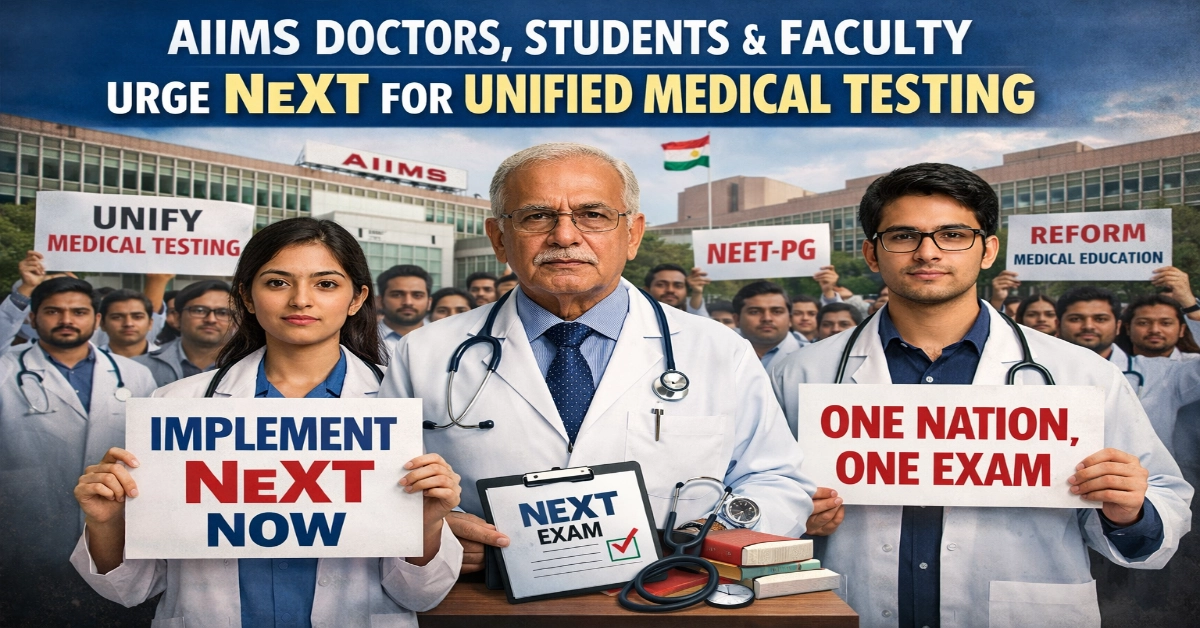
AIIMS Doctors, Students, and Faculty Urge NExT for Unified Medical Testing: Doctors, students, and faculty members from the prestigious All India Institute of Medical Sciences (AIIMS) have strongly advocated for the immediate implementation of the National Exit Test (NExT), calling it a crucial reform to streamline and standardize medical education in India.
In a recent editorial published in the Journal of Family Medicine and Primary Care, medical professionals from AIIMS Delhi, Nagpur, Patna, and Dr Ram Manohar Lohia (RML) Hospital highlighted the urgent need for a unified assessment system for MBBS graduates.
Why NExT Matters
The proposed NExT exam, introduced under the National Medical Commission (NMC) Act, 2019, is designed to replace three major examinations:

- Final MBBS university exams
- NEET-PG
- Foreign Medical Graduate Examination
According to the authors, the current system is “fragmented and inconsistent,” with wide variations in evaluation standards across universities. They noted that existing assessments often fail to align with competency-based medical education, leading to disparities in determining whether a graduate is truly ready to practice medicine.
Key Concerns with Current System
- Subjectivity in university exams: Theory-based assessments differ significantly across institutions.
- Limited scope of PG entrance tests: Exams like NEET-PG rely on a small pool of MCQs, increasing the role of chance.
- Mismatch in exam formats: Students must prepare separately for theory-heavy finals and MCQ-based entrance tests, increasing stress and inefficiency.
How NExT Aims to Transform Evaluation
NExT proposes a two-step, competency-based assessment model:
 Join NEET News 2026
 - Step 1: A comprehensive MCQ-based exam featuring clinical case scenarios and applied reasoning.
- Step 2: A practical examination to evaluate clinical skills, communication, and real-world competence.
This unified approach is expected to bring transparency, reliability, and clinical relevance to medical assessments.
Benefits:
Medical experts believe NExT could:
- Ensure a uniform national standard for all medical graduates
- Reduce the burden of multiple exams
- Improve learning outcomes through clinically oriented questions
- Enhance public trust in medical training
- Provide a single score usable for PG admissions, government jobs, and fellowships
Importantly, the exam will apply to all candidates, students from government and private colleges as well as foreign medical graduates, ensuring fairness and consistency.
Despite its potential, the implementation of NExT has been postponed multiple times, creating uncertainty among aspirants and delaying long-awaited reforms. The authors stressed that further delays could hinder improvements in the quality of medical education.
The Way Forward
To ensure a smooth transition, the following are the suggestions by experts:
- Conducting multiple mock tests
- Providing sample question banks and workbooks
- Releasing a clear and detailed syllabus
The experts emphasised that without a strong evaluation framework, rapid expansion in medical education could compromise quality, something India cannot afford.
As the debate continues, the urge from AIIMS and other leading institutions signals growing momentum for implementing NExT as a transformative reform in India’s medical education system
Read Also: How To Revise Everything Before NEET UG 2026
