
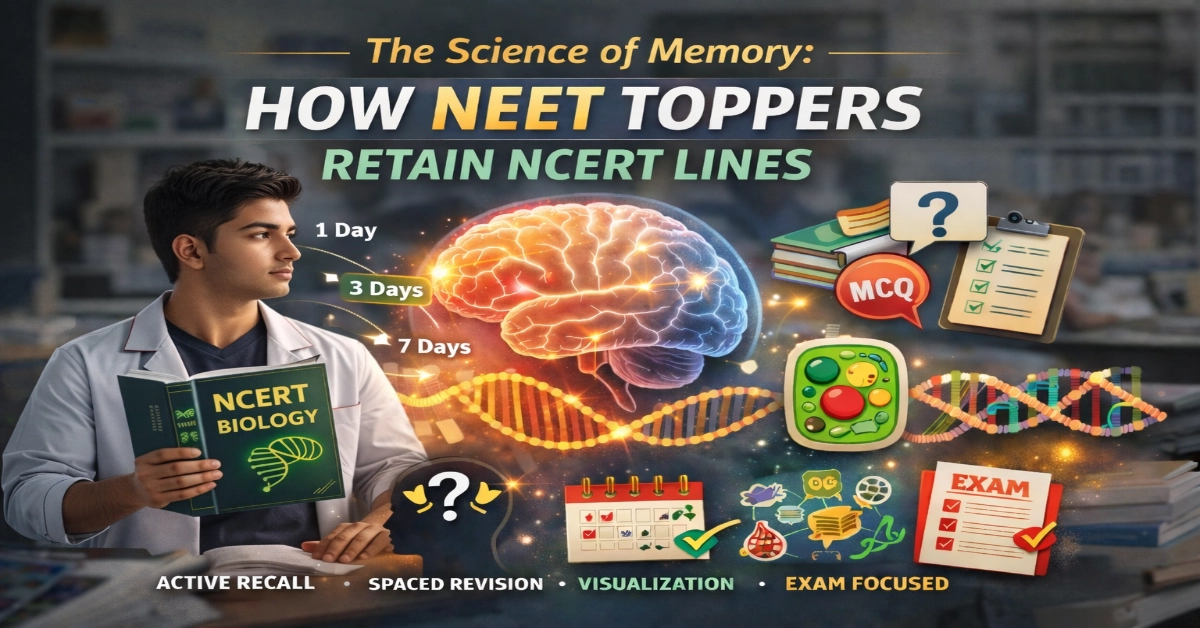
NEET UG: Cracking NEET UG is not just about studying more, it’s about remembering better. NEET toppers don’t rely on rote learning alone; they use scientifically proven memory principles to retain NCERT line-by-line, especially in Biology. Understanding how memory works can completely change the way you study and revise.
This article breaks down the actual cognitive science strategies NEET toppers use, explained simply and practically, so you can apply them in your daily preparation.
1. How Human Memory Actually Works (Short-Term vs Long-Term)
Memory is not a single storage box. When you read NCERT, information first enters short-term memory, which can hold data only for a few seconds. If not processed properly, most of it fades quickly, this is why passive reading feels familiar but fails in exams.

NEET toppers consciously convert short-term memory into long-term memory by repeated retrieval, association, and emotional engagement. They don’t just read lines, they work with them, forcing the brain to store information more permanently.
Key points NEET toppers follow:
 Join NEET News 2026
 - Short-term memory lasts up to 20-30 seconds without revision
- Long-term memory needs active processing
- Recalling information strengthens memory more than re-reading
- Writing, speaking, or testing activates deeper memory pathways
Read Also: Why Hard Work Without Strategy Fails in NEET UG 2026
2. Active Recall
Active recall means forcing your brain to remember without looking at the book. NEET toppers rarely reread NCERT passively. Instead, they close the book and ask themselves questions like: “What was written in this paragraph?”
This method feels difficult, but that difficulty is exactly what strengthens memory. Research shows that struggling to recall improves retention far more than easy rereading. This is why toppers prefer self-testing, MCQs, and oral recall.
How toppers use active recall:
- Read one NCERT paragraph → close book → recall key lines
- Convert lines into questions
- Use daily MCQs from NCERT statements
- Revise using flashcards or short notes, not textbooks
3. Spaced Repetition: Why Toppers Don’t Revise Everything Daily
Revising everything daily is inefficient. The brain forgets information in a predictable pattern called the forgetting curve. NEET toppers beat this by revising content just before they forget it-this is called spaced repetition.
Instead of random revision, they follow a planned revision cycle (Day 1, Day 3, Day 7, Day 21). Each revision strengthens memory and increases the gap before forgetting, making NCERT lines stick for months.
Spaced revision strategy used by toppers:
- 1st revision within 24 hours
- 2nd revision after 3-4 days
- 3rd revision after 1-2 weeks
- Final revision before tests/exams
Read Also: NEET UG 2026 Revision Timetable for the Last 90 Days
4. Visualization & Association
The brain remembers images, stories, and patterns better than plain text. NEET toppers mentally visualize biological processes, diagrams, and sequences while reading NCERT. This turns abstract lines into memorable mental pictures.
They also associate new information with something they already know—linking chapters, concepts, or even silly stories. These associations create multiple memory hooks, making recall faster during the exam.
Techniques toppers use:
- Visualize processes like photosynthesis, respiration, or meiosis
- Create flowcharts and mind maps from NCERT lines
- Link similar statements across chapters
- Use mnemonics for lists and classifications
5. Emotional Engagement & Exam-Oriented Focus
Emotion plays a powerful role in memory. NEET toppers attach purpose and urgency to what they study-every NCERT line is seen as a potential exam question, not just theory.
They constantly remind themselves that NCERT is the paper setter’s language. This mindset increases focus and emotional relevance, making the brain treat the information as important and worth remembering.
Mindset habits of NEET toppers:
- Study NCERT with exam intent, not curiosity alone
- Mark previous-year question lines emotionally
- Celebrate small recall wins to reinforce confidence
- Avoid multitasking to protect memory formation
Read Also: The Psychology Of NEET UG Toppers
Memory Is a Skill, Not a Talent
NEET toppers are not born with photographic memory, they train their brain scientifically. By using active recall, spaced repetition, visualization, and focused revision, they turn NCERT into long-term knowledge.
If you shift from reading more to remembering better, NCERT will stop feeling overwhelming, and start working in your favor. Master the science of memory, and NEET becomes a game of strategy, not stress.
GOOD LUCK!!
