

Important NCERT Diagram For NEET UG 2026 (Day 15): In the journey of NEET UG 2026 preparation, mastering NCERT diagrams is not just an advantage; it is a game-changer. With nearly 20-25% of Biology questions being diagram-based or heavily reliant on visual interpretation, consistent daily practice of high-yield NCERT figures can easily add 30-50 crucial marks to your score. On Day 15 of this focused series, we dive into another essential diagram that frequently appears in NEET exams, helping you strengthen conceptual clarity and boost your accuracy.
FLUID MOSAIC MODEL
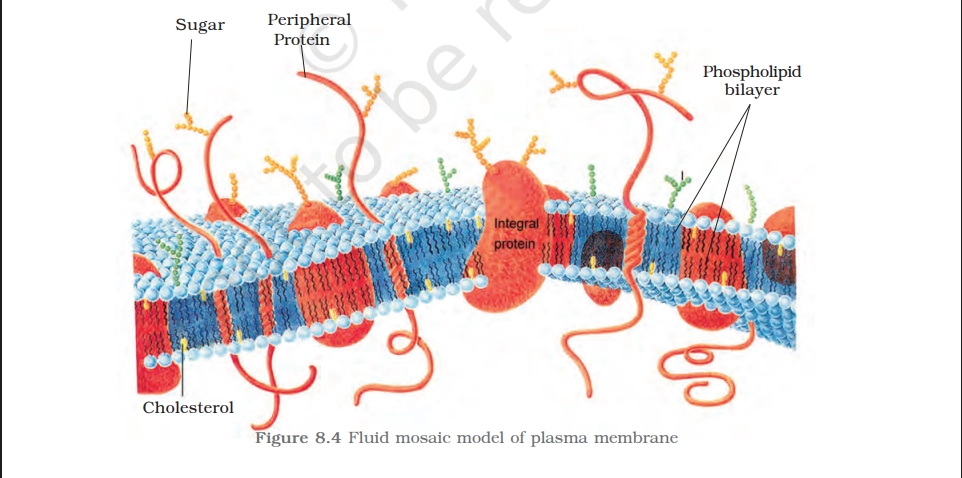
The fluid mosaic model is the widely accepted scientific description of the structure of the plasma membrane (cell membrane) in all living cells. Proposed in 1972 by biochemists S.J. Singer and Garth L. Nicolson, it portrays the membrane as a dynamic, flexible structure rather than a rigid one.
Why “Fluid Mosaic”?
- Fluid: The membrane behaves like a two-dimensional liquid. Its components (lipids and proteins) can move laterally (side to side) within the plane of the membrane, similar to icebergs floating in the sea. This fluidity allows the membrane to flex, self-seal, and enable processes like cell movement and vesicle formation.
- Mosaic: The membrane is a patchwork (“mosaic”) of different molecules- primarily phospholipids, with embedded proteins, cholesterol, and carbohydrates- distributed unevenly but not in a fixed pattern.
This model replaced earlier static ideas (like the protein-lipid-protein sandwich model) and is consistent with thermodynamic principles: hydrophobic (water-repelling) parts cluster inside, while hydrophilic (water-attracting) parts face the aqueous environments inside and outside the cell.

Main Components of the Fluid Mosaic Model
- Phospholipid Bilayer:
- Phospholipids are amphipathic molecules with a hydrophilic (polar) phosphate head and two hydrophobic (nonpolar) fatty acid tails.
- They spontaneously form a bilayer: heads face outward toward water (extracellular fluid and cytoplasm), tails face inward, creating a hydrophobic core.
- This bilayer is semi-permeable, acting as a barrier to most polar molecules and ions while allowing small nonpolar ones (like O₂ and CO₂) to pass freely.
- Proteins (embedded or attached):
- Integral proteins: Span the entire bilayer (transmembrane). Examples include channel proteins, carrier proteins, and receptors.
- Peripheral proteins: Loosely attached to the membrane surface, often on the cytoplasmic side; they can associate with integral proteins or the cytoskeleton.
- Proteins provide functions like transport, enzymatic activity, cell signaling, and structural support. They “float” in the lipid “sea” and can move laterally.
- Cholesterol:
- Scattered among phospholipids in animal cells.
- It modulates fluidity: prevents the membrane from becoming too fluid at high temperatures or too rigid at low temperatures.
- Carbohydrates (on the outer surface):
- Attached to lipids (glycolipids) or proteins (glycoproteins).
- Form the glycocalyx, important for cell recognition, adhesion, and protection.
This structure enables the membrane to separate the cell’s interior from the external environment while remaining dynamic enough for life processes.
Practice Question Based on the Fluid Mosaic Model
Q.1. Assertion (A): The plasma membrane shows fluid behaviour.
Reason (R): According to the fluid-mosaic model, the membrane is a mosaic or composite of diverse lipids and proteins that can move laterally.
A) Both A and R are true and R is the correct explanation of A
B) Both A and R are true but R is not the correct explanation of A
C) A is true but R is false
D) A is false but R is true
E) Both A and R are false
Q.2.
| Column-I | Column-II |
|---|---|
| A. Singer and Nicolson | (i) Fluid mosaic model |
| B. Quasi-fluid nature of membrane | (ii) Lateral movement of lipids & proteins |
| C. Glycocalyx | (iii) Cell recognition & protection |
| D. Amphipathic molecules | (iv) Phospholipids & integral proteins |
A) A-(i), B-(ii), C-(iii), D-(iv)
B) A-(ii), B-(i), C-(iv), D-(iii)
C) A-(i), B-(iv), C-(ii), D-(iii)
D) A-(iii), B-(ii), C-(i), D-(iv)
Q.3. Assertion (A): The fluid-mosaic model is the most widely accepted model of the plasma membrane.
Reason (R): It states that protein icebergs float in a sea of lipids (mainly phospholipids).
A) Both A and R are true and R is the correct explanation of A
B) Both A and R are true but R is not the correct explanation of A
C) A is true but R is false
D) A is false but R is true
E) Both A and R are false
Q.4. Assertion (A): In the fluid-mosaic model, flip-flop movement (transverse diffusion) of phospholipids is very common.
Reason (R): The quasi fluid nature of the membrane allows free movement of lipids and proteins within the bilayer.
A) Both A and R are true and R is the correct explanation of A
B) Both A and R are true but R is not the correct explanation of A
C) A is true but R is false
D) A is false but R is true
E) Both A and R are false
Q.5. Assertion (A): Cholesterol modulates the fluidity of the plasma membrane.
Reason (R): At high temperatures, cholesterol decreases fluidity, and at low temperatures, it prevents the membrane from becoming too rigid.
A) Both A and R are true and R is the correct explanation of A
B) Both A and R are true but R is not the correct explanation of A
C) A is true but R is false
D) A is false but R is true
E) Both A and R are false
Read Also: Physics NEET UG 2026 Practice Paper (Day 41)
As you wrap up Day 15, remember that consistency in diagram practice is what separates a good score from a topper’s rank. Revise today’s figures multiple times, label them accurately, and understand the underlying NCERT concept associated with each. Keep building this visual memory day by day – because in NEET UG 2026, the candidate who can perfectly recall and reproduce NCERT diagrams under pressure often walks away with the winning edge. Stay focused, keep practicing, and see you tomorrow for Day 16!
Comment Below For Answers!!
All The Best!
Read Also: RM Group of Education Launches Smart App for NEET Aspirants
