
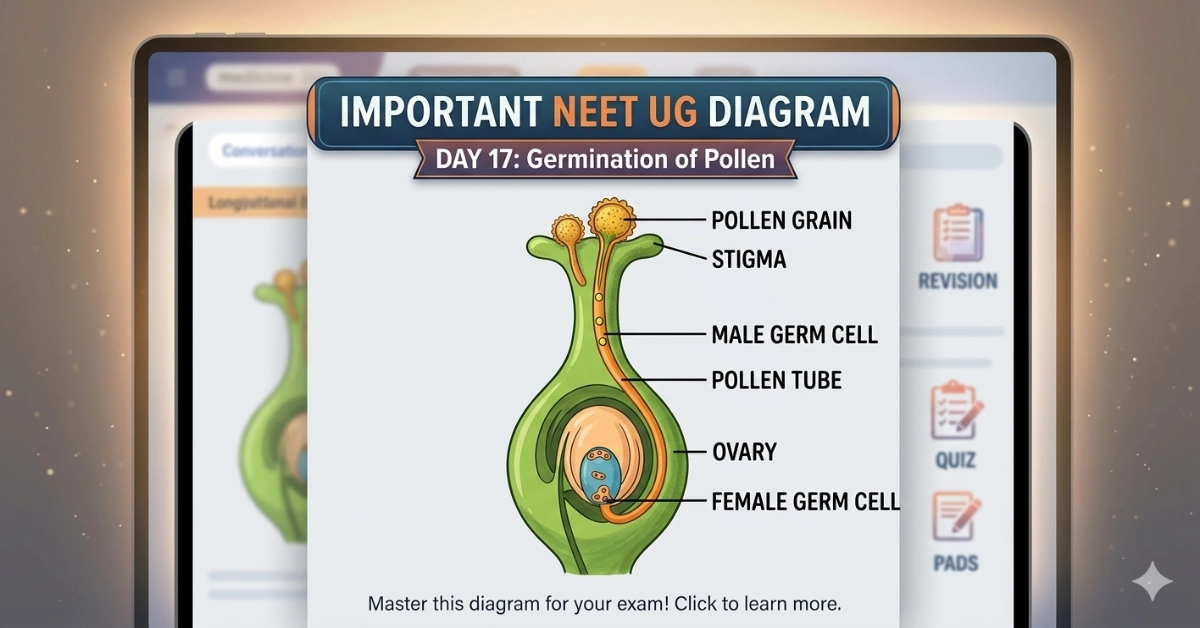
Important NEET UG Diagram Day 17: In the study of Sexual Reproduction in Flowering Plants, understanding the interaction between the pollen grain and the pistil is crucial. The diagram of a germinating pollen tube provides a visual representation of how male gametes reach the female gametophyte for fertilization.
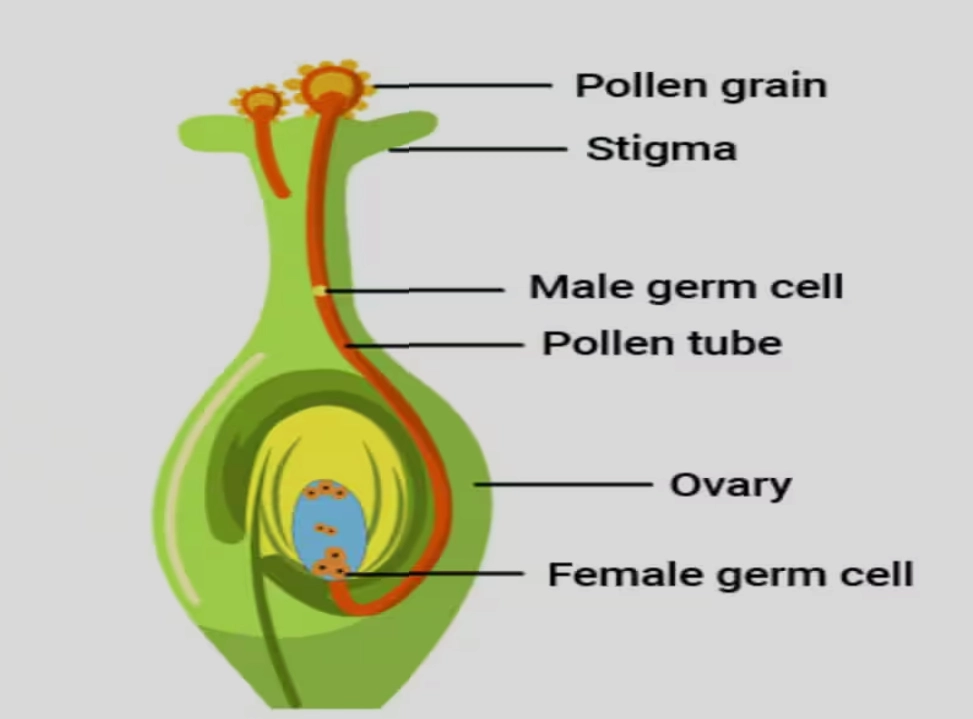
Important Points to Remember
- Pollen-Pistil Interaction: This is a dynamic process involving pollen recognition followed by promotion or inhibition of the pollen.
- Site of Germination: Pollen grains land on the stigma, which provides the necessary nutrients (like sugars and boron) for germination.
- Vegetative vs. Generative Cell: In most angiosperms (60%), pollen is shed at the 2-celled stage (vegetative and generative). In others, the generative cell divides into two male gametes before shedding (3-celled stage).
- Chemotropic Movement: The growth of the pollen tube through the style toward the ovary is a chemotropic movement, guided by chemicals secreted by the synergids in the ovule.
| Label | Structure | Function |
|---|---|---|
| Pollen grain | Male gametophyte | Contains vegetative cell and generative cell; generative cell divides mitotically into two male gametes (sperm cells). |
| Stigma | Receptive surface of pistil | Receives pollen grains during pollination; secretes sticky substances and enzymes for pollen germination. |
| Pollen tube | Tubular outgrowth | Formed by the vegetative cell; grows chemotropically through the style; carries the two male germ cells to the ovule. |
| Male germ cell | Two sperm cells | Non-motile male gametes; one fuses with egg cell (syngamy → zygote), other fuses with central cell (triple fusion → endosperm). |
| Ovary | Basal swollen part of pistil | Contains one or more ovules; site where fertilization occurs. |
| Female germ cell | Egg apparatus in embryo sac | Egg cell (n) + two synergids; the egg fuses with one male gamete during syngamy. |
Sequence of events:
- Pollination → pollen grain lands on stigma.
- Pollen grain absorbs water and germinates.
- Vegetative cell forms pollen tube (grows through style).
- Generative cell divides into two male germ cells inside the pollen tube.
- Pollen tube enters ovule usually through micropyle (porogamy – most common in angiosperms).
- One synergid degenerates and guides the male gametes.
- Double fertilization (unique to angiosperms): Syngamy (2n zygote) + Triple fusion (3n primary endosperm nucleus).
Key Terms
- Pollen tube growth is chemotropic (guided by chemicals secreted by synergids).
- The pollen tube is diploid initially but carries haploid male gametes.
- After fertilization: Zygote → embryo; Primary endosperm nucleus → endosperm (nutritive tissue).
- This diagram is often asked with variations: (a) identification of parts, (b) which part carries male gametes, (c) site of double fertilization.
- Common NEET trap: Male germ cells are not formed in the pollen grain but inside the pollen tube after germination.
Important Features
- Double fertilization is the hallmark of angiosperms.
- Pollen tube acts as a conduit; it degenerates after delivering male gametes.
- Embryo sac is 7-celled, 8-nucleate (Polygonum type – most common).
- The diagram clearly distinguishes male gametophyte (pollen grain + tube) from female gametophyte (embryo sac inside ovule).
- Post-fertilization: Ovule → seed; Ovary → fruit.
Diagram – Based Practice Questions
Q.1. In the given diagram, the structure labelled as ‘Male germ cell’ is carried by:
A) Pollen grain

B) Pollen tube
C) Stigma
D) Ovary
Q.2. The female germ cell shown in the diagram is actually:
A) Central cell
B) Egg cell
C) Antipodal cell
D) Synergid
Q.3. Assertion (A): The pollen tube grows through the style to reach the ovule.
Reason (R): Growth of pollen tube is chemotropic and guided by substances secreted by synergids.
A) Both A and R are true and R is the correct explanation of A.
B) Both A and R are true but R is not the correct explanation.
C) A is true but R is false.
D) A is false but R is true.
Q.4. Identify the correct sequence of events shown in the diagram:
A) Pollination → Pollen tube formation → Male gametes reach embryo sac
B) Fertilization → Pollen tube formation → Pollen germination
C) Pollen tube formation → Pollination → Syngamy
D) Triple fusion → Double fertilization → Seed formation
Comment Below For Answers!!
Read Also: NEET UG 2026 Daily Practice Paper Day 45
