
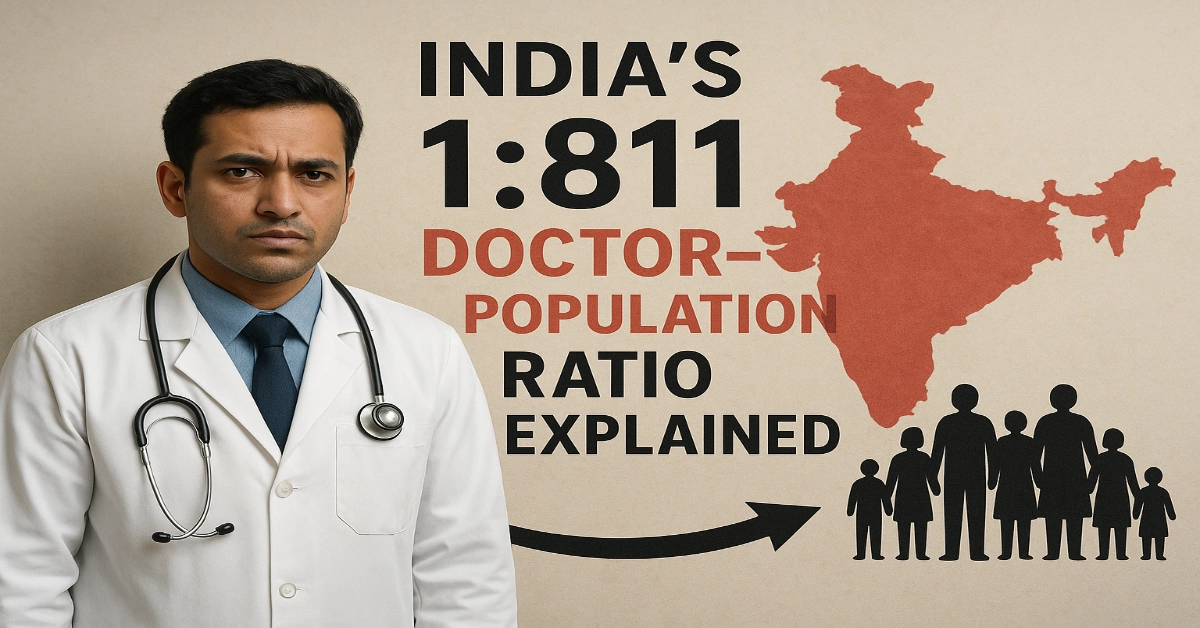
The government has recently announced that the doctor-to-population ratio in India has become 1:811, which sounds like a remarkable achievement. But let’s explore some overlooked realities to understand whether it is what it seems or if there is a darker side to it.
According to the WHO, the desired doctor-to-population ratio should be 1:1000, but the Union government in yesterday’s parliament session has glorified their achievement of attaining a 1:811 doctor-to-population ratio. The government has claimed that after the NDA government came into power, the number of seats and colleges providing medical education has significantly increased.
Medical Colleges from 387 to 818; UG seats from 51,348 to 1,28,875 and PG seats from 31,185 to 82,059 from 2014 till date. (source PIB)

Let’s look at the darker reality of this glorified achievement.
Lack of Trained faculty
The government’s claim of a 1:811 doctor-population ratio further overlooks the significant shortage of trained medical faculty across the country, which directly impacts the sustainability and quality of future medical workforce creation.
 Join NEET News 2026
 In India, most colleges rely on contractual and guest faculty to impart education, which raises concerns about the insufficient number of experienced educators to train new doctors. This shortfall not only lowers the rigour of the medical institution but also limits the potential of institutions to grow enrollment without losing quality.
As a result, the official ratio fails to account for the systemic bottleneck in producing competent, practice-ready doctors. The gap between on-paper statistics and ground realities is further widened when the teaching faculty and trainers themselves remain understaffed and under-resourced.
Data Integrity and Accuracy Issues
A closer study of the government’s reported 1:811 doctor-population ratio reveals serious data integrity and accuracy flaws that bring the credibility of this figure into question.
First, physicians who are officially registered but not actively practising, such as those who have retired, relocated overseas, taken on administrative or research responsibilities, or quit their jobs entirely, are frequently included in the computation.
Counting these individuals inflates the perceived availability of medical experts without reflecting their actual presence in the healthcare system.
Second, a major portion of the ratio’s data comes from the private sector, where physicians may be unevenly distributed, fee-dependent, and often unavailable to low-income groups.
This generates a skewed image of national capacity, especially when public hospitals, the primary providers for the majority, continue to run with severe staff shortages.
Low Doctor-to-Population Ratio in Rural Areas
Third, and the most important issue that this data overlooks is the unavailability of doctors in rural areas. Most of the trained doctors are available in the urban and suburban areas, but there is still a lack of adequate data on the doctor-population ratio in rural areas.
Talking about the rural areas, they generally lack basic medical facilities, but are highly populated. Rural hospitals and primary health centres struggle to recruit and retain qualified doctors due to inadequate facilities, insufficient diagnostic support, limited career growth, and poor working environments.
As a result, millions of rural residents rely on medical officers in nearby urban areas (Note that this nearby is often more than 50 to 100 km.), temporary contractual staff, or, in many cases, unqualified practitioners.
For example, when I was visiting Darbhanga Medical College & Hospital in Bihar, what I witnessed was shocking. People from surrounding districts like Supaul and Madhepura came here for treatment, and believe me distance was not just more than 100 KM, but it would take around 7-8 hours for a way journey.
The disproportionate burden of disease in rural areas, combined with difficult terrain, long travel distances, and weak referral networks, further enhances the impact of this shortage.
Which means the government’s doctor-population ratio becomes a misleading indicator, failing to capture the deep inequalities in healthcare access outside urban centres.
Read Also: Doctor-Patient Ratio in India Reach WHO Target: South India Leads, Rural Gaps Persist
The Silent Crisis of Overworked Doctors
The government’s 1:811 doctor-to-population ratio is further undermined by the fact that long work hours continue to be one of the most concerning but frequently disregarded aspects of the healthcare system. The excessive workload that physicians are subjected to, particularly in high-stress public institutions, raises serious concerns regarding patient safety and providers’ well-being, even in situations where they are technically “available.” During a recent visit to AIIMS and Safdarjung Hospital, I overheard several interns discussing how they were instructed to “take an hour of rest before starting a 72-hour shift” in the emergency and OPD wards. Such situations are not isolated; everyone is aware of this.
This shows a systematic dependence on overworked residents and interns who must compensate for persistent understaffing. These extended, frequently nonstop work hours result in exhaustion, burnout, poor decision-making, and an increased risk of medical errors, directly affecting the quality of healthcare facilities among the population.
Blurring the Lines to Improve the Ratio
Another fundamental issue in the government’s doctor–population ratio is the practice of adding allopathic and AYUSH practitioners into a single figure. On paper, this strategy increases the size of the healthcare workforce, but it hides important differences between modern medicine and ancient systems like Ayurveda, Homeopathy, and Unani in terms of training, scope of practice, and clinical responsibility.
Although AYUSH physicians are crucial to India’s healthcare system, they cannot be used in place of MBBS-qualified allopathic practitioners, particularly when it comes to complex medical procedures, emergency care, surgery, critical care, or anaesthesia.
By integrating these fundamentally different groups, the government artificially boosts the ratio, providing a sense of adequacy that does not reflect the actual availability of clinically educated, hospital-ready doctors. This statistical confusion eventually misrepresents the nation’s medical capacity and hides severe shortages in essential allopathic specialties that rural and public hospitals depend on most.
A Growing Health Crisis Beyond the Numbers
The post–COVID-19 period has also witnessed a significant spike in both communicable and non-communicable diseases, further overburdening an already overstretched healthcare system. Long COVID, poor respiratory health, increased cases of cardiovascular difficulties, higher mental health burdens, and delayed diagnoses of chronic conditions have combined to grow the country’s healthcare demand far beyond pre-pandemic norms.
Many individuals who avoided hospitals throughout the pandemic are now coming in with advanced-stage diseases, requiring more intensive and lengthy medical assistance. This heightened disease load renders the government’s 1:811 doctor–population ratio even more inadequate, as the number of doctors needed today must reflect not only population size but also increased clinical complexity.
In this setting, the claimed ratio ignores the larger workload and the additional medical attention necessary in the post-pandemic landscape.
Way Forward:
Addressing the deep structural flaws hidden by the 1:811 doctor–population ratio requires a comprehensive and evidence-driven reform strategy. First, the government must adopt transparent, accurate, and regularly updated methods of calculating doctor availability, distinguishing between active practitioners, public versus private sector contribution, and the distribution of allopathic and AYUSH practitioners.
Strengthening the healthcare workforce demands urgent expansion of medical seats, improved faculty recruitment, and incentives that make rural postings professionally motivating. Public hospitals must be supplied with enough infrastructure, sophisticated diagnostic support, and equitable working conditions to lessen the excessive strain currently placed on interns, residents, and frontline doctors.
An equally important need is a vibrant research environment within medical facilities. Post-pandemic health patterns, emerging diseases, and shifting demographic risks necessitate ongoing investment in epidemiological research, health systems studies, and therapeutic innovation. In order to ensure that workforce planning is in line with actual health demands, the evidence produced by such research should inform policy decisions, resource allocation, and curriculum improvement.
Finally, collaboration between government, academic groups, and public health specialists may build a long-term strategy that prioritizes quality, accessibility, and resilience over superficial numerical results. Not only is a more extensive, ethically sound, and research-based healthcare system desirable, but it is also necessary to protect the future of the country.
Read Also: Medical Colleges Rise from 387 to 818 Since 2014; UG & PG Seats Hit Record Highs
