
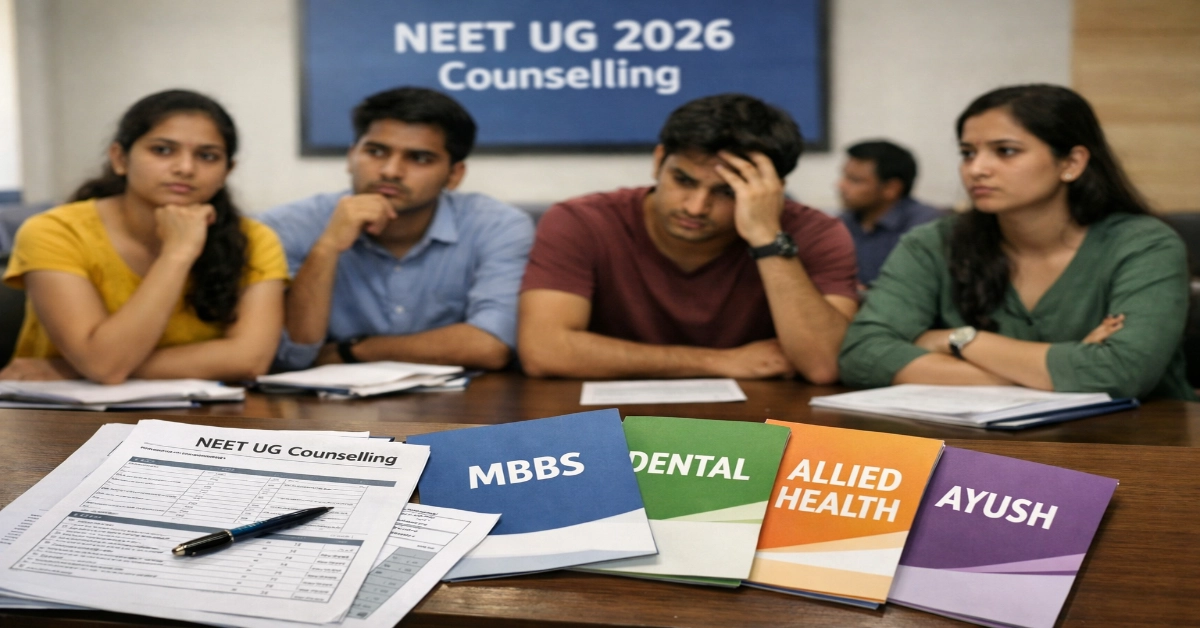
NEET UG: MBBS Is Not the Only Option After NEET UG 2026 – But Are the Alternatives Worth It? Every year after NEET UG results, a familiar advice dominates coaching centers, counselling halls, and social media feeds: “If not MBBS, then nothing.”
But the reality is different. There are various alternatives apart from NEET UG, But the one question we often encounter is whether these alternatives are worth?
Read Also: Beyond MBBS: How Allied Health Sciences Are Reshaping India’s Medical Workforce
Let’s try to understand these alternative and their worth:

With over 23+ lakh aspirants competing for roughly 1.1 lakh MBBS seats in India, a majority of students are forced to consider alternatives, despite India’s increase in colleges and seats. The critical question for students and parents is not whether alternatives exist, but whether they offer similar value in terms of career stability, social recognition, financial return, and long-term growth.
This article examines the question of whether these alternatives are worth it or not.
 Join NEET News 2026
 Why MBBS Still Remains the Golden Choice:
Before discussing alternatives, it’s important to understand why MBBS continues to dominate aspirations:
- Clear professional identity – (Doctor)
- Structured career: MBBS- Internship – PG – Super-specialisation
- High social trust and respect
- Relatively stable demand in both public and private sectors
- Global mobility with licensing exams
This clarity is precisely what many alternatives lack, not in merit, but in policy support and market structure.
Common Alternatives After NEET UG – And Their Real Value
1. BDS (Dental Surgery)
Once considered the closest alternative to MBBS, dentistry has faced market saturation, especially in urban areas.
Pros
- Same professional identity (Dr.)
- Shorter training period
- Independent practice possible
Challenges
- Limited government jobs
- High cost of private practice setup
- Uneven income distribution
Worth it only for students genuinely interested in dentistry.
2. AYUSH Courses (BAMS, BHMS, BUMS)
Promoted heavily as “equivalent” alternatives, AYUSH courses have grown rapidly- sometimes faster than job creation.
Pros
- Government recognition
- Growing policy visibility
- Lower competition compared to MBBS
Challenges
- Limited integration into mainstream healthcare
- Ambiguous scope in emergency and hospital medicine
- Lower average earnings
Valuable for committed practitioners, but not equivalent to MBBS in career flexibility.
3. Allied Health Sciences (BSc Nursing, Physiotherapy, Radiology, Lab Technology, Forensic Sciences)
These professions are essential to healthcare systems – yet often undervalued and underpaid in India.
Pros
- Faster entry into the workforce
- High global demand
- Skill-based roles
Challenges
- Limited autonomy
- Slower career progression
- Lower societal recognition in India
Strong options if paired with international opportunities or advanced specialization.
4. Biotechnology, Biomedical Sciences, Public Health
Often recommended to academically strong students who narrowly miss the MBBS seats.
Pros
- Research and policy roles
- International academic pathways
- Exposure to innovation
Challenges
- Long gestation period for returns
- Requires postgraduate education
- Limited industry absorption in India
Suitable for research-oriented students, not those seeking clinical practice.
The Core Issue: Not Choice, But Comparability
The problem is not that alternatives exist.
The problem is that they are not structurally comparable to MBBS in India.
- No alternative offers the same clarity of role
- No alternative has a similar nationwide demand
- No alternative guarantees clinical authority and decision-making power
Until policy ensures:
- Better pay parity
- Defined scopes of practice
- Strong public sector absorption
These options will continue to feel like compromises rather than choices.
So, Are the Alternatives Worth It?
Yes – If?
1. When the student has a genuine interest
A genuine interest is not simply a willingness to adjust. It reflects a clear inclination toward the nature of work the profession demands.
For example:
- BDS requires entrepreneurial patience and fine motor skills, not just clinical knowledge.
- AYUSH demands philosophical commitment and long-term practice building.
- Allied health roles involve team-based care rather than independent authority.
- Research-oriented degrees require comfort with delayed outcomes and uncertainty.
Students who choose these paths with genuine interest tend to outperform peers who enter them reluctantly. In contrast, those who see the course merely as an alternative to MBBS, leading to stagnation or repeated career switches.
2. When the family understands long-term realities
Family expectations significantly shape career satisfaction in India. Alternatives to MBBS often involve:
- Slower income growth
- Fewer government positions
- Limited social recognition
Families that expect MBBS-like prestige, income, and job security from non-MBBS courses inadvertently create pressure that the profession is not designed to absorb. When families instead accept the actual career trajectory, students are more likely to persist, specialize, and succeed.
Supportive families plan for time, training, and transition, not just degrees.
Read Also: NEET and Mental Health: The Hidden Struggle Behind the Dream
3. When the career plan includes specialization or global exposure
Most non-MBBS careers reach meaningful stability only after additional qualifications.
Examples include:
- MDS, MPH, MSc, PhD, or advanced clinical certifications
- Overseas licensure or employment pathways
- Hospital administration, research, or teaching roles
Without such progression, many alternatives face income and role ceilings. With it, however, they can become sustainable, respected, and globally mobile careers.
Hence, MBBS allows flexibility without planning; alternatives demand planning from day one.
NO – If ?
1. When chosen purely due to rank pressure
Rank-based panic is one of the most damaging forces in post-NEET decision-making.
Choosing a course simply because:
- Counselling deadlines are approaching
- Relatives are advising “anything medical is fine”
- A seat is available at a lower cutoff
often leads to disengagement and regret. Students in such situations frequently attempt NEET again, abandon the course midway, or struggle to build motivation for postgraduate growth.
A degree chosen in haste often becomes a career endured, not built.
2. When seen as “MBBS-lite.”
No alternative medical course is a scaled-down version of MBBS. Treating them as such creates false expectations regarding:
- Clinical authority
- Prescribing rights
- Hospital leadership roles
- Public perception
When students enter these fields expecting MBBS-like autonomy, frustration is inevitable. This misunderstanding contributes to dissatisfaction, professional insecurity, and attrition.
Each discipline has its own scope – but none are substitutes for MBBS.
3. When entered without understanding job outcomes
Many students and parents evaluate courses based on admission brochures, not employment data.
Critical questions often go unasked:
- What percentage of graduates find stable jobs?
- What is the median income after 5–7 years?
- How many require further degrees to remain employable?
- What is the public vs private sector split?
Without clarity on outcomes, families may invest significant time and money into paths that offer limited returns, leading to financial stress and emotional burnout.
A Word to Students and Parents
Medicine is not just a degree – it is a 40-year career commitment.
Forcing an unwilling student into an alternative course often leads to frustration, dropouts, or repeated exam attempts.
Support informed decisions, not emotional ones.
Conclusion
MBBS is not the only option after NEET UG – but it remains the most structured, protected, and socially embedded medical career in India.
Alternatives can be meaningful, respectable, and rewarding – if chosen consciously, not defensively.
The real reform lies not in telling students to “choose differently,” but in making those choices equally viable.
Read Also: NEET UG 2026: The Ultimate 4-Month Strategy to Score 600+ Marks
