
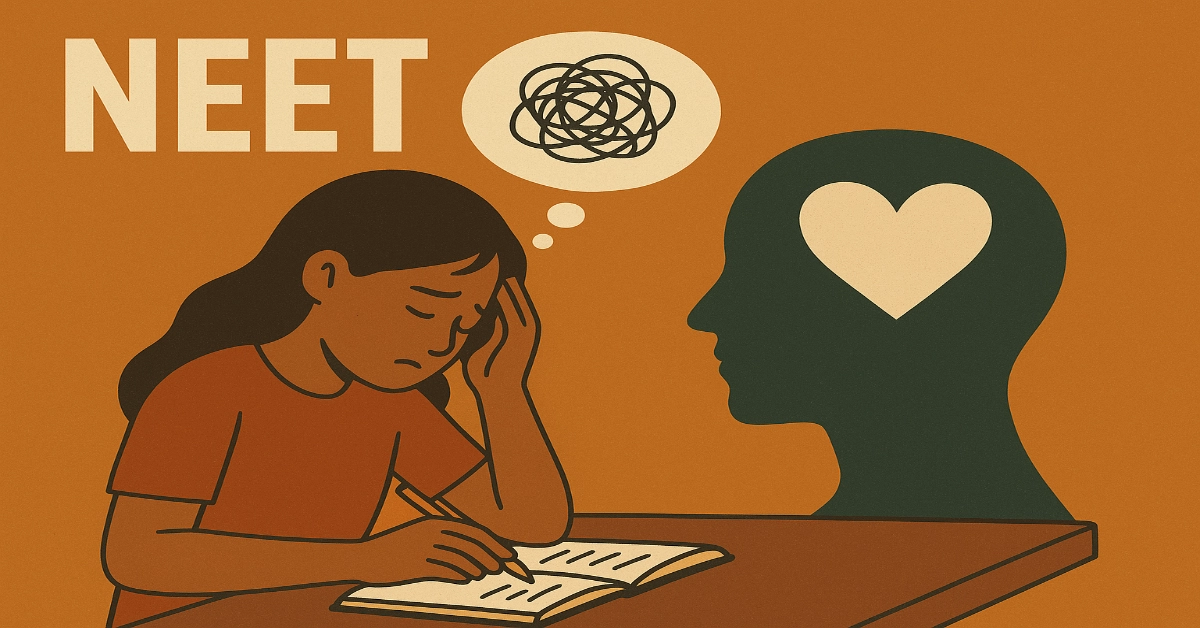
When a child dreams of becoming a doctor, the dream is filled with lots of hope and desire to change lives by curing them. But those innocent children are unaware of the long and difficult road that lies ahead. What begins as an ambition slowly transforms into a test of endurance and perseverance. The struggles of NEET preparation, such as long study hours, fierce competition, repeated revisions, mock tests, and constant comparisons, are widely known to parents, teachers, and peers.
Yet, beneath these visible challenges lies a silent battle that is often ignored. The growing burden on a student’s mental health. Anxiety, fear of failure, emotional exhaustion, and self-doubt quietly take root, turning a beautiful dream into a source of constant pressure. This hidden crisis is rarely discussed openly, but it shapes the lives of thousands of aspirants every year.
Frequent news of NEET aspirants losing their lives has forced society to pause and reflect deeply. It is heartbreaking to think that students who once dreamed of saving lives are now no longer part of this world. These incidents are not just numbers in the news but stories of young minds burdened by pressure, fear of failure, and unbearable expectations. Each such loss reminds us that academic success should never come at the cost of a life. It is a painful warning that the mental well-being of our students needs urgent attention, care, and compassion.

Read Also: WHO World Mental Health Day 2025: Why Medical Students and NEET Aspirants Deserve Our Attention?
Understanding the Root Causes:
NEET Pressure Cooker: As all of us are aware of the competition that NEET aspirants have to face. Every year, more than 24 Lakh students give the NEET examination across the country, and around 1,28,875 seats as announced by the Union Government in the recent parliamentary session. This figure clearly highlights the intensity of competition.
 Join NEET News 2026
 Stress, Isolation, and Burnout: Endless study hours, rigid coaching schedules and classes, chronic sleep deprivation, misleading sources, and the overwhelming flood of online material quietly shape their daily life. What begins as disciplined preparation slowly turns into a cycle of pressure where rest feels like guilt and breaks feel like a luxury.
In the race to stay ahead, many students struggle to differentiate between what is truly important and what is not, leading to confusion, burnout, and self-doubt. Caught between high expectations and harsh realities, aspirants often fight not just the syllabus, but their own physical and mental limits every single day.
Fear of Failure: Fear of failure is one of the leading factors in deteriorating mental health conditions among NEET aspirants, turning the preparation journey into a constant psychological battle. With nearly 24 lakh students competing for a limited number of seats, the pressure to clear the exam becomes overwhelming, and failure begins to feel like a permanent label, not a temporary one.
The fear of not qualifying, disappointing parents, and falling behind peers fuels constant anxiety, self-doubt, and emotional distress. Many students start measuring their self-worth solely through mock test scores and ranks, which leads to chronic stress, sleep deprivation, and burnout. Even slight dips in performance can trigger panic, hopelessness, and a sense of helplessness. Over time, this fear silently lowers confidence, suppresses motivation, and isolates students emotionally, making it one of the most dangerous yet normalized contributors to the mental health crisis among NEET aspirants
Role of Family and Society: Family and society play a very crucial role in shaping the mental health of NEET aspirants, often in ways that go unnoticed or unaddressed. While support from home can be a powerful source of strength, constant comparison, unrealistic expectations, and social pressure frequently turn it into a source of emotional burden.
Casual remarks, mocking from relatives, and public judgment based on ranks and results gradually reduce students’ confidence. Society’s tendency to glorify success and stigmatize failure creates a toxic environment where aspirants feel trapped between ambition and fear.
Many students silently endure taunts, pressure to “prove their worth,” and the belief that one exam defines their entire future. This continuous psychological stress often leads to emotional breakdowns, anxiety disorders, and deep feelings of isolation, proving that the mental health struggle of NEET aspirants is not just personal but rooted in social factors as well.
Impacts of Repeat Attempts and Drop Year: Repeat attempts and drop years often carry a heavy emotional and psychological toll on NEET aspirants, far beyond academic pressure. With every unsuccessful attempt, emotional exhaustion deepens, self-doubt grows stronger, and self-confidence steadily declines. Students begin to question their abilities, intelligence, and even their purpose, especially when they see peers moving ahead in their careers.
The fear of facing fresh competition each year, with new aspirants, revised patterns, and rising cut-offs, further intensifies this pressure. What starts as a determination to try again slowly turns into chronic stress, isolation, and burnout. Over time, the repeated cycle of expectation and disappointment weakens mental resilience, making drop years one of the most psychologically challenging phases in a NEET aspirant’s journey.
Social Media: While technology has undoubtedly simplified many aspects of our lives, it has also made us more vulnerable to mental stress and emotional trauma, especially through the unchecked influence of social media. For NEET aspirants, constant exposure to toppers’ routines, rank celebrations, and overwhelming advice creates an illusion that everyone else is progressing faster and doing better.
What appears as motivation for a few often turns into silent pressure for many, triggering unhealthy comparisons and feelings of inadequacy. Aspirants begin to doubt their own methods, lose focus, and feel compelled to match unrealistic standards set online. Social media also amplifies peer pressure, making students feel guilty for resting, anxious about falling behind, and fearful of being judged. Instead of being a tool for guidance, it often becomes a source of distraction, self-doubt, and emotional instability, quietly intensifying the mental health struggles of NEET aspirants.
During my own NEET preparation days, I constantly struggled to stay motivated while following the same monotonous study routine every day. At that time, toppers’ interviews and videos used to be my biggest source of inspiration. I often watched YouTube videos where toppers proudly brag about studying for 12 hours straight, with titles like “Study With Me for 12 Hours.” Watching this made me believe that long study hours were the only way to succeed, so I pushed myself to follow the same exhausting routine.
However, I later chose a different career path, and I finally realized how deeply that lifestyle had affected my mental and physical health. I was always restless, tired due to lack of proper sleep, and developed several health issues from sitting for long hours without balance or breaks. Today, I may not be an expert on the NEET exam anymore, but as someone who has studied Psychology, I can confidently say that such extreme study routines are not healthy. Hard work is important, but not at the cost of one’s mental peace, physical health, and overall well-being.
Beyond Books and Ranks, What Needs to Change:
For Aspirants:
- Set realistic goals and avoid unhealthy comparisons.
- Take regular breaks, sleep properly, and protect your routine.
- Remember: Your worth is bigger than one exam or one rank.
- Talk openly about stress instead of bottling it up.
For Parents:
- Replace pressure with patience and expectations with emotional support.
- Avoid constant comparison with relatives’ children and toppers.
- Celebrate effort, not just results.
- Make home a safe space, not an extension of the coaching class.
For Schools & Coaching Institutes:
- Promote mental health awareness alongside academic performance.
- Provide professional counselling and stress-management sessions.
- Design balanced study schedules, not burnout routines.
- Train teachers to identify early signs of anxiety and depression.
Mental health issues are serious concerns that cannot be handled at an individual level alone; they demand collective attention, understanding, and cooperation. Since parents and teachers are the primary caregivers in a student’s life, the responsibility largely falls on them to create a safe and supportive environment.
They must initiate conversations, listen without judgment, and encourage aspirants to express their fears, stress, and emotional struggles openly. When students feel heard and supported rather than scrutinized or pressured, they are more likely to seek help in time. Open communication, empathy, and emotional reassurance from parents and teachers can make a powerful difference in preventing silent suffering and long-term psychological harm.
This article also serves as a sincere note of gratitude to every supportive parent who stands beside their child during the most challenging phases of preparation. I, too, once carried the same dream as your children, but when the pressure of preparation began to take a toll on my mental health, I turned to my parents, and they stood by me with understanding and compassion. Their support reminded me of a truth that we must never forget: ‘No examination is more important than a human life’. It is only when we place mental well-being above scores and ranks that we truly succeed as a society.
Read Also: Why Ragging Still Happens in Medical Colleges: Mental-Health Crisis Among Students
