
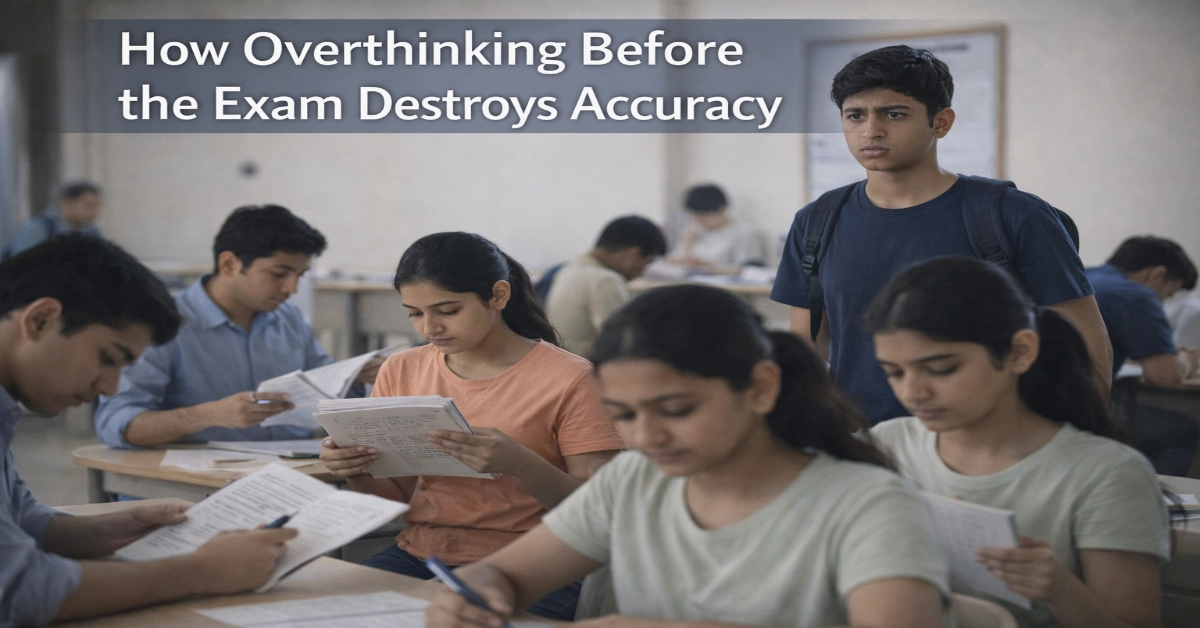
NEET UG 2026: You’ve studied the syllabus. You’ve solved enough questions. And yet, one hour before the exam, your brain suddenly starts asking: “What if I forget everything?” “What if the paper is too hard?” “What if others are more prepared than me?”
This is overthinking, and it silently damages exam accuracy more than a lack of preparation. Overthinking happens to almost everyone; it is not something unique, but how it happens and how students must deal with it is the core issue that this article deals with.
So that those who are preparing for NEET UG 2026 don’t lose marks, even after months of hard work.

Let’s break down why overthinking happens, how it hurts your performance, and what to do instead of overthinking
What Overthinking Really Does to Your Brain
Overthinking before an exam pushes your brain into threat mode. When you repeatedly replay worst-case scenarios, your brain releases stress hormones like cortisol. This causes:
 Join NEET News 2026
 - Slower recall
- Poor concentration
- Increased silly mistakes
- Mental fatigue before the exam even starts
In short, your brain starts fighting imaginary danger instead of solving real questions. What happens next is that you start forgetting things you have revised before the exam.
The Accuracy Trap: When You Know the Answer But Still Get It Wrong
Every aspirant has experienced this:
- You know the formula
- You recognise the question
- Yet you misread one word or choose the wrong option
Why? Because of overthinking, what overthinking does:
- Makes you doubt your first instinct
- Forces you to over-analyse simple questions
- Pulls your attention away from the present question
Accuracy doesn’t come from thinking more; it comes from thinking clearly and recalling facts and concepts.
Why “Last-Minute Revision” Often Turns into Panic
Students often say: “I’ll just revise once more to feel confident.”
But what actually happens?
- You open too many topics
- You notice what you don’t remember
- Confidence drops
- Panic rises
This creates the illusion that you are unprepared, even when you aren’t.
Remember, Revision should reassure you, not scare you.
The Comparison Problem
One of the biggest triggers of overthinking is comparison:
“They’re revising faster than me.” “They look more confident.” “They solved more mocks.”
What you forget is:
- You can’t see their mistakes
- You can’t measure their anxiety
- You can’t borrow their brain on exam day
Exams don’t reward confidence; they reward calm execution during stressful situations.
What Toppers Do Differently Before the Exam
Top scorers don’t try to “win the exam” in the last few hours.
Instead, they focus on:
- Protecting their mental clarity
- Trusting the work they’ve already done
- Keeping the brain calm and alert
Their goal is simple: “Don’t lose marks I already deserve.”
How to Stop Overthinking (Practically)
Here are student-tested strategies that actually work:
1. Fix a “Stop Time” for Heavy Studying
At least 6-8 hours before the exam, stop learning new things.
Switch to:
- Formula sheets
- Mistake notebook
- Light revision only
2. Write, Don’t Think
If a thought keeps looping (“What if I forget?”), Write it down once.
Your brain relaxes when it sees thoughts outside the head.
3. Trust First Answers (During the Exam)
Unless you spot a clear mistake, your first answer is usually right.
Over-revisiting increases error probability.
4. Control the Body, Calm the Mind
Slow breathing for 2 minutes:
- Inhale 4 seconds
- Hold 2 seconds
- Exhale 6 seconds
This resets your nervous system faster than motivation talks.
Read Also: NEET and Mental Health: The Hidden Struggle Behind the Dream
Remember This on Exam Day
- You don’t need a perfect memory
- You don’t need maximum confidence
- You don’t need to know everything
You only need: A calm brain, solving one question at a time. Overthinking steals accuracy. Calmness protects it.
If you’ve prepared sincerely, your job before the exam is not to panic, it’s to stay calm and attempt the paper, trusting yourself.
I have seen many students panicking after watching others revise their notes at the exam centre. DO NOT PANIC. Whatever you have studied till the day of your exam is enough, don’t rush after new information, keep calm, meditate, eat a dark chocolate to stay alert, and attempt the paper with full confidence.
