
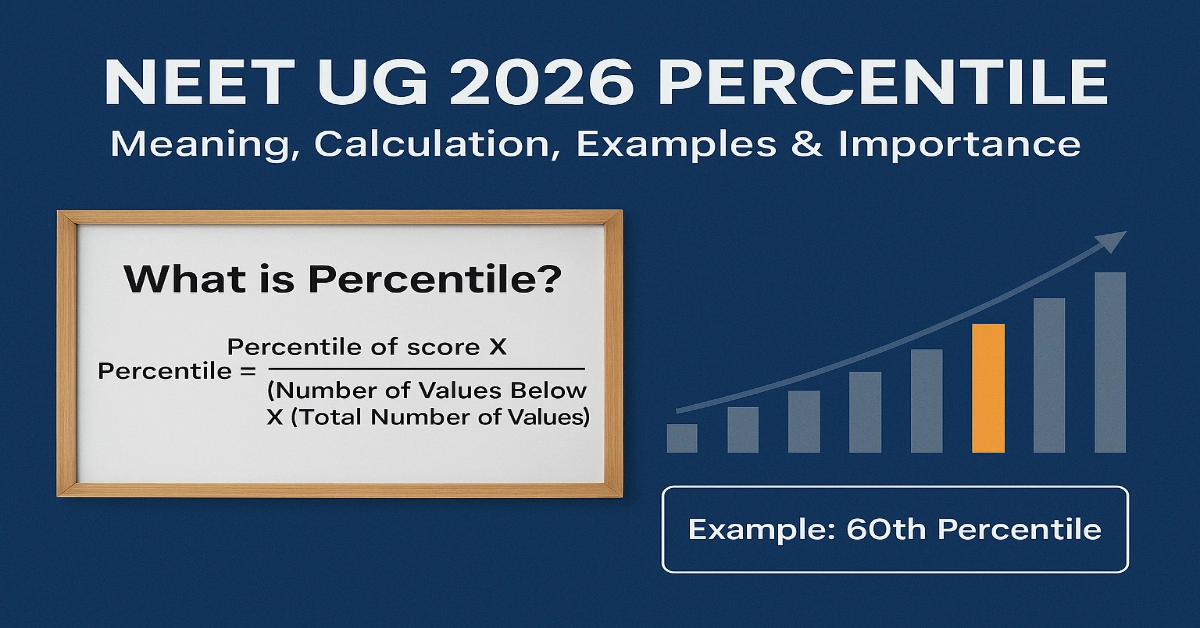
NEET UG 2026 Percentile: How It Works and Why It Matters? Many confuse percentile with percentage, but both are completely different. Understanding percentile is one of the biggest challenges for NEET aspirants, especially when lakhs of students appear every year and competition becomes intense.
NEET UG 2026 percentile plays a major role not only in qualifying criteria but also in interpreting rank, performance, and competition level.
This article explains percentile in the simplest way possible, using examples, formulas, and NEET-specific rules.

What Is Percentile?
A percentile tells you how many candidates scored below you, not how many marks you got.
If your percentile is 90, it means you have performed better than 90% of all students, and only 10% of students have scored more than you. Put even more simply, a high percentile means you are ahead of many people, while a low percentile means many people are ahead of you.
 Join NEET News 2026
 This is why percentile matters so much in exams like NEET, JEE, or any national-level competitive test.
Percentage vs Percentile: What Students Often Confuse
| Feature | Percentage | Percentile |
|---|---|---|
| What it measures | Marks out of total marks | Your position among all students |
| Example | 350/720 = 48.6% | 50 percentile means half of students are ahead of you |
| Based on | Individual score | Comparison with group |
| Important for NEET? | No | Yes |
NEET uses percentile to set qualifying cut-offs, not percentage.
How Percentile Works?
Imagine all students’ scores arranged from lowest to highest.
Your percentile tells:
- How many students scored less than you
- What percentage they form out of the total
Example:
If your score is at the 75th percentile, it means:
- 75% of students scored lower
- 25% scored equal or higher
Percentile = your relative standing in the competition.
Numerical Example of Percentile
Consider scores of 10 students (out of 100), arranged in ascending order:
28, 35, 41, 47, 53, 60, 66, 72, 85, 92
If a student scored 66, then:
- Scores below 66 = 6
- Total students = 10
Percentile = (6 / 10) * 100 = 60
So, 66 marks = 60th percentile means he scored better than 60% of the class.
How to Calculate Percentile?
If you know all scores:
Percentile of score X = (Number of Values Below X / Total Number of Values) × 100
This is the simplest way to understand percentile.
Read Also: NEET UG 2026: Rank vs Percentile Explained
NEET Percentile Example: Topper Case
Mahesh Kumar (AIR 1) out of 22,09,318 candidates.
Percentile=(22,09,318−1) / 22,09,318 ×100 ≈ 99.999954737%
He performed better than almost 100% of candidates.
Percentile When Students Have the Same Marks
NEET involves lakhs of students, so tie in marks is common.
NTA Rule: When multiple students get the same score, NTA uses the lowest rank among them to calculate percentile.
Example: From Rank 64 to 70, all candidates had identical marks.
- NTA uses Rank 70 to calculate percentile
- All students from Rank 64 to 70 get the same percentile:
99.9968316
This is exactly how NEET handles ties. This ensures fairness and uniformity.
Why NEET Uses Percentile Instead of Percentage
NEET is unpredictable. Some years the paper is easy; some years it’s tough. Using percentage-based cut-offs would be unfair. Percentile solves this problem by measuring:
- Relative performance
- Competition level
- Position in lakhs of aspirants
It ensures:
- Even if the paper is very difficult, top performers still qualify
- A fixed proportion of candidates cross the 50th percentile (General) or 40th percentile (Reserved) marks
Types of NEET Percentile Used in 2026
1. Score Percentile (Based on Topper’s Score)
Score Percentile = (Your Score / Topper’s Score) × 100
Tells how close your score is to the topper. Used mainly in analysis, not in ranking.
2. Rank Percentile (Used in NEET Ranking)
Rank Percentile = (Total Candidates − Your Rank) / Total Candidates ×100
- Total candidates = 7,00,000
- Your rank = 90
Percentile = (7,00,000 − 90) / 7,00,000 × 100 ≈ 99.98
You performed better than 99.98% of students. This is the standard method for NEET percentile.
How Percentile Helps in NEET Ranking & Counselling
- Percentile plays a crucial role in ranking because AIR is calculated based on relative performance, which directly depends on percentile logic.
- It is essential for cut-off declaration, where the General Category cut-off is set at the 50th percentile and the OBC/SC/ST cut-off is set at the 40th percentile, ensuring that cut-offs remain meaningful even when the exam is tough.
- Percentile helps in the normalisation of performance by removing the effect of paper difficulty across different shifts or years.
- It ensures fair seat allocation, as limited seats are offered only to the top performers who score higher percentiles.
Why Percentile Matters for NEET UG 2026 Aspirants
Understanding percentile helps you:
- Analyse your performance scientifically
- Set realistic target ranks
- Know where you stand in lakhs of competitors
- Avoid confusion between marks vs rank vs percentile
- Plan improved preparation for NEET UG 2026
Percentile tells you your true competitive standing, not just how many questions you got right.
Percentile is one of the most important concepts in NEET UG 2026. It measures your relative position among all candidates, determines qualification, and influences counselling outcomes.
When students shift from “marks-based thinking” to “percentile-based understanding,” they can plan smarter and interpret their NEET results more accurately.
