
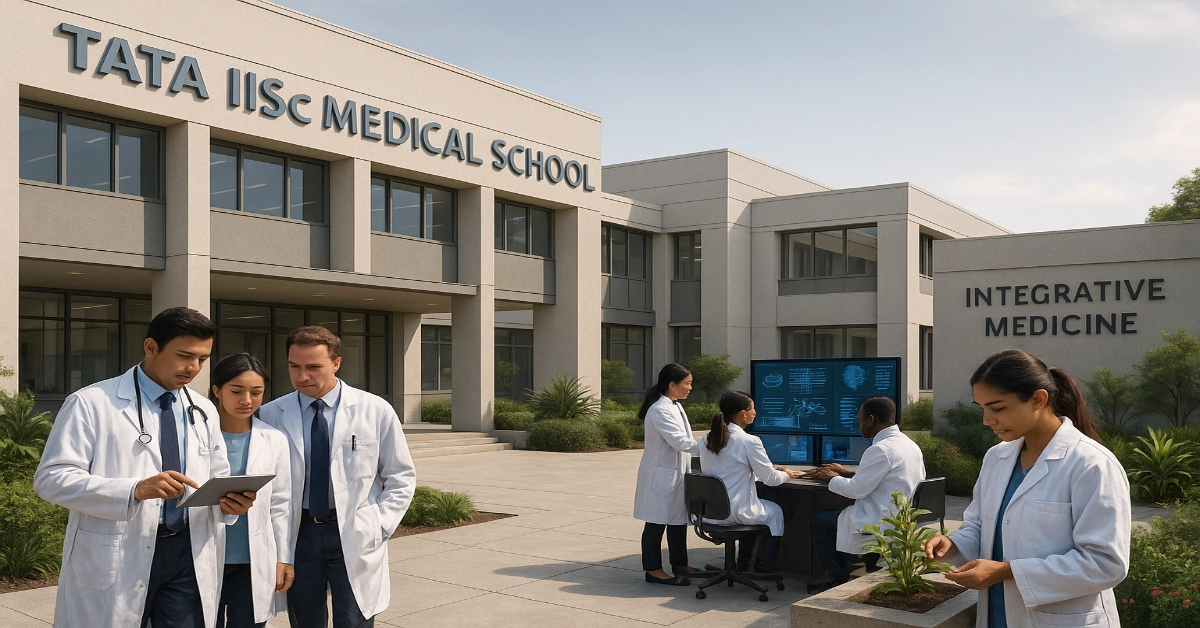
Tata IISc Medical School: The upcoming Tata IISc Medical School, a visionary initiative by the Tata Group and the Indian Institute of Science (IISc) Bengaluru, is set to transform India’s medical education and healthcare research ecosystem.
The institute plans to introduce a unique integrative model, combining traditional medicine systems with modern scientific research, paving the way for a new era of evidence-based holistic healthcare.
This article explains the vision, structure, academic plans, impact areas, and challenges of this innovative medical school.

What Is the Tata IISc Medical School?
Planned with a ₹500-crore investment, the Tata IISc Medical School will operate alongside the upcoming Bagchi-Parthasarathy Hospital at the IISc campus. Unlike traditional medical colleges, this school aims to:
- Train physician-scientists with strong grounding in clinical sciences and advanced research
- Integrate modern biomedicine with validated traditional therapies
- Build a globally competitive research ecosystem
The school will offer a combination of MD/MS, DM/MCh, MPH, and MD-PhD dual-degree programs, with a strong focus on interdisciplinary training.
 Join NEET News 2026
 Integrating Traditional Medicine with Modern Science: What Does It Mean?
One of the most revolutionary proposals is the school’s plan to formally integrate traditional systems, including Ayurveda and other Indian medical knowledge systems, with rigorous modern research.
Key Objectives of the Integration
- Holistic Care: Move beyond disease treatment and focus on preventive and wellness-based healthcare.
- Scientific Validation: Study traditional practices through clinical trials, biochemical research, and technological tools.
- New Treatment Outcomes: Identify plant-based or traditional remedies that can complement modern therapeutics.
- Collaborative Research: Enable partnerships between modern medical researchers, Ayurveda scholars, and public health scientists.
A dedicated Department of Integrative Medicine is expected to be established to support this interdisciplinary collaboration.
Why IISc Is the Best Institution for This Model
IISc offers exceptional strengths that make this initiative powerful:
- Strong biomedical and engineering research base
- World-class labs and scientific expertise
- Focus on translational medicine (turning lab research into clinical outcomes)
- Existing interdisciplinary departments, which can support medical innovation
The combination of basic science, engineering, and clinical medicine is expected to produce groundbreaking results.
Read Also: Combined MBBS-BAMS Degree at JIPMER: Can It Produce Competent Doctors?
Academic Structure: What Students Can Expect
The Tata IISc Medical School aims to produce graduates who are not only clinicians but also research-driven innovators. Planned academic offerings include:
Dual-Degree Route
- MD-PhD programs to create physician-scientists
- Research-intensive Master’s and Doctoral programs
Focus Areas of Education
- Clinical medicine
- Integrative therapeutics
- Biomedical engineering
- Biotechnology
- Neuroscience
- Public health and epidemiology
Research Themes
- Chronic metabolic diseases
- Mental health and neuroscience
- Infectious diseases
- Oncology
- Regenerative medicine
- Digital health and AI-driven diagnostics
This structure ensures students gain clinical competence + research excellence.
Expected Impact on Indian Healthcare
The Tata IISc Medical School has the potential to reshape public health and clinical practice in India.
1. Evidence-Based Traditional Medicine
Traditional treatments will be validated using scientific methodologies, making them acceptable in mainstream medical practice.
2. New Research Outputs
Drug discovery, herbal pharmacology, and novel therapeutic protocols may emerge through rigorous studies.
3. More Physician-Scientists
India faces a shortage of clinician-researchers. This school will help bridge that gap.
4. Boost to Preventive Healthcare
With lifestyle diseases on the rise, an integrative model can impact large-scale public health outcomes.
5. Global Recognition
India could become a global leader in scientifically validated integrative medicine.
Also Read: MBBS-BAMS Dual Degree: IMA Protests JIPMER Plan
Challenges Ahead
Despite its promise, integrating two fundamentally different systems is not easy.
- Need for Strong Evidence: Traditional systems must pass through the same rigorous trials as modern medicine.
- Possible Resistance from Medical Fraternity: Some practitioners may question the scientific credibility of integrative models.
- Standardization Issues: Traditional practices often vary widely; creating standardized clinical protocols is complex.
- Training Balance: Students must master clinical medicine while also learning research and traditional systems, a demanding academic load.
A New Chapter for Indian Medical Innovation
The upcoming Tata IISc Medical School represents one of the most ambitious transformations in India’s medical education landscape. By combining traditional wisdom with state-of-the-art scientific research, the institute aims to create a holistic, evidence-based, and future-ready model of healthcare.
If executed well, this medical school could:
- Redefine integrative medicine
- Produce world-class physician-scientists
- Strengthen India’s biomedical research
- Improve public health outcomes on a national scale
It is not just a new medical college, it is a new direction for India’s healthcare future.
