

UN Study on Career Counselling Gap: The United Nations (UN) study reveals that only 1 in 10 students worldwide have access to professional career counselling. The rest are left to navigate one of the most crucial decisions of their lives, choosing a career, through trial and error, family pressure, or social trends. This statistic, revealed in a United Nations (UN) study, exposes a deep global crisis in career guidance.
For India, the problem is even more urgent. With 1.5 crore+ students appearing for competitive exams like NEET, JEE, and UPSC every year, most make choices based not on aptitude or interest but on peer or parental expectations.
A majority of them do not even know the real costs, prospects, or alternative pathways available.
The outcome? Degrees without direction, jobs without satisfaction, and a growing employability crisis.
India boasts the largest youth population in the world, yet surveys show that 90% of its students choose careers blindly. Without structured guidance, dreams are often replaced with “safe” professions, while passion and potential remain untapped.
 Join NEET News 2026
 The question is: Can India’s National Education Policy (NEP) 2020 bridge this UN-flagged career counselling gap?
UN Study on Career Counselling Gap: Global vs India
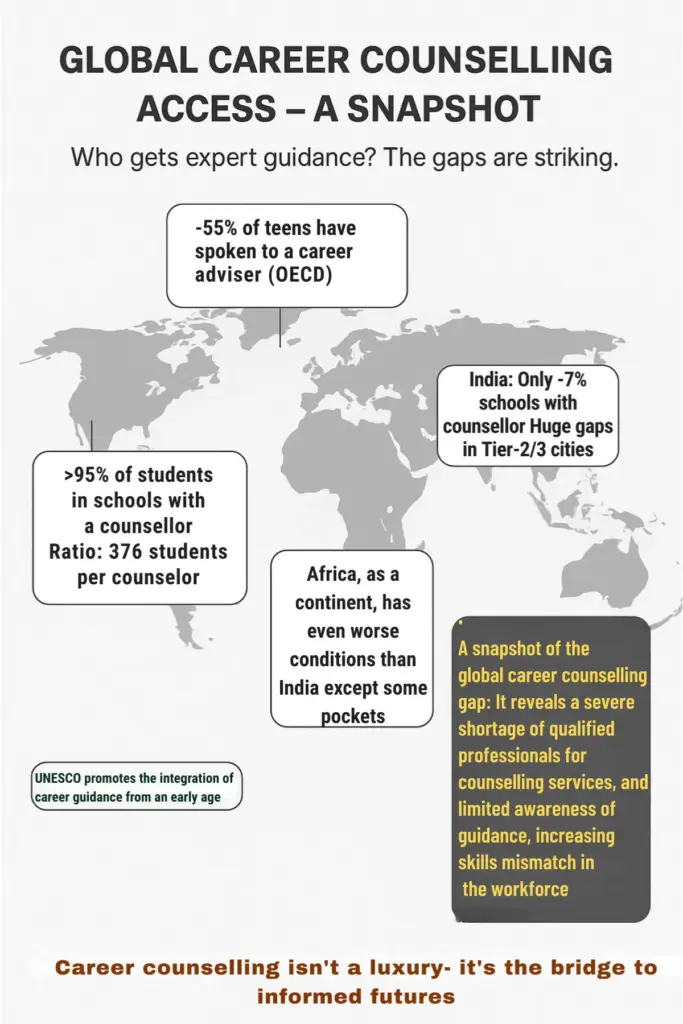
In developed nations like Canada, Australia, and the UK, career counselling is embedded in the education system. Students undergo aptitude tests, attend career fairs, and receive structured mentoring before choosing a college or career path. This ensures alignment between interests, skills, and opportunities.
By contrast, India’s situation is bleak. The student-counsellor ratio is alarmingly poor. According to education experts, while developed countries maintain a healthy 1:250 ratio, India has one counsellor for every 3,00-5,000 students, and in many rural schools, there are none at all.
The UN study of 21,239 students across seven states revealed that only 10.4% had access to professional counselling. Surprisingly, uncertainty was higher in private schools (41% unsure about future course choices) than in government schools (35%). This challenges the assumption that private school students enjoy better support systems.
India-specific surveys further underline the crisis:
- ASER Reports highlight gaps in rural education, where career guidance is virtually absent.
- NCERT surveys confirm that while students may excel academically, they lack awareness of career pathways and employability skills.
- India Skills Report and NASSCOM studies repeatedly show that nearly 50% of Indian graduates are unemployable by industry standards.
In essence, while access to schools has improved, access to clarity has not.
The Career Confusion Crisis in India
The lack of structured counselling manifests in several ways:
Wrong Career Choices
Millions of students prepare for NEET, JEE, or UPSC exams each year without a backup plan. Those who don’t succeed often feel lost, having never explored alternative paths aligned with their skills.
High Dropouts
With limited guidance, students enrol in courses they don’t understand or enjoy. Dropout rates rise when passion doesn’t meet profession.
Mental Health Struggles
Exam stress, burnout, and a “stuck” feeling in the workplace are common.
According to the Gallup 2024 State of the Global Workplace Report, only 14% of Indian employees feel they are thriving, compared to a global average of 34%. Misaligned career choices are a major contributor.
Cultural Obsession with Safe Professions
Medical, Engineering, and civil services remain the “holy trinity” of Indian career dreams, even as emerging fields in AI, renewable energy, design thinking, and climate tech offer far more opportunities.
In short, the absence of professional counselling creates a career crisis that drains both talent and morale.
NEP 2020 and Career Counselling
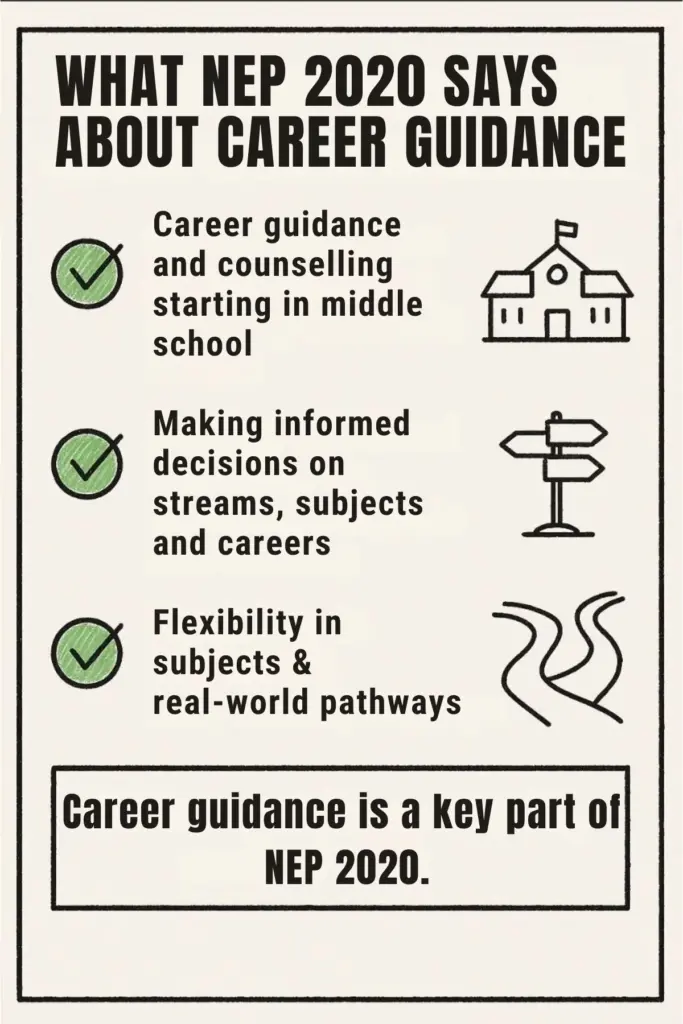
The National Education Policy (NEP) 2020 offers hope by reimagining India’s education system. It emphasises holistic development, skill-based learning, and structured guidance. Here’s how it addresses the counselling gap:
Early Career Awareness
NEP 2020 pushes for introducing career awareness at the middle school level, ensuring students start exploring options early rather than waiting until post-12th panic sets in.
Vocational Education Integration
By 2025, the policy aims for 50% of students to have vocational exposure, bridging the gap between academics and industry. Internships and skill-building workshops are to be integrated into curricula.
Multidisciplinary Approach
Instead of siloed streams (arts, science, commerce), NEP 2020 encourages multidisciplinary learning, letting students pursue combinations like coding with psychology or economics with environmental science.
Institutional Support for Counsellors
The policy advocates for trained counsellors in schools, supported by CBSE and state boards, to guide students based on aptitude mapping and psychometric assessments.
| The CBSE Counselling Hub & Spoke Model is designed to strengthen mental health support in schools. In this system, CBSE mentor hub schools work with spoke schools to share ideas, train teachers, and improve student wellness. Linked to the vision of NEP 2020, the model aims to make career guidance and mental health support more accessible, while also building the skills of teachers, counsellors, and wellness educators. |
21st-Century Skills Focus
Critical thinking, problem-solving, and adaptability are prioritised, preparing students for jobs that don’t even exist yet.
However, the challenge lies in implementation. Policies on paper must translate into counsellors in classrooms, structured internships, and awareness campaigns for parents.
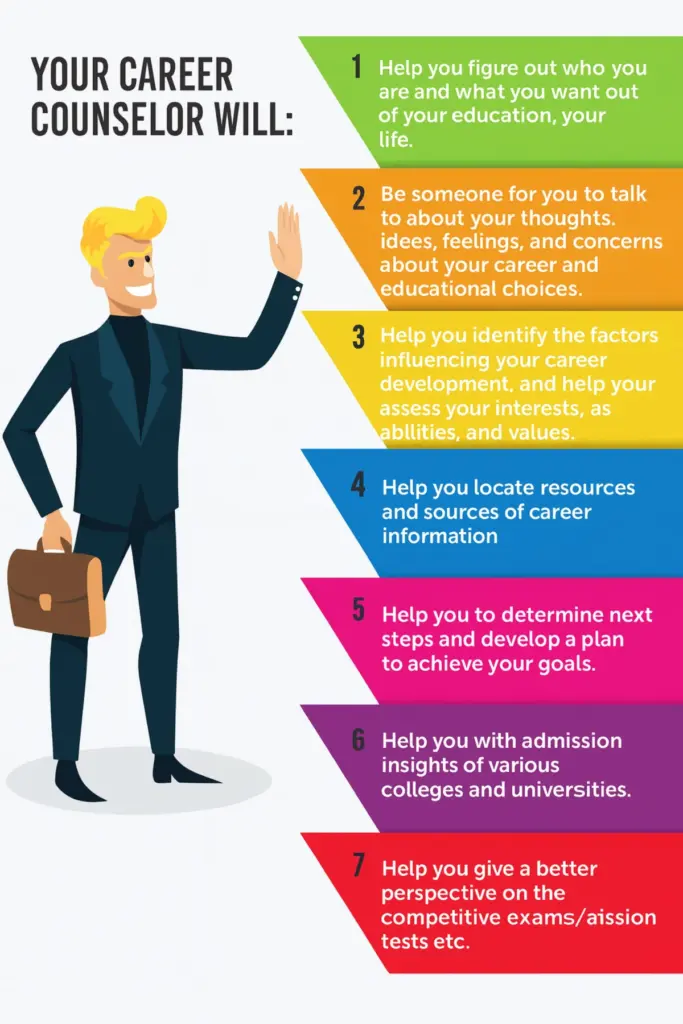
What Career Counsellors Do?
Earlier, it was parents or well-educated members of the family and friends who used to do counselling for their wards, but now in 21th century, there have been changes and evolution of the counselling process.
Tech & AI in Career Counselling
Technology is emerging as a powerful ally to fill the counselling gap, especially in Tier 2 and Tier 3 towns.
AI-Powered Platforms
Startups are leveraging AI to offer aptitude tests, career recommendations, and personalised guidance in multiple Indian languages. AI chatbots can democratise counselling by making it affordable and accessible to students in remote areas.
State Initiatives
Some states have piloted career guidance portals and digital mentorship programs. For example, Delhi’s government introduced structured counselling in schools, and Karnataka partnered with EdTech firms for digital tests.
Hybrid Models
Experts caution that AI cannot fully replace human empathy and mentorship. The best approach is hybrid: AI tools as scalable entry points, with trained human counsellors providing context, empathy, and deeper insights.
Global Best Practices
Countries like the UK and Canada integrate tech with in-person counselling, ensuring students receive both data-driven insights and human mentorship. India can adapt this model at scale.
The digital revolution, if aligned with NEP 2020, could transform counselling from an elite service into a basic right for every student.
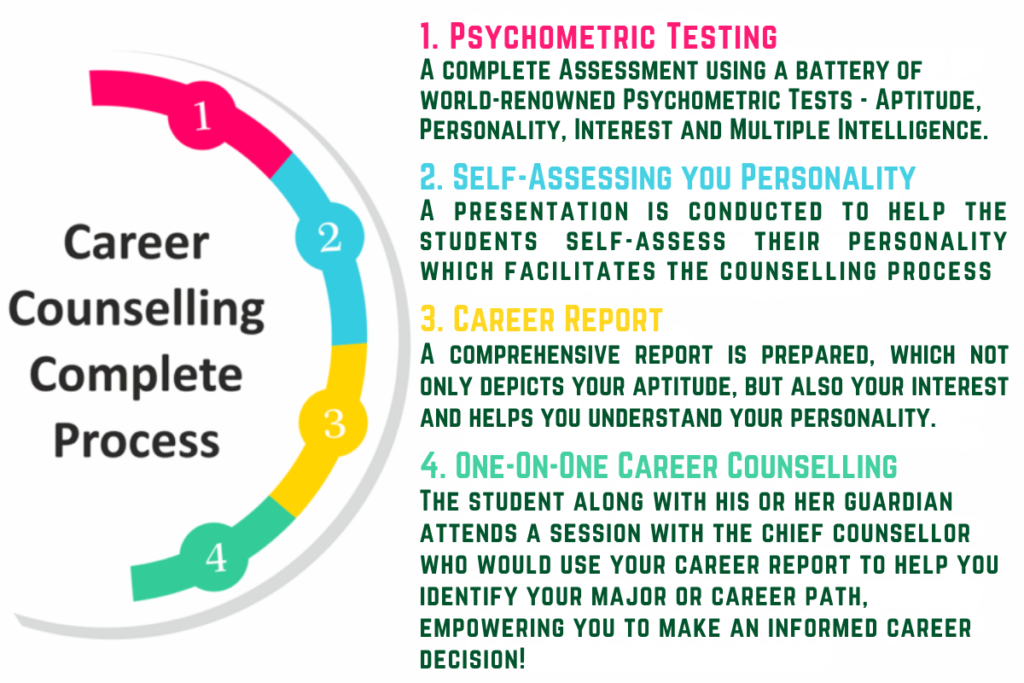
Career Counselling Processes
Solutions for India
To bridge the UN-flagged gap, India needs a multi-pronged strategy:
- Mandatory Counsellors in Schools: Both government and private schools must appoint certified counsellors.
- Teacher Training: Equip teachers with basic counselling skills so they can provide first-level guidance.
- Public–Private Partnerships: Collaborations between schools, EdTech companies, and industries can expand access.
- Parent Awareness Campaigns: Break cultural biases around “safe” careers through workshops and digital outreach.
- Digital Counselling Access: Ensure AI-powered platforms reach rural areas via smartphones and local-language apps.
Read Also: Monopoly in Medical Education in India: Ownership, Costs & Reforms 2025
By institutionalising these measures, career counselling can become as essential as math or science instruction.
India stands at a crossroads. With the world’s largest youth population, the country has a once-in-a-generation opportunity to turn its demographic dividend into an engine of growth. But without structured career counselling, millions risk drifting into mismatched careers, wasted potential, and job dissatisfaction.
The UN study’s 1-in-10 statistic is not just a number; it is a wake-up call. If NEP 2020’s vision of holistic education, vocational training, and digital innovation is executed effectively, India can bridge this counselling gap and set a global example.
Because the real question is not whether India can afford career counselling, it is whether India can afford not to.
