
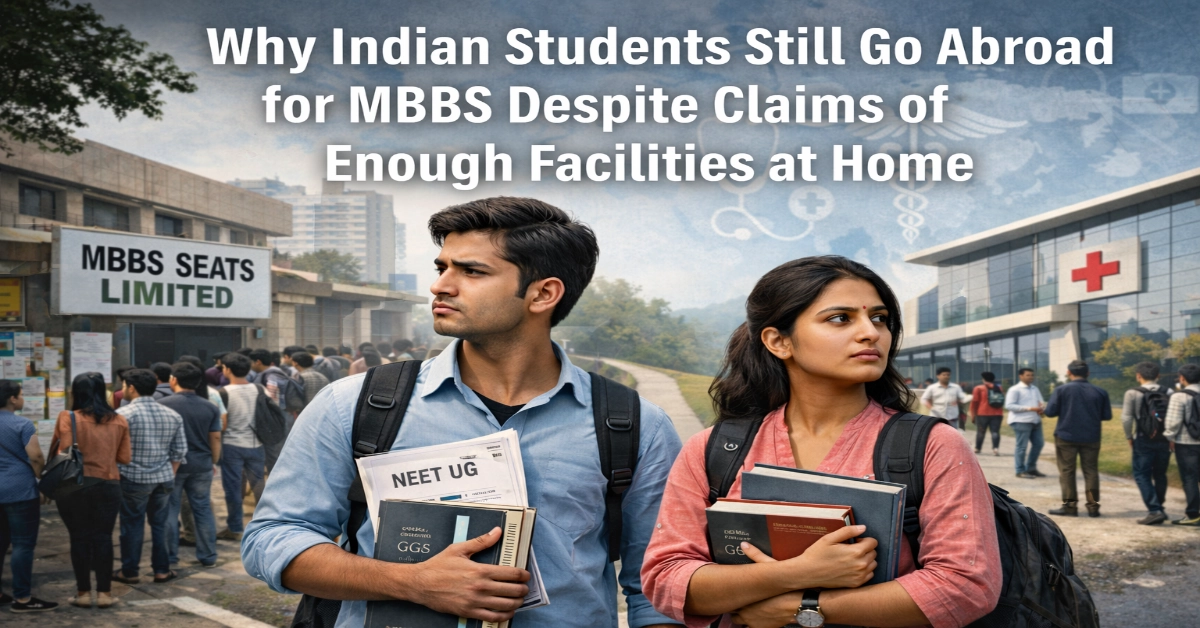
MBBS Abroad Is Not Just a Choice, It’s a Necessity: Union Health Minister Jagat Prakash Nadda’s recent statement that medical aspirants should no longer say lack of facilities or infrastructure as a reason to study MBBS abroad reflects the government’s confidence in India’s expanding medical education ecosystem. Over the past decade, India has undoubtedly witnessed a significant increase in medical colleges, seats, and healthcare institutions.
However, a policy review based on official data and student behaviour suggests that the decision to pursue medical education abroad is not driven by any excuse, but by systemic constraints related to access, affordability, and uniform quality.
Seat Scarcity: The Core Structural Imbalance
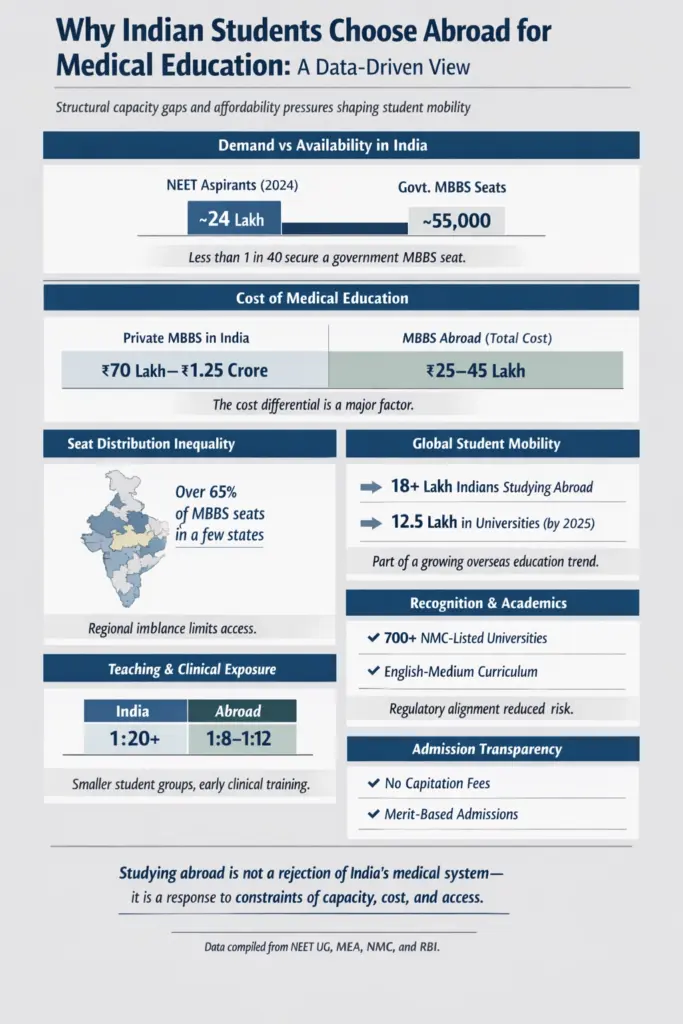
India conducts one of the world’s largest medical entrance examinations. According to National Testing Agency (NTA) figures, over 24 lakh candidates appear for NEET UG every year.

In contrast, data released by the National Medical Commission (NMC) and cited by the Press Information Bureau (PIB) shows that India currently has approximately 1.28–1.29 lakh MBBS seats, including both government and private colleges. While this marks a significant increase from around 51,000 seats in 2014, the seat-to-aspirant ratio remains severely less at roughly 1:18.
This mismatch creates an intensely competitive environment where even academically strong students fail to secure government MBBS seats. Which means Capacity expansion has not kept pace with demand.
 Join NEET News 2026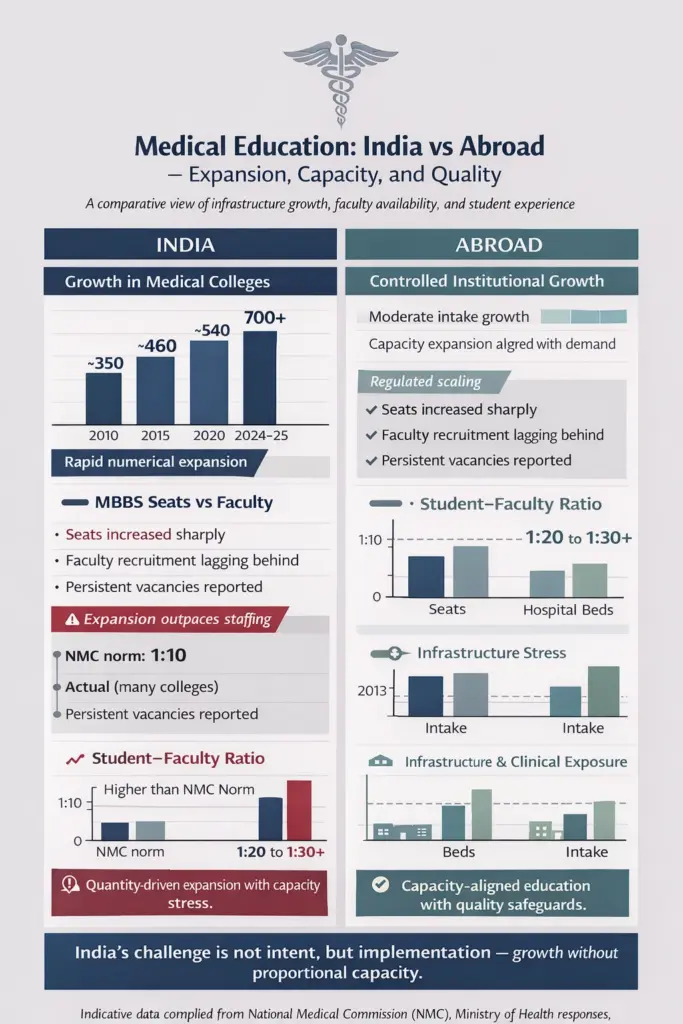
Affordability: The Deciding Factor for Middle-Income Families
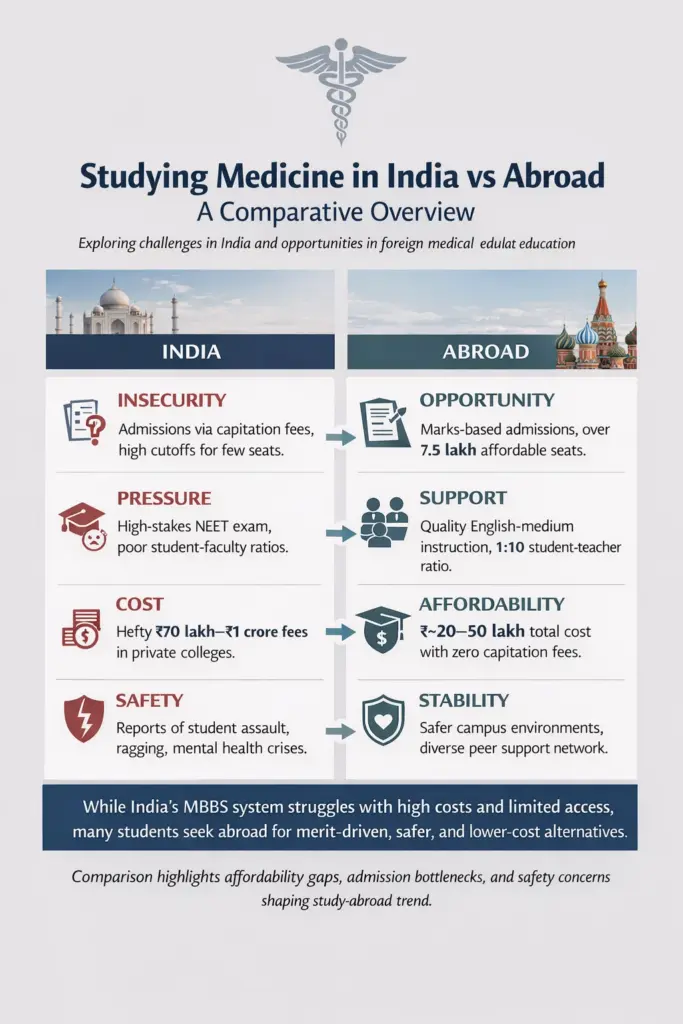
For aspirants unable to secure government seats, private medical education in India often becomes financially draining. Fee data across states indicates that total MBBS course costs in private colleges frequently exceed ₹1-1.2 crore, excluding living expenses.
In contrast, MBBS programmes in countries such as Russia, Georgia, Kazakhstan, Uzbekistan, and parts of Eastern Europe typically cost between ₹30-55 lakh, including tuition and accommodation. These programmes offer predictable fee structures, multi-year clarity, and admission processes free from donation-based distortions.
For many families, studying abroad is therefore not a preference but a financially rational alternative
Infrastructure: Expansion Without Uniformity
While premier institutions like AIIMS and selected government medical colleges offer world-class infrastructure, uniformity across India’s rapidly expanding medical college network remains uneven.
Faculty associations, inspection reports, and student representations have consistently highlighted issues such as:
- Shortage of qualified teaching faculty in newer colleges
- Limited patient inflow affecting clinical exposure
- Delays in hospital integration for newly approved institutions
- Inadequate hostels, laboratories, and simulation facilities
Medical education is fundamentally clinical in nature. Without sustained patient exposure and supervision, physical infrastructure alone cannot ensure quality outcomes.
Faculty Shortages and Clinical Exposure Gaps
India continues to face a shortage of medical faculty, particularly in government colleges located in semi-urban and rural areas. In several institutions, departments function with minimum permissible staffing, impacting:
- Student–teacher ratios
- Clinical mentoring quality
- Research and academic exposure
By contrast, many foreign medical universities operate under standardised faculty norms, structured clinical rotations, and early patient exposure, which appeals to students seeking consistency rather than institutional prestige alone.
MEA and RBI Data
Despite official assurances of sufficiency, data from the Ministry of External Affairs (MEA) and Reserve Bank of India (RBI) shows sustained demand for overseas education.
Indian Students Abroad:
MEA data tabled in Parliament indicates that over 18 lakh Indian students are currently studying in 153 countries, with more than 12.5 lakh enrolled in universities and tertiary institutions in 2025 (Indian Express). This demonstrates that Indian students continue to seek education abroad, despite claims of adequate domestic facilities, supporting the argument that structural demand persists.
RBI Remittance Trends:
RBI data under the Liberalised Remittance Scheme (LRS) shows that Indian outward remittances for overseas education, including tuition, living costs, and related expenses, remain significant. In August 2025, remittances for education purposes were approximately $319 million, a decline of 23% year-on-year due to external constraints such as stricter visa rules and immigration policies (Economic Times).
Destination Shifts in Medical Studies:
The same RBI LRS data indicates that remittances for medical studies to destinations such as Georgia rose to $50.25 million in 2024-25 (Times of India), marking nearly a fivefold increase since 2018-19. This shift reflects changing student preferences rather than reduced demand for MBBS abroad.
These figures underscore that outbound medical education is driven by structural factors rather than aspirational excess.
Regulatory Volatility and Policy Uncertainty
Frequent changes in:
- Inspection norms
- Seat approvals
- Recognition timelines
- Eligibility criteria
- Screening and licensure rules
have created uncertainty for students and institutions alike. Delays in recognition and mid-cycle policy changes often heighten anxiety during an already competitive admission process.
Ironically, many students argue that regulatory clarity abroad is greater, with stable rules across academic cycles—despite the requirement to clear screening examinations upon return to India.
Interpreting the Recent Decline in Outbound Numbers
Recent data suggests a marginal decline in the number of Indian students going abroad. However, this reduction does not reflect growing confidence in domestic medical education.
Instead, it is largely attributable to external constraints, including:
- Stricter visa regimes
- Longer processing timelines
- Higher financial scrutiny
- Changing immigration policies
- Entry denials and deportations due to documentation gaps
These factors have temporarily slowed mobility but have not addressed the underlying demand for overseas medical education, particularly in professional courses like MBBS.
Conclusion: Facilities Are Not the Excuse, Structural Gaps Are
JP Nadda’s statement reflects policy intent, but data from PIB, NMC, RBI, and MEA, along with student behaviour, present a more complex reality. India’s medical education ecosystem has expanded, but expansion alone does not ensure equitable access, affordability, or uniform quality.
Until India addresses:
- The persistent seat-to-aspirant imbalance
- The affordability gap between government and private education
- Faculty shortages and clinical exposure deficits
- Regulatory volatility and institutional inconsistency
Studying MBBS abroad will remain a structural compulsion for many aspirants, not a choice born out of convenience or Excuse.
