
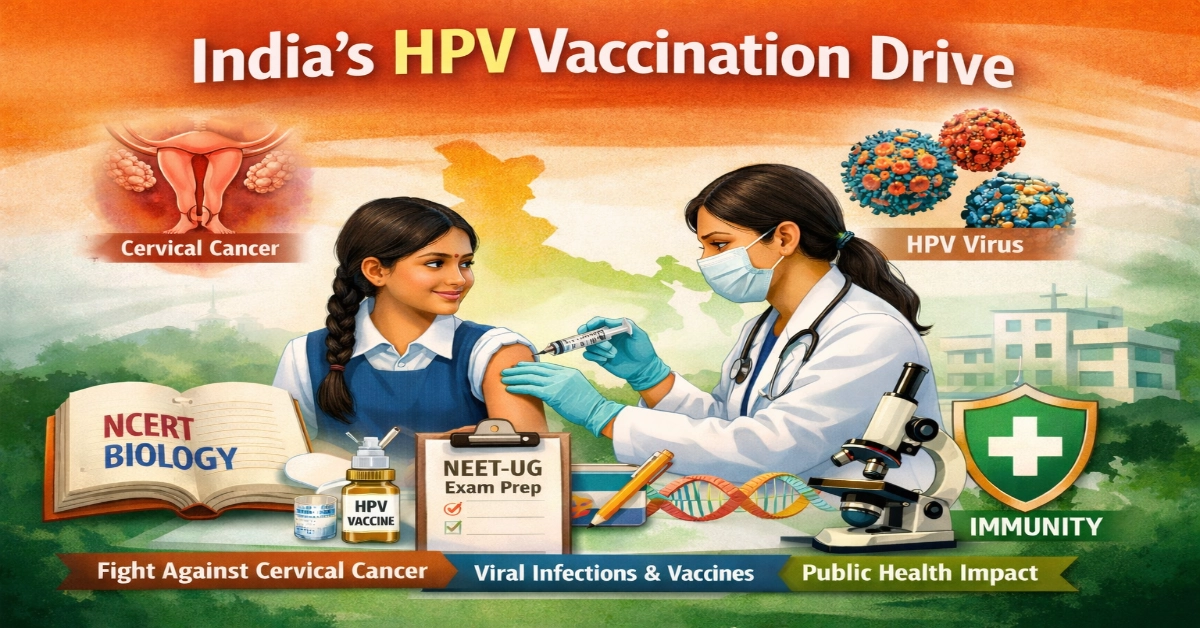
HPV Vaccination Drive in India: India has begun a nationwide Human Papillomavirus (HPV) vaccination programme for adolescent girls, marking a significant public-health move in the fight against cervical cancer, a disease largely caused by persistent HPV infection. The programme targets girls aged around 14 years, offering a free, voluntary single-dose vaccine at government health facilities across the country.
Why HPV Vaccination Matters
HPV is a DNA virus that infects epithelial cells and includes types that are categorized as high-risk for oncogenesis, especially types 16 and 18, which together contribute to over 80% of cervical cancers. Persistent infection with these high-risk strains leads to cellular changes in the cervix, ultimately causing malignancy over a period of years if untreated.
The HPV vaccine works by generating neutralising antibodies against key virus proteins, preventing HPV from establishing infection in cervical epithelial cells. For NEET-UG students, this reflects core immunology principles: active immunisation induces adaptive immunity well before potential exposure, yielding long-lasting protection.
Programme Design & Implementation
- The vaccine (primarily Gardasil-4, a quadrivalent vaccine) protects against HPV types 6, 11, 16, and 18 : covering both cancer-causing and wart-causing strains.
- The vaccination will be administered at government health facilities with the presence of trained medical staff and teams to manage adverse events following immunization (AEFI).
- A single-dose regimen, recommended by the World Health Organization (WHO), will be used.
Cervical cancer remains the second most common cancer among women in India, with tens of thousands of new cases and deaths each year. Vaccination before exposure to HPV dramatically reduces the risk of infection, pre-cancerous lesions, and ultimately cancer itself – making it a primary preventive strategy alongside screening (e.g., Pap smear) and early treatment.
From a NEET-UG perspective, this initiative highlights several key concepts:
 Join NEET News 2026
 - Disease prevention through immunisation
- Role of vaccines in reducing oncogenic infections
- Public health strategies that leverage immunological principles for population-level impact
In many countries, HPV vaccination programmes have already led to significant declines in infection rates and cancer precursors, showcasing the real-world effectiveness of vaccines beyond theory.
Challenges & Considerations
The programme’s success hinges on:
- Maintaining cold-chain storage to preserve vaccine efficacy
- Transparent reporting of adverse events to build public confidence
- Increasing screening uptake, as vaccination does not replace regular cervical screening but complements it.
The initiative focuses on vaccinating adolescent girls to protect them against high-risk strains of the Human Papillomavirus (HPV), a key cause of cervical cancer. From a NEET-UG perspective, the programme highlights important biology concepts such as viral infections, immunity, vaccines, and public health strategies.
