
Important Diagrams For NEET UG 2026 Day 13: Highlighters ready? Brain switched to “exam mode”? It’s time to decode the magic of biology with Important Diagrams for NEET UG 2026 – Day 13! In NEET, diagrams aren’t just drawings – they’re secret score boosters.
One clear look at a well-practiced diagram can help you eliminate options faster than you flip a page! Today, we’re diving into must-know visuals that make concepts stick like glue in your memory. So sharpen your pencils (literally and mentally!) and let’s turn these diagrams into guaranteed marks.
Mendel’s Dihybrid Cross
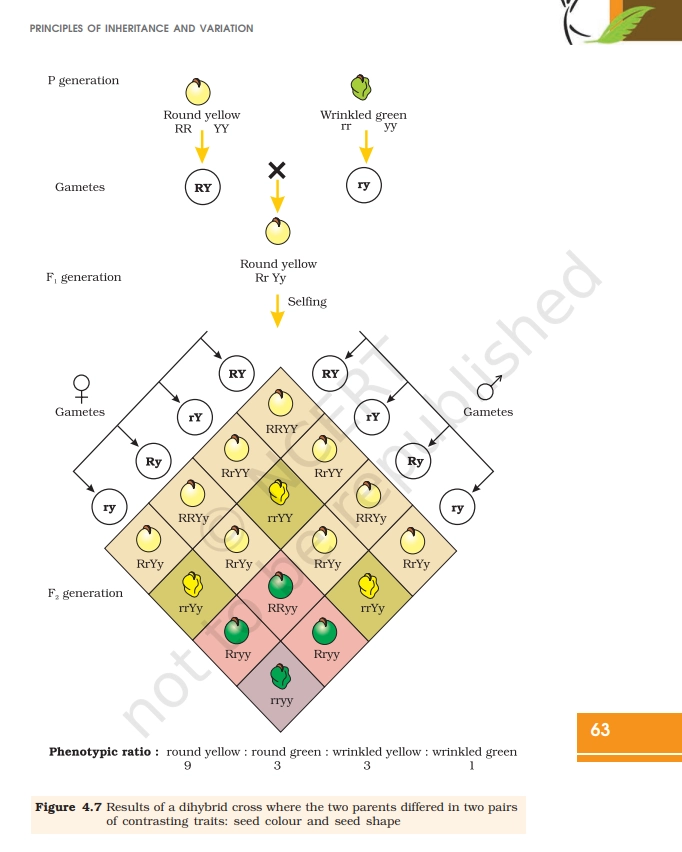
Traits Taken:
Two contrasting traits of pea plant:
- Seed Shape
- Round (R) – Dominant
- Wrinkled (r) – Recessive
- Seed Colour
- Yellow (Y) – Dominant
- Green (y) – Recessive
Parental Generation (P)
- RRYY – Round, Yellow
- rryy – Wrinkled, Green
Both are true breeding (homozygous).
Gamete Formation (Law of Segregation)
- RRYY produces only RY gametes
- rryy produces only ry gametes
Each gamete carries only one allele of each gene.
F₁ Generation
Cross: RY × ry
All offspring: RrYy
- Phenotype: Round Yellow
- Genotype: Heterozygous for both traits
- Shows Dominance (R over r, Y over y)
Selfing of F₁ (RrYy × RrYy)
Now each F₁ produces 4 types of gametes due to independent assortment:
- RY
- Ry
- rY
- ry
Total combinations in Punnett square = 4 × 4 = 16
F₂ Generation Results
Genotypic Ratio (16 total)
- 1 RRYY
- 2 RRYy
- 2 RrYY
- 4 RrYy
- 1 RRyy
- 2 Rryy
- 1 rrYY
- 2 rrYy
- 1 rryy
Phenotypic Ratio (VERY IMPORTANT FOR NEET)
Round Yellow : Round Green : Wrinkled Yellow : Wrinkled Green
9 : 3 : 3 : 1
- 9 Round Yellow
- 3 Round Green
- 3 Wrinkled Yellow
- 1 Wrinkled Green
Law of Independent Assortment
- Alleles of one gene assort independently of alleles of another gene.
- Seed shape inheritance does NOT affect seed colour inheritance.
- Applies when genes are on different chromosomes (or far apart).
Key Points to Remember for NEET UG
- Dihybrid cross phenotypic ratio = 9:3:3:1
- Total F₂ combinations = 16
- Number of gametes formed by RrYy = 4 (2ⁿ, where n=2)
- Independent assortment occurs during Metaphase I of Meiosis
- Test cross of dihybrid (RrYy × rryy) gives 1:1:1:1 ratio
- If genes are linked → 9:3:3:1 ratio will NOT appear
- Formula for gametes = 2ⁿ (n = number of heterozygous gene pairs)
PRACTICE QUESTIONS
Q.1. In a classic Mendelian dihybrid cross between plants heterozygous for both traits, , what is the expected phenotypic ratio in the F generation for seed shape (round vs wrinkled) and seed color (yellow vs green)?
A. 3 round yellow : 1 wrinkled green
B. 1 round yellow : 2 round green : 1 wrinkled green
C. 9 round yellow : 7 wrinkled green
D. 9 round yellow : 3 round green : 3 wrinkled yellow : 1 wrinkled green
Q.2. Which of the following best explains why Mendel used a dihybrid cross to formulate the law of independent assortment?
A. To show that alleles of different genes segregate into gametes independently of one another
B. To prove that dominant alleles are always more frequent in a population than recessive alleles
C. To show that environmental factors have no effect on the expression of traits
D. To demonstrate that traits always blend in the offspring rather than appearing as discrete units
Q.3. In Mendel’s dihybrid cross for seed shape (R = round, r = wrinkled) and seed color (Y = yellow, y = green), what gametes can be produced by a plant with genotype ?
A. Rr, Yy only
B. RY, Ry, rY, ry
C.
D. RY and only
Q.4. If a dihybrid plant is crossed with a homozygous recessive plant , what phenotypic ratio is expected in the offspring, assuming independent assortment and complete dominance?
A. 1 round yellow : 1 wrinkled green
B. 3 round yellow : 1 wrinkled green
C. All wrinkled green
D. 1 round yellow : 1 round green : 1 wrinkled yellow : 1 wrinkled green
Q.5. Which of the following F phenotype combinations represents recombinant types in Mendel’s dihybrid cross for seed shape and seed color, given the parental combination as round yellow and wrinkled green?
A. Round yellow and wrinkled green
B. Round yellow only
C. Round green and wrinkled yellow
D. Wrinkled green only
Read Also: Important Practice Questions For NEET UG 2026 (Day 31)
And that’s a wrap for Day 13! Remember, every diagram you master today is one less thing to panic about tomorrow. Revise them, redraw them, and test yourself until you can visualize them with your eyes closed. Consistency is your superpower, and each small effort brings you one step closer to your NEET dream. See you tomorrow!
We’ve decided to take up just one diagram a day. Why? Because we don’t want to overburden you with too much at once. NEET preparation is a marathon, not a sprint – so let’s move slowly, smartly, and consistently toward success.
All The Best!
ANSWERS & EXPLANATIONS
Ans.1. D. 9 round yellow : 3 round green : 3 wrinkled yellow : 1 wrinkled green. In Mendel’s pea experiments, he chose traits controlled by genes located on different chromosomes so they assorted independently. When two such traits are studied together and both exhibit simple dominance, the expected F2 phenotypic ratio is 9:3:3:1.
Ans.2. A. To show that alleles of different genes segregate into gametes independently of one another. Mendel controlled the environment to minimize its effects so he could clearly observe hereditary patterns. By analyzing the F generation of dihybrid crosses, he noted that combinations of traits appeared with frequencies consistent with independent segregation of gene pairs.
Ans.3. B. RY, Ry, rY, ry. A plant with genotype RrYy has two alleles for each of two genes. During meiosis, one allele from each pair is segregated into each gamete. Due to independent assortment, each R or r allele can combine with each Y or y allele, producing four distinct gamete types.
Ans.4. D. 1 round yellow : 1 round green : 1 wrinkled yellow : 1 wrinkled green. The heterozygous parent passes on dominant alleles to about half of its gametes, ensuring that not all progeny are double recessive. Independent assortment ensures that each combination of alleles (round yellow, round green, wrinkled yellow, wrinkled green) appears with equal likelihood.
Ans.5. C. Round green and wrinkled yellow. Recombinant phenotypes are those that represent new combinations of the traits compared with the P generation. Since the parents had trait combinations of round yellow and wrinkled green, any F individuals showing round green or wrinkled yellow must have received different combinations of alleles, arising from independent assortment.
NEET UG Counselling Guides 2026
State-wise MBBS/BDS Counselling Guide 2026
State-wise counselling & admission guidance
MCC NEET UG Counselling Guide 2026
MCC counselling, choice filling & admission planning
AACCC AYUSH NEET Counselling Guide 2026
AYUSH counselling & admission guidance


Neet
Mam answers please
The answers have been uploaded on the same post. Kindly Refer: https://www.edufever.com/important-diagrams-for-neet-ug-2026-day-13/
So kindful to you edufever & prakriti mam🥺🙏for the support