
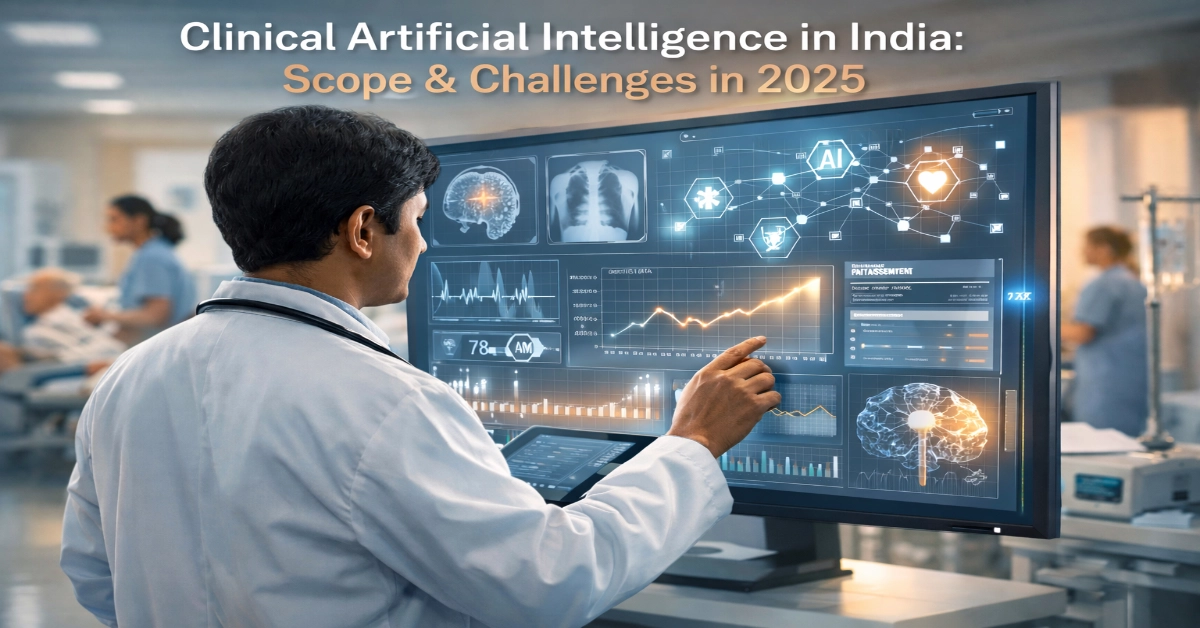
Clinical Artificial Intelligence in India 2025: We are living in a rapidly changing world where Artificial Intelligence (AI) has become an integral part of our daily lives. Today, it helps us solve complex problems, supports doctors in treating patients, and even helps with the early detection of diseases.
Without us realising it, AI has become a quiet companion in our lives, work, education, and everything.
After being associated with academics and researching children, education, and today’s challenges for so long, one thing that kept coming up was the growing role of artificial intelligence in everyday life.

In healthcare, this change is especially visible. AI is now used to suggest diagnoses, support doctors, and guide patients even before they visit a hospital. For many people, it has become the first place they turn to for medical advice.
While this brings many benefits, it also makes us stop and think: should we trust AI completely when it comes to health and life? Can it ever replace a doctor’s experience, judgment, and human care?
 Join NEET News 2026
 Read Also: Doctor Shortage in India 2025: Can AI Bridge the Healthcare Gap Before It’s Too Late?
Clinical AI Revolution In India
In 2025, artificial intelligence (AI) is rapidly reshaping clinical care across the globe and India too. What began as research tools has now emerged into real-world clinical applications across diagnostics, emergency care, disease screening, and administrative work.
AI’s promise to enhance accuracy, reduce costs, and expand access has positioned it at the frontline of India’s healthcare transformation.
From rural districts to urban hospitals, AI technologies are increasingly being deployed to support clinicians, streamline systems, and improve patient outcomes. But as adoption grows, a complex battle emerges between technological promise and real-world challenges unique to India’s healthcare ecosystem.
India is a place of diversity, and complete reliance on AI in the context of healthcare can never be suitable in the Indian context.
AI’s Growing Presence in Indian Clinical Settings
AI Supporting Early Diagnosis and Screening
AI-assisted tools are already improving the detection of diseases like tuberculosis and stroke across India. For example, several districts in Rajasthan are deploying AI-enabled portable X-ray machines to detect TB in underserved rural areas, significantly speeding up diagnosis where radiologists are scarce. (The Times of India)
Similarly, AI-powered stroke detection systems are helping clinicians act within the critical “golden hour,” increasing survival rates and reducing long-term disability. (The Economic Times)
Centres of Excellence and National Initiatives
To accelerate home-grown innovation, the Government of India has established dedicated AI research hubs like the Translational AI for Networked Universal Healthcare (TANUH) Foundation at IISc Bengaluru. This centre focuses on developing AI tools for early disease detection, personalised care, and frontline health support.
Other public-private initiatives are also partnering to improve physician education and digital content delivery using AI, such as the AI-based medical content hub launched in Mumbai by Bristol Myers Squibb in collaboration with Accenture.
Clinical Support and Hospital Workflows
Leading hospital networks, including large private systems, are integrating AI to reduce clinician workload, digitise medical documentation, and support decision-making. These tools automate routine tasks and allow doctors to focus more on direct patient care.
Apart from these, during COVID times, we all witnessed AI deployed in hospitals to check temperature, take samples for COVID tests.
AI’s Scope In India
India’s healthcare system faces fundamental constraints, uneven distribution of specialists, lack of diagnostic infrastructure in rural areas, and high patient loads in urban hospitals. AI presents a strategic tool to overcome these barriers.
Read Also: AI in NEET UG 2026 Preparation: Can it Replace Coaching Institutes?
What AI Can Change
- Enhanced Screening & Diagnostics: AI models can analyse, scan and clinical data faster than traditional workflows, improving early disease detection. This could be a very promising scope, especially in rural areas and also during pandemic times.
- Bridging Workforce Gaps: With a limited doctors-to-population ratio, AI can assist healthcare workers in decision-making. Help increase the potential of healthcare workers.
- Rural Healthcare Reach: Predictive AI and telemedicine platforms can extend specialist expertise to remote communities.
- Streamlined Administration: Automating record-keeping and administrative burden allows clinical staff to prioritise patient care more effectively.
Read Also: India’s 1:811 Doctor-Population Ratio Explained: The Flaws in the Government’s Claim
Challenges in India’s Clinical AI Journey
Reading the above scopes, one might have felt overwhelmed and enthusiastic. With scope AI comes challenges, especially in the healthcare sector, where lives are at stake.
1. Data Quality, Privacy & Security
AI depends on large, well-labelled datasets. India’s fractured digital health infrastructure, with many paper records and failed systems, makes data aggregation difficult. Moreover, privacy concerns and the lack of AI-specific regulation present a significant risk.
Although the Digital Personal Data Protection Act, 2023 seeks to strengthen privacy, comprehensive enforcement in clinical settings remains a work in progress.
2. Infrastructure & Rural Divide
Advanced AI tools require connectivity, digital devices, and reliable electricity conditions still lacking in many Tier-2 and rural centres. Without infrastructure development, AI’s benefits may remain concentrated in urban hospitals only.
3. Trust and Adoption in Clinical Practice
Indian clinicians are optimistic about AI’s potential but express concerns about transparency, liability, and impact on clinical autonomy. Trust in AI systems hinges on clear regulatory pathways and demonstrable real-world performance.
4. Workforce Skills Gap
Effective use of AI requires training clinicians in digital literacy and interpretation of AI recommendations, a capability still evolving in India’s medical education.
5. Lack of Accountability
In medicine, numerous lives are at stake; we cannot risk them to AI, as holding AI accountable for its actions is not a solution, also it’s more on the impossible side. Who would take responsibility for AI’s actions?
AI comes with its own benefits can challenges, so replacing healthcare professionals with AI can never be on the list. AI can be used merely to assist healthcare professionals, but not as their replacements.
The Road Ahead
As India scales its clinical AI ambitions, the journey will likely be defined by both collaboration and cautious innovation:
- Public-Private Collaboration: Joint work between government bodies, academic centres, startups, and hospitals can accelerate technology development tailored to India’s context.
- Ethical Frameworks & Governance: Clear policies on data use, algorithmic fairness, and clinical accountability will build trust among patients and providers.
- Localised Solutions: AI systems designed with Indian demographics, languages, and disease patterns will improve accuracy and equity.
- Scalable Infrastructure: Investment in digital health records, broadband, and cloud computing across districts can democratise AI benefits.
- Using AI as an Assistant, Not a Replacement: It is important to pause and think that AI must never replace healthcare professionals and experts.
As we come to the end of this article, I sincerely request every reader to remember that artificial intelligence is meant to assist us, not replace experts in any field. AI can support decisions, but it can never replace expert opinion, especially in healthcare.
When it comes to matters of health and life, there is no substitute for a trained medical professional. AI may guide, but care, responsibility, and final decisions must always remain in human hands.
