
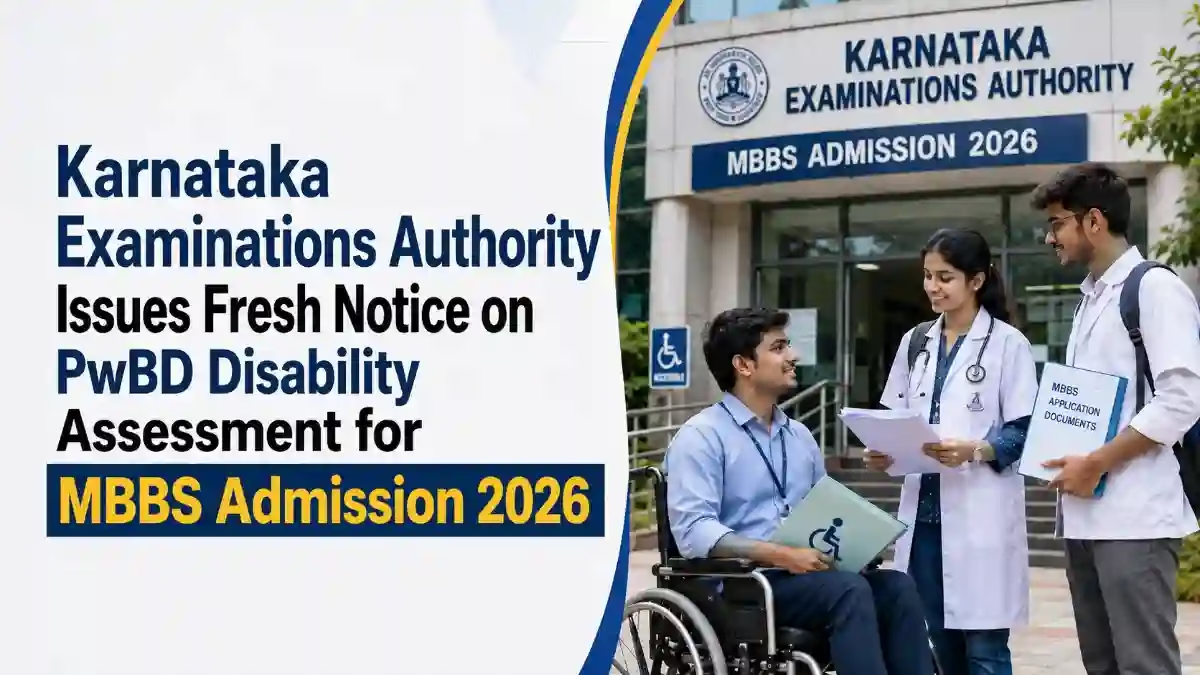
The Karnataka Examinations Authority (KEA) has issued a public notice directing candidates with benchmark disabilities (PwBD) seeking admission to the MBBS course under the CET-2006 rules to get their eligibility assessed strictly as per the National Medical Commission’s (NMC) “Guidelines on Assessment of Persons with Benchmark Disabilities (PwBD) for Admission to the MBBS Course, 2026,” referenced in the NMC’s Undergraduate Medical Education Board (UGMEB) communication dated July 30, 2026.
What the KEA Notice Says
As per the notice issued by KEA’s Executive Director, candidates claiming eligibility for a PwBD medical seat in Karnataka’s counselling – irrespective of whether they are seeking their eligibility certificate under the previous CET-2006 disability rules – must obtain their Schedule-II eligibility certificate under the 2026 guidelines and submit it at the time of admission to the allotted college. Each certificate must carry the candidate’s CET application number and NEET roll number.
Candidates are required to submit the following set of documents:
- Appendix-A – mandatory for every PwBD applicant
- Appendix-B to Appendix-F – as applicable, depending on the specific disability category declared
Background: How the PwBD Assessment Framework Changed
The current framework traces back to an NMC communication issued in July 2025, following the Supreme Court’s judgment in Om Rathod vs. Union of India & Ors. (SLP (C) No. 21942 of 2024, dated October 25, 2024). The Court’s ruling prompted the NMC to reconstitute an expert committee – chaired by Dr. Achal Gulati – to revisit Appendix H-1 of the 2019 Disability Guidelines originally issued by the Medical Council of India, and to bring the assessment process in line with the Rights of Persons with Disabilities (RPwD) Act, 2016, and the Ministry of Social Justice and Empowerment’s (MoSJE) notification of March 12, 2024.
The most significant change under the interim framework: the previously mandated fixed disability-percentage threshold no longer applies. In its place, the NMC has moved to a functional competency approach, under which a candidate’s eligibility is assessed on their actual ability to perform the tasks required of a medical student and practitioner, rather than a rigid percentage cut-off on their disability certificate.
How the Assessment Process Works
Under the interim guidelines, PwBD candidates are required to:
- Hold a valid UDID (Unique Disability ID) card, issued through the mandatory UDID online portal per the Department of Empowerment of Persons with Disabilities’ gazette notification of May 5, 2021.
- Submit self-certified affidavits in the prescribed format (Schedule-I), declaring the specific functional competencies they possess – covering areas such as communication, hearing, dominant-hand functionality, comprehension, and vision, depending on the disability category.
- Report in person to one of 16 designated medical boards for verification of the declared affidavit.
The designated medical boards are tasked with verifying whether a candidate’s self-declared competencies hold up on examination. If a board finds that a declared competency is not substantiated, it must issue a reasoned, speaking order declaring the candidate ineligible – a blanket rejection without justification is not permitted. Where a candidate cannot demonstrate a listed competency but can show they compensate for it through an alternative functional ability, the board is directed to take a holistic view of the candidate’s overall capability to pursue the MBBS course, rather than disqualifying them on that single criterion.
 Join NEET News 2026
 Final admission will be processed by the counselling authority based on NEET scores, institutional/category preferences, and the designated medical board’s verification outcome, after which medical colleges are expected to provide reasonable accommodations to admitted PwBD students.
Institutional Obligations
The interim guidelines also spell out what medical colleges are expected to do under the RPwD Act, 2016, including:
- Ensuring no PwBD candidate is denied admission solely on the ground of disability
- Providing barrier-free access to classrooms, laboratories, libraries, and hostels
- Running sensitisation and capacity-building programmes for faculty and staff
- Appointing a Nodal Officer or setting up a Disability Cell for PwBD students
- Maintaining an accessible grievance redressal mechanism
What This Means for Candidates
For NEET UG 2026 candidates applying under the PwBD category – in Karnataka and other states following the NMC framework – this means the self-certification and medical-board verification process, not just the raw disability percentage on their UDID card, will determine their eligibility for an MBBS seat. Candidates are advised to keep their UDID card, Schedule-I affidavits, and any assistive-device documentation ready well before their scheduled counselling round, and to report to their designated medical board promptly once intimated, since delays in verification can affect seat confirmation within tight counselling timelines.
NEET UG Counselling Guides 2026
State-wise MBBS/BDS Counselling Guide 2026
State-wise counselling & admission guidance
MCC NEET UG Counselling Guide 2026
MCC counselling, choice filling & admission planning
AACCC AYUSH NEET Counselling Guide 2026
AYUSH counselling & admission guidance
