
The statement made by YSRCP MLC Kumbha Ravibabu, claiming that the privatization of government medical colleges built during Y.S. Jagan Mohan Reddy’s tenure is against the principles of the Indian Constitution, shows a serious misinterpretation of constitutional values and legal realities.
While the Indian Constitution clearly emphasizes social welfare, access to education, and public health, it does not require that all educational or healthcare institutions must be owned or administered only by the government.
Claiming the opposite, referring to the constitution, is an incorrect interpretation of constitutional provisions and also misleading.

To understand the truth, we must look at what the Constitution actually says:
The Constitution Does Not Guarantee “Free” Medical Education for All
Kumba Ravibabu, in his statement, said that the privatization of medical colleges is against the principles of the Indian Constitution, which strongly advocates free education and health for all citizens of India.
 Join NEET News 2026
 The claim that the Constitution “strongly encourages free education and health for all citizens” is a misrepresentation of the law.
Indeed, under the Directive Principles of State Policy, the Constitution promotes the State to enhance public health and education. However, these rules do not restrict the involvement of private institutions.
It is also important to make it clear that the Constitution only provides free education up to the primary level (Article 21A). Free medical education and free higher education are not specified under this article of the Constitution.
In India, public medical education has never been the only option. Private medical colleges have existed for decades, under every government, across parties, without being declared unconstitutional.
To suddenly label them as violators of constitutional principles is dishonest and misleading for both the aspirants as well as other citizens.
Privatisation Is Constitutionally Protected, Not Prohibited
Rather than opposing privatization, the Constitution of India supports it. Article 19(1)(g) guarantees the right to carry on any occupation or profession, including running educational institutions, subject to reasonable regulation.
The Supreme Court has repeatedly upheld the legitimacy of private and deemed medical colleges, provided they adhere to regulatory standards.
Hence, calling privatisation unconstitutional is a significant misinterpretation.
Financial Constraints Are a Reality, Not a “Pretext”
Kumbha Ravibabu, in his statement, also mentioned that the lack of funds is only a pretext to privatise the medical colleges.
The claim that lack of funds is merely a “pretext” to privatise medical colleges reflects either ignorance or wilful denial. Running a medical college is one of the most resource-intensive responsibilities any government can undertake.
It requires:
- Continuous investment in hospitals and equipment
- Competitive salaries to keep qualified faculty
- Constant upgrades to meet NMC regulations & norms
- Operational funding year after year
- Constant funding to include advanced technologies.
Welfare programs, infrastructure development, debt repayment, and salaries already put a lot of burden on state governments. Pretending that finances are irrelevant is politically very easy to ignore, but administratively misleading.
No responsible policymaker should deny the reality that governments alone cannot constantly fund, staff, and upgrade every medical college without private participation.
The Capacity Crisis Is the Real Issue
India continues to face a serious shortage of doctors, medical specialists, and medical seats. Every year, more than 23 lakh students appear for medical entrance exams, but only a small percentage manage to secure seats in government medical colleges.
This huge gap between demand and availability creates high competition and stress for aspirants.
Read Also: India’s 1:811 Doctor-Population Ratio Explained: The Flaws in the Government’s Claim
If private medical colleges were not part of the system, the situation would become even worse. The number of MBBS seats would grow very slowly, making it even harder for deserving students to get admission.
Many students would be forced to go abroad for medical education, spending huge amounts of money and often facing challenges related to recognition and quality.
At the same time, rural and underserved areas would suffer the most, as fewer doctors would be trained to serve these regions.
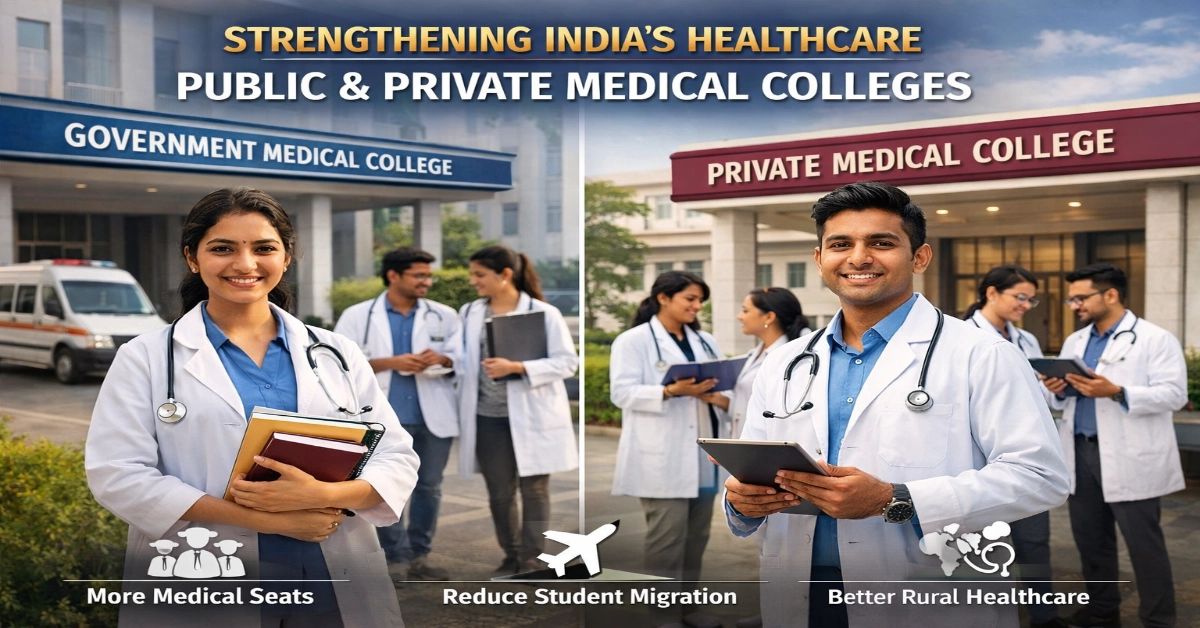
Private medical colleges help bridge this gap by increasing seat availability and supporting healthcare infrastructure. They complement government efforts and play an important role in meeting India’s growing healthcare needs.
Ultimately, medical colleges, whether run by the government or private institutions, should be evaluated on how well they educate students, the quality of doctors they produce, how accessible they are, and how effectively they serve patients. The focus should be on quality, regulation, and outcomes, not on ownership or political ideology.
A strong healthcare system needs both public and private institutions working together, not competing against each other.
Politicising Medical Education Harms Students
Turning medical education into an ideological battleground is a disservice to students and patients. Public colleges built with taxpayer money must be protected and strengthened, but that does not require opposing private participation.
Read Also :NEET and Mental Health: The Hidden Struggle Behind the Dream
The real debate should focus on:
- Strong regulation
- Fee transparency
- Quality enforcement
- Faculty standards
- Rural healthcare outcomes
Not constitutional misinterpretations designed for a political vote bank.
A Balanced Approach
Invoking the Constitution to oppose the privatisation of medical colleges may sound politically appealing, but it completely ignores the practical reality.
The Constitution does not prohibit private medical education. Even the Courts do not prohibit it. India’s healthcare needs cannot survive without both public and private participation in it.
A mature democracy does not oppose public and private institutions against each other. It regulates both, strengthens both, and holds both accountable.
The importance of medical education cannot be compromised for the sake of political statements and ideologies. Facts, law, and national interest must prevail over misleading statements.
Read Also: Top 5 Star-Performing Medical Colleges in MCC 2025 Counselling
