
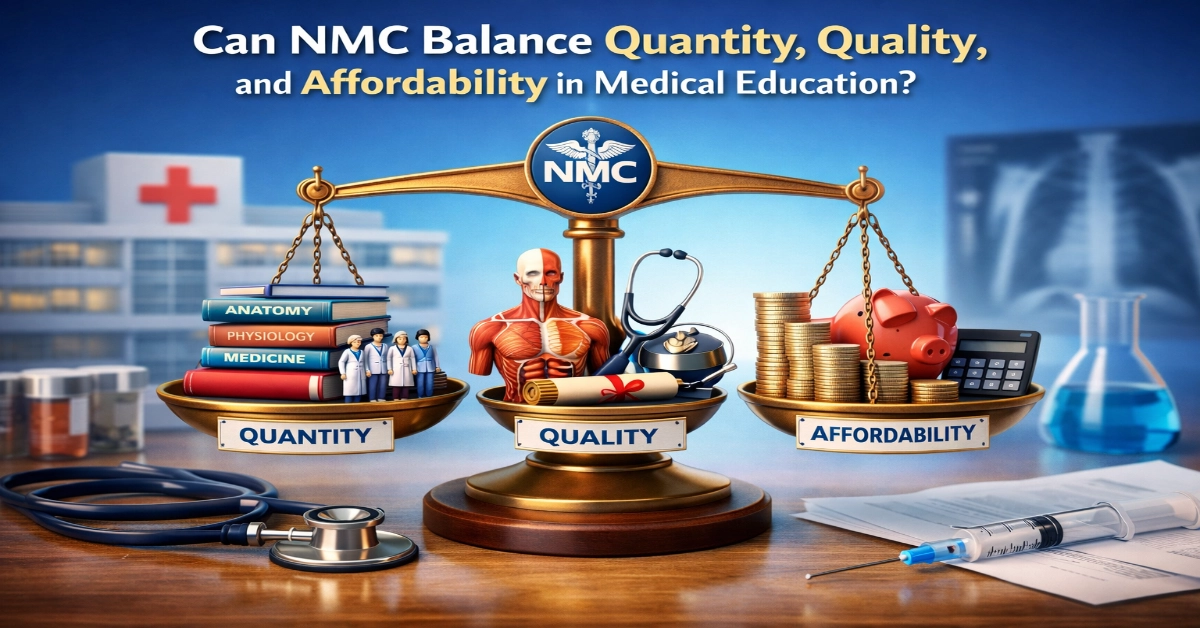
Every year, lakhs of capable students compete in one of the world’s toughest entrance examinations, only to discover that merit alone no longer guarantees access to medical education. With an ever-growing population, rising disease burden, and a chronic shortage of doctors, especially in rural and underserved regions, the demand for more medical seats has never been higher.
At the centre of this challenge stands the National Medical Commission (NMC), expected to manage competing priorities that are hard to achieve at the same time. increase the number of doctors (quantity), maintain global standards (quality), and ensure that medical education remains financially accessible (affordability).
The important question is – Can NMC Balance Quantity, Quality, and Affordability in Medical Education? All three at the same time.

The Quantity: More Seats, More Colleges
In the last ten years, India has focused heavily on increasing the number of medical seats. Many new medical colleges have been established across the country, and this growth has been especially fast in the private sector. At the same time, the government has started medical colleges in district hospitals, which have added thousands of new MBBS seats every year.
Read Also: Top 10 NMC Reforms Needed in Medical Education: From a Student’s Perspective
 Join NEET News 2026
 At first, this rapid expansion looks like a positive step. More colleges mean more seats, and more seats mean more doctors. On paper, India has now achieved the World Health Organization’s recommended doctor-to-population ratio. These numbers are often used to show progress in healthcare planning.
However, numbers do not tell the real story. Simply increasing the number of seats does not automatically improve healthcare access. A medical college is not just a building; it needs enough trained teachers, proper hospitals with real patients, good laboratories, and a strong learning environment. When colleges are opened too quickly, these basic requirements are often not fully in place.
The bigger concern is that expansion has moved faster than regulation. When oversight is weak, quality suffers. Students may graduate with degrees, but without enough hands-on training or clinical experience. This affects not only students, but also patients who depend on well-trained doctors.
In short, increasing quantity without strict monitoring creates a risky situation. Without strong regulation and continuous supervision, more medical colleges may produce more graduates, but not necessarily better doctors or better healthcare. Recent spam controversies around medical colleges clearly highlight this concern.
Quality Under Pressure: Are Standards Slipping?
Medical education is much more than classrooms, lecture halls, or modern buildings. It depends on having enough experienced teachers, a steady flow of patients for training, proper clinical exposure, a culture of research, and strong ethical values.
These are the foundations of good medical education. However, the rapid expansion of medical colleges has put heavy pressure on all these areas.
One of the biggest problems is the shortage of qualified faculty. When new colleges open quickly, there are often not enough experienced doctors available to teach. As a result, the same teachers are stretched across multiple responsibilities, affecting the quality of teaching.
Another major concern is limited clinical exposure, especially in newly established colleges. Medical students need real patient interaction to learn diagnosis and treatment. When hospitals do not have enough patients, students miss out on hands-on training, which is essential for becoming competent doctors.
Read Also: NMC New Year Resolutions 2026: What the Medical Education Regulator Must Fix First
There is also an overdependence on periodic inspections. Inspections may check records and infrastructure, but they cannot fully measure day-to-day teaching quality. Without regular monitoring and follow-up, problems often remain hidden until they become serious.
The National Medical Commission has introduced reforms such as CBME, the proposed NEXT examination, and digital inspections with the aim of improving standards.
However, critics argue that these reforms look stronger on paper than in practice. Policies alone are not enough if they are not applied equally and enforced strictly across all colleges.
Without clear rules, regular monitoring, and transparent action against shortcomings, quality is at risk of becoming the first victim of rapid expansion. If standards continue to slip, the impact will be felt not only by students, but by the healthcare system and patients as well.
The Affordability: Education at a Cost
Perhaps the most important issue is affordability. With the growth of medical colleges, MBBS fees have significantly increased, often running into crores of rupees for the full course. For middle-class families, medical education increasingly feels like a luxury rather than a merit-based opportunity.
Although some states regulate fees and the NMC has issued advisory guidelines, there is no national mechanism to ensure uniform affordability.
High fees also raise ethical concerns:
- Does financial capacity overshadow merit?
- Will heavily indebted graduates avoid public service or rural postings?
- Does expensive education create inequality within the medical profession itself?
Unless affordability is addressed seriously, increasing seats may only widen social and economic divides.
The NMC’s Dilemma: Regulator or Reformer?
The NMC was established as a reform-oriented replacement for the Medical Council of India (MCI), free from corruption and inefficiency. However, balancing three competing priorities is easier said than done.
Read Also: NMC Global Accreditation Strengthens Medical Education and Research in India
To succeed, the NMC must:
- Link seat expansion strictly to infrastructure, faculty, and patient load
- Adopt continuous, technology-driven quality audits
- Ensure transparent and enforceable fee regulation
- Strengthen both public and private medical colleges
- Align medical education with national healthcare needs.
Without this balance, the system risks producing either too few doctors, poorly trained doctors, or doctors affordable only to the wealthy.
Quantity, quality, and affordability in medical education cannot be achieved merely by granting approvals or issuing advisory guidelines. They demand continuous and active enforcement of standards, clear and transparent penalties for violations, and a regulatory approach that places students and public interest at the centre of every decision.
Most importantly, the regulator must be willing to step in firmly when standards are compromised, rather than limiting its role to giving permissions on paper.
If the National Medical Commission continues to act mainly as an approving authority instead of a true public guardian, medical education will remain costly, unequal, and inconsistent, regardless of how many new seats are added.
Regulatory power without responsibility is not reform – it is a failure to act.
Read Also: ‘Unconstitutional’ or Misleading? The Truth About Medical College Privatization
