
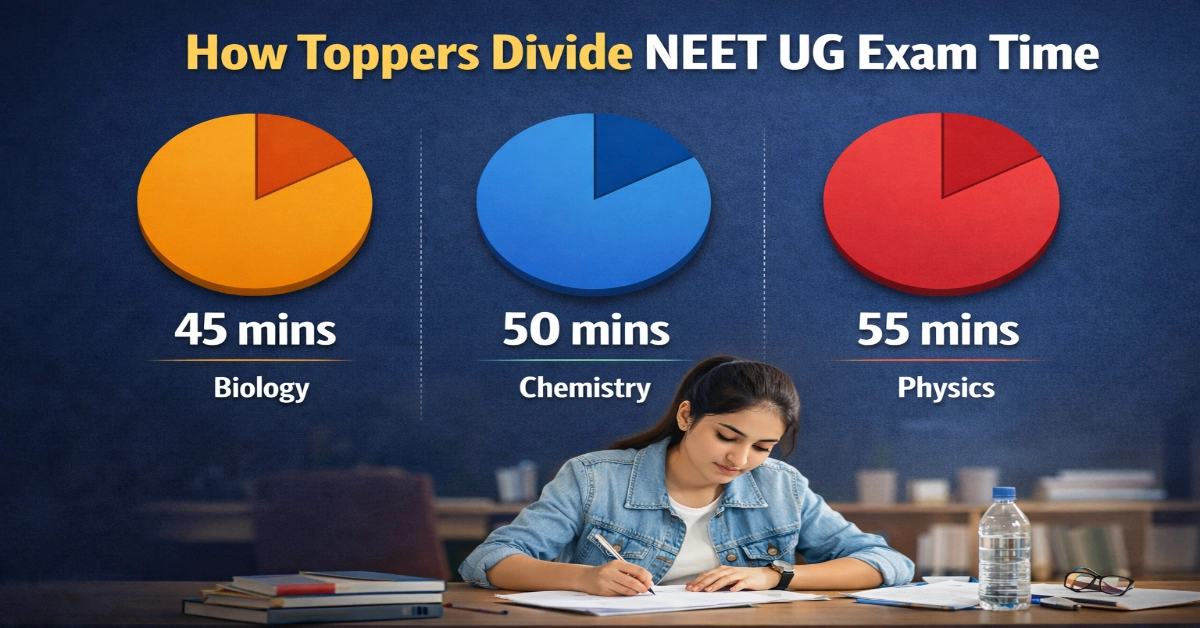
NEET UG Exam: NEET UG is not merely a test of academic preparation; it is a real-time decision-making challenge where time pressure plays a decisive role. Every year, thousands of capable aspirants lose valuable marks because they fail to manage the clock effectively. Toppers, however, approach the exam with a pre-planned time-division strategy that allows them to stay calm, accurate, and focused throughout the 3 hours.
Here is a section-wise breakdown of how NEET toppers divide their exam time:
Why Time Division Is Crucial in NEET UG
NEET offers a large number of questions within a limited timeframe, creating the illusion that speed alone will ensure success. In reality, the exam rewards a balanced approach, knowing when to move fast and when to slow down. Toppers recognize that every question does not deserve equal time. Some questions can be solved in seconds, while others can drain minutes with minimal reward.

Instead of reacting impulsively during the exam, toppers enter the hall with a pre-decided time framework. This reduces panic, prevents early burnout, and ensures that no single section dominates their mental energy.
Key points toppers understand early:
 Join NEET News 2026
 - Time lost is harder to recover than a skipped question
- Accuracy matters more than attempts
- A calm start leads to a controlled finish
Biology: The Confidence-Building Section (65-70 Minutes)
Biology carries the maximum weightage in NEET and is largely NCERT-driven, making it the most scoring section for well-prepared students. Toppers almost always begin their paper with Biology to settle into the exam rhythm and build early confidence. The questions are reading-based rather than calculation-heavy, allowing for faster completion.
Instead of overthinking, toppers rely on familiarity with NCERT lines and diagrams. They avoid spending excessive time on assertion-reason or confusing statements in the first round, marking them for review instead.
How toppers manage Biology time:
- Start the paper with Biology
- Target quick, direct questions first
- Avoid revisiting the same question repeatedly
- Finish in one strong, continuous flow
Chemistry: Smart Balancing of Speed and Logic (40-45 Minutes)
Chemistry is treated as a middle-ground section, faster than Physics but more thinking-oriented than Biology. Toppers divide this section internally. Inorganic and Organic Chemistry are usually attempted first because they rely on memory, reaction understanding, and NCERT facts rather than lengthy calculations.
Physical Chemistry numericals are approached later and only if the solution path is clear. Toppers avoid spending more than a minute on any numerical in the first round, knowing that time mismanagement here can affect the entire paper.
Chemistry time strategy includes:
- Inorganic and Organic first
- Physical numericals in the second pass
- Skipping calculation-heavy traps early
- Maintaining steady pace without rushing
Physics: The Most Controlled Section (50-60 Minutes)
Physics is where most students struggle, not because of difficulty alone, but because of poor time management. Toppers treat Physics with caution and discipline. They identify formula-based, direct questions and solve them first to secure easy marks. Lengthy numericals should be skipped in the initial pass.
Rather than aiming to attempt every Physics question, toppers aim for maximum accuracy with minimum stress. They know that solving fewer questions correctly is better than attempting many with errors.
Physics strategy used by toppers:
- Solve direct and one-step questions first
- Skip multi-step numericals initially
- Avoid rechecking calculations repeatedly
- Return only if time permits
The Two-Round Attempt Strategy
Toppers rarely attempt the paper in a single straight run. Instead, they divide their attempt into two rounds. The first round is about securing safe marks, while the second is about intelligent risk-taking.
In Round 1, toppers focus only on questions they are confident about. This builds momentum and ensures that a major portion of the paper is completed calmly. Round 2 is reserved for moderately difficult or time-consuming questions that were marked earlier.
Two-round strategy highlights:
- Round 1: Sure-shot questions only
- No guessing or overthinking early
- Round 2: Controlled attempts using elimination
- Avoid emotional decision-making
Read Also: The Hidden Role of Guesswork in NEET
Last 10-15 Minutes: Where Ranks Are Protected
The final minutes of the NEET exam are not meant for solving new questions. Toppers use this time as a safety buffer. They carefully check OMR responses, ensure correct bubbling, and review marked questions if needed.
Many rank losses happen due to careless OMR mistakes, not lack of knowledge. Toppers protect their hard-earned marks by staying disciplined till the end.
Final-minute rules toppers follow:
- No new risky attempts
- Careful OMR verification
- Calm, error-free finishing
How to Practise This Time Strategy Before NEET
This strategy is not built overnight. Toppers practise the same time division repeatedly during mock tests so that it becomes instinctive on exam day. They analyse where time is wasted and consciously adjust pacing in subsequent mocks.
By exam day, their brain follows the time structure automatically, freeing them to focus on accuracy and clarity rather than the clock.
Read Also: How Many Questions Should You Leave in NEET 2026 to Maximize Score?
Final Takeaway
NEET UG rewards those who respect time as much as knowledge. Toppers don’t rush, panic, or chase every question. They move with clarity, skip wisely, and return strategically. With consistent mock practice and a well-defined time-division plan, even average students can significantly improve their performance.
In NEET, how you use your time often decides your rank more than how much you know.
GOOD LUCK!!
