
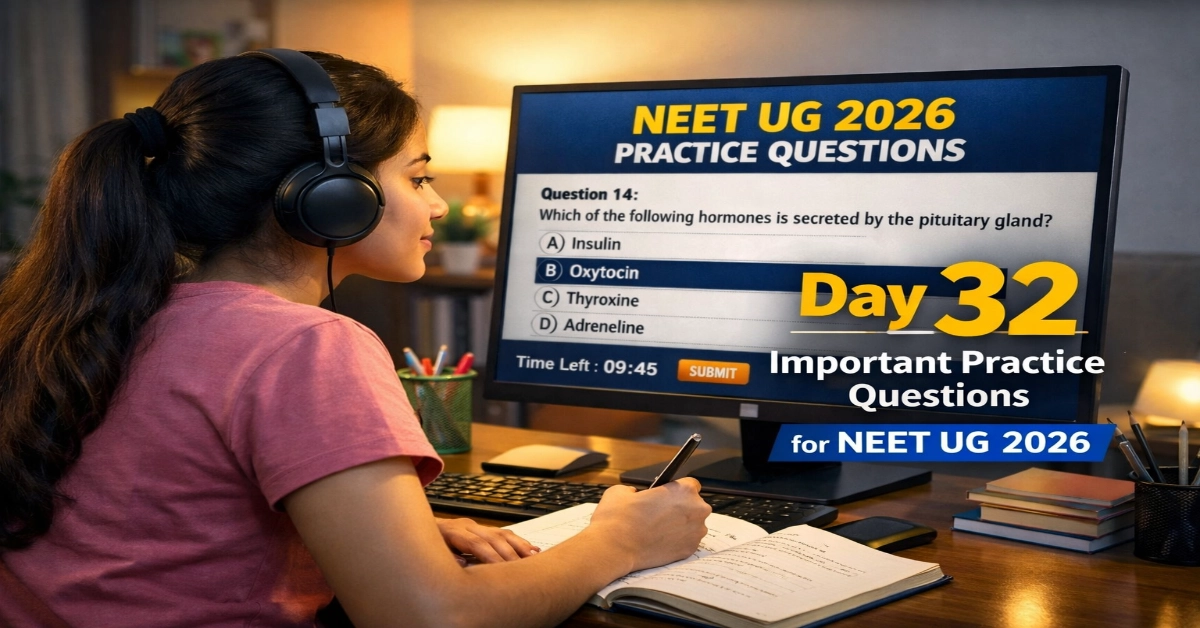
Important Practice Questions For NEET UG 2026 (Day 32): Hello, future doctors! Day 32 of our practice series is here, and guess what? Every single MCQ you solve today is one step closer to your dream medical college. Remember, NEET is not about studying everything in one go; it’s about consistent daily practice, sharp revision, and learning from mistakes. So grab your notebook, set your timer, and let’s train your brain to think like a topper!
BIOLOGY
Q.1. In a healthy nephron, which process is primarily responsible for the selective reabsorption of glucose from the filtrate back into the blood?
A. Ultrafiltration across the glomerular capillaries
B. Active transport in the proximal convoluted tubule
C. Facilitated diffusion in the loop of Henle
D. Simple diffusion along its concentration gradient
Q.2. In a pedigree for an autosomal recessive disorder, two unaffected parents have an affected child. Which of the following conclusions is most consistent with this observation?
A. Both parents are heterozygous carriers for the recessive allele
B. The disorder must be X-linked recessive
C. One parent is homozygous recessive and the other is heterozygous
D. Both parents are homozygous dominant for the disease locus
Q.3. In mitochondrial oxidative phosphorylation, the primary role of the electron transport chain is to:
A. Directly synthesize ATP from ADP and
B. Break down glucose into pyruvate
C. Convert lactic acid back into glucose
D. Pump protons across the inner membrane to create a proton gradient
Q.4. Which of the following is an example of passive immunity?
A. Activation of T-cells after infection
B. Clonal selection of B-cells producing memory cells
C. Antibody production after vaccination with a weakened pathogen
D. Transfer of maternal antibodies to the fetus through the placenta
Q.5. Which plant hormone is primarily responsible for promoting cell elongation in stems and is also involved in phototropism and apical dominance?
A. Auxin
B. Gibberellin
C. Cytokinin
D. Abscisic acid
Q.6. During DNA replication in prokaryotes like , which enzyme is primarily responsible for synthesizing the leading strand continuously in the direction?
A. DNA polymerase III
B. Primase
C. DNA polymerase I
D. DNA ligase
Q.7. In a typical C3 plant leaf, which of the following processes directly produces the first stable organic product of photosynthesis, and where does this reaction occur?
A. Carboxylation of ribulose-1,5-bisphosphate by RuBisCO in the stroma of chloroplasts
B. Photolysis of water on the inner side of the thylakoid membrane
C. Reduction of 3-phosphoglycerate to glyceraldehyde-3-phosphate in the cytoplasm
D. Carboxylation of phosphoenolpyruvate in mesophyll cytosol
Q.8. Which of the following best explains why the action potential travels in one direction along a myelinated motor neuron?
A. Neurotransmitters are released only at dendrites, not at axon terminals
B. Refractory period of previously depolarized segments prevents back propagation
C. Myelin sheath only allows ions to move in one direction
D. Voltage-gated potassium channels are absent in the axon hillock
Q.9. A population of beetles lives on a group of islands separated by narrow but deep channels of water. Over many generations, distinct species arise on different islands. Which evolutionary mechanism most directly explains this pattern?
A. Allopatric speciation via geographic isolation
B. Genetic drift in a single panmictic population
C. Stabilizing selection
D. Sympatric speciation through polyploidy
Q.10. Which of the following best describes the role of the loop of Henle in mammalian kidneys?
A. It creates and maintains an osmotic gradient in the medulla, enabling concentrated urine formation
B. It is the primary site of ultrafiltration of blood plasma
C. It actively secretes glucose into the filtrate to maintain blood sugar homeostasis
D. It stores urine temporarily before it enters the ureter
CHEMISTRY
Q.11. A 0.1 solution of a weak monoprotic acid HA has a pH of 4. What is the approximate acid dissociation constant of HA at this concentration?
A.
B.
C.
D.
Q.12. Which of the following best explains why the oxygen dissociation curve of hemoglobin is sigmoidal rather than hyperbolic?
A. Buffering action of bicarbonate ions in blood
B. Presence of iron in the heme group
C. High solubility of oxygen in plasma
D. Cooperative binding of oxygen to hemoglobin subunits
Read Also: Important Practice Questions For NEET UG 2026 (Day 31)
Q.13. Which statement correctly describes the hybridization and geometry of carbon in ethene ?
A. Each carbon is sp-hybridized with linear geometry
B. Each carbon is -hybridized with tetrahedral geometry
C. One carbon is – and the other is -hybridized
D. Each carbon is -hybridized with trigonal planar geometry
Q.14. In mitochondrial oxidative phosphorylation, the primary role of the electron transport chain is to:
A. Directly synthesize ATP from ADP and
B. Break down glucose into pyruvate
C. Convert lactic acid back into glucose
D. Pump protons across the inner membrane to create a proton gradient
Q. 15. Which of the following aqueous solutions will have the highest boiling point, assuming ideal behavior and complete dissociation where applicable?
A. Pure water
B. 0.1 glucose
C. 0.1
D. 0.1 NaCl
PHYSICS
Q.16. A ball is thrown vertically upward with an initial velocity of . Neglecting air resistance and taking , what is the maximum height reached by the ball?
A. 40 m
B. 20 m
C. 30 m
D. 10 m
Q.17. A wire of length and resistance is stretched uniformly so that its length becomes . What will be its new resistance, assuming the volume remains constant?
A. R
B.
C. 4R
D. 2R
Q.18. Two resistors of and are connected in parallel, and this combination is then connected in series with a resistor. What is the equivalent resistance of the entire circuit?
A.
B.
C.
D.
Q.19. A ray of light passes from air into glass at an angle of incidence of . What is the angle of refraction in the glass (approximately)?
A.
B.
C.
D.
Q.20. A projectile is fired horizontally with speed from the top of a cliff of height . Neglecting air resistance, which of the following correctly gives the time taken to reach the ground and the horizontal range?
A. Time ; Range
B. Time ; Range
C. Time ; Range
D. Time ; Range
And that’s a wrap for Day 32! If you found a question tricky, don’t worry – that’s exactly how growth happens. Go through the solutions carefully, understand where you slipped, and make a quick revision note.
Small improvements every day lead to big results on exam day. Stay consistent, stay confident, and I’ll see you tomorrow for Day 33. Your MBBS seat is waiting!
Comment Your Scores Below!
Read Also: Important Diagrams For NEET UG 2026 Day 13
Answers & Explanations
Ans.1. B. Active transport in the proximal convoluted tubule. In this segment, glucose is selectively and efficiently reabsorbed via Na+-glucose symporters that rely on an energy-driven sodium gradient. This mechanism allows the nephron to recover nearly all filtered glucose so that none appears in the urine under normal conditions, illustrating how specific segments of the nephron have specialized roles.
Ans.2. A. Both parents are heterozygous carriers for the recessive allele. Two carriers have a predictable segregation pattern (), which allows some children to inherit both recessive alleles and show the disorder despite both parents being phenotypically normal.
Ans.3. D. Pump protons across the inner membrane to create a proton gradient. This gradient, consisting of a difference in proton concentration and electrical charge across the membrane, is what powers ATP synthase to form ATP during oxidative phosphorylation.
Ans.4. D. Transfer of maternal antibodies to the fetus through the placenta. In passive immunity, antibodies are supplied from an external source, providing short-lived defense without involving the recipient’s own antibody production or memory cell formation.
Ans.5. A. Auxin. Auxin gradients influence differential cell elongation on the shaded side of a stem during phototropism, causing bending towards the light, and high auxin concentration at the shoot tip helps maintain apical dominance.
Ans.6. A. DNA polymerase III. This enzyme is the main replicative polymerase in prokaryotes, synthesizing most of the new DNA on both leading and lagging strands in the direction.
Ans.7. A. Carboxylation of ribulose-1,5-bisphosphate by RuBisCO in the stroma of chloroplasts. In C3 plants, the Calvin cycle occurs entirely in the chloroplast stroma, and RuBisCO is the key enzyme that fixes directly into a 5-carbon acceptor, RuBP. The resulting 3-PGA is the first stable product.
Ans.8. B. Refractory period of previously depolarized segments prevents back propagation. Directionality is mainly due to the physiological state of membrane channels, not the structural insulation. Once a segment has fired, its channels are inactivated, so action potentials cannot reinitiate there immediately.
Ans.9. A. Allopatric speciation via geographic isolation. Physical barriers reduce gene flow and allow populations to diverge, and both drift and selection may act differently in each isolated group. With enough time and genetic change, these groups become reproductively isolated and are recognized as separate species, matching the beetle pattern across islands.
Ans.10. A. It creates and maintains an osmotic gradient in the medulla, enabling concentrated urine formation. The loop of Henle, especially in juxtamedullary nephrons, establishes a counter-current multiplier system. As the descending limb is permeable to water but not salt, and the ascending limb is permeable to ions but not water, solutes are pumped out into the medulla, creating a high osmolarity. This gradient allows the collecting ducts to reabsorb water efficiently when antidiuretic hormone is present, concentrating the urine.
Ans.11. D. . Using the relation for a weak monoprotic acid, when and assuming . Substituting and , we get . More refined reasoning (considering approximations) places around , consistent with a weak acid that dissociates only slightly.
Ans.12. D. Cooperative binding of oxygen to hemoglobin subunits. Hemoglobin is a tetramer with four polypeptide chains, each with its own heme group. When one oxygen molecule binds to a subunit, it induces a conformational change that increases the affinity of the remaining subunits for oxygen.
Ans.13. D. Each carbon is -hybridized with trigonal planar geometry. Both carbons use three hybrid orbitals to form σ-bonds, while each retains one unhybridized p-orbital that overlaps to form the π-component of the C=C bond, giving ethene its planar structure and characteristic double bond.
Ans.14. D. Pump protons across the inner membrane to create a proton gradient. This gradient, consisting of a difference in proton concentration and electrical charge across the membrane, is what powers ATP synthase to form ATP during oxidative phosphorylation.
Ans.15. C. 0.1 . Because dissociates into three ions, it yields a higher effective particle concentration in solution at the same molarity. Since boiling point elevation is proportional to (where is the van ’t Hoff factor and m is molality), will produce the largest .
Ans.16. B. 20 m. At this height, the upward kinetic energy has been converted to gravitational potential energy mgh, satisfying , which also leads to .
Ans.17. C. 4R. Stretching the wire to twice its original length while conserving volume halves its cross-sectional area, so resistance, proportional to , increases fourfold to .
Ans.18. C. 7 Ω. First, find the equivalent resistance of the 4 Ω and 6 Ω in parallel: Then add the 5 Ω in series to get which rounds to 7 Ω.
Ans.19. D. . Using with the given values yields , corresponding to a refracted angle of about , consistent with bending towards the normal in a denser medium.
Ans.20. A. Time ; Range . This uses the free-fall equation for the vertical motion and constant horizontal velocity for the horizontal motion.
Dear Aspirants, You may notice that a few questions are repeated; this has been done deliberately to strengthen your revision and reinforce key concepts. So far, we have kept the difficulty level easy to moderate to help you overcome the initial hesitation of starting regular practice tests. From now onwards, we will gradually raise the standard to match the actual NEET level and exam pattern.
NEET UG Counselling Guides 2026
State-wise MBBS/BDS Counselling Guide 2026
State-wise counselling & admission guidance
MCC NEET UG Counselling Guide 2026
MCC counselling, choice filling & admission planning
AACCC AYUSH NEET Counselling Guide 2026
AYUSH counselling & admission guidance


Dated On :- 02/03/26 NEET – UG Update Your Morning Online Classess Physics,Chemistry & Biology 20 Question Answer Explanation is a Excellent Keep It Up .
Thankyou!
Questions repeated…y??
Check new set of questions on edufever’s website
And finally you call as future dr’s🥹 , from the beginning I’m waiting for this mention thankyou so much mam❣️✨ and I have a problem to solve some questions and taking a lit bit longer what should I do?
Solutions plz
We will be sharing an article on that soon! and the answers have been uploaded!