
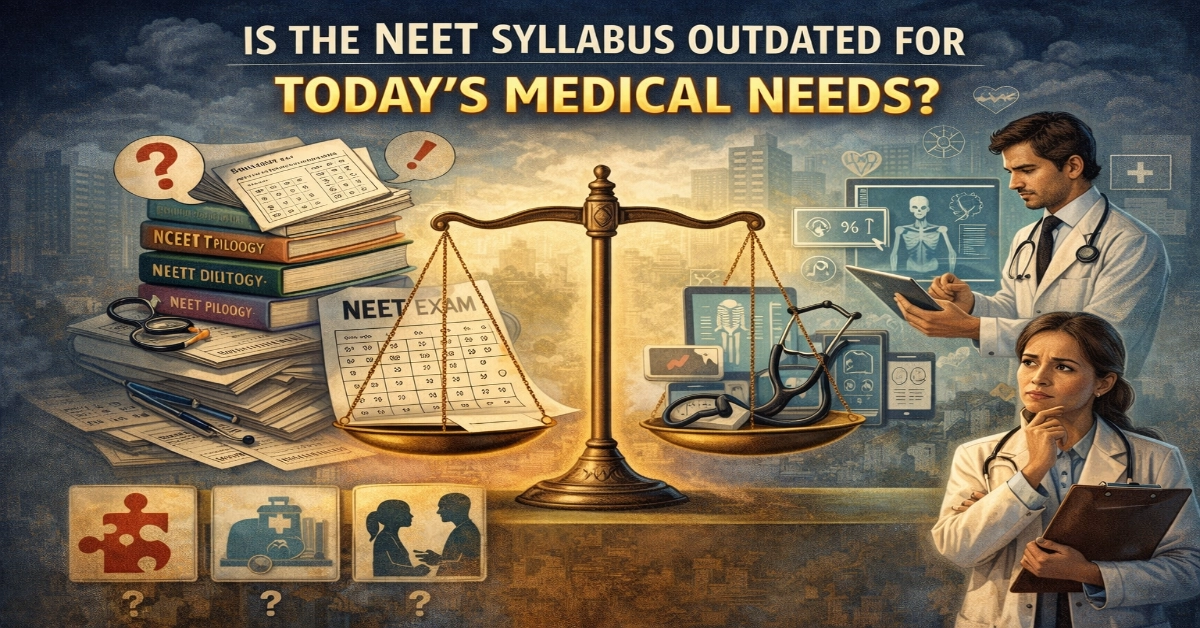
NEET Syllabus: Every year, over 20 lakh students prepare for NEET with a single goal: to become future doctors. They memorize NCERT lines, practice thousands of MCQs, and perfect exam strategies. But a question is being asked more often now- “Does the NEET syllabus truly reflect the skills and knowledge today’s doctors actually need?” As medicine evolves rapidly, the gap between entrance exam preparation and real-world healthcare is becoming harder to ignore.
What the NEET Syllabus Focuses On
The NEET syllabus is heavily based on Class 11 and 12 Physics, Chemistry, and Biology, with Biology carrying the maximum weightage. It emphasizes factual knowledge, definitions, and the ability to recall information under time pressure.
This structure has clear strengths. It ensures:

- A common, standardized evaluation for students across the country.
- Strong grounding in basic sciences, especially Biology.
- Objective assessment through MCQs, reducing subjectivity.
For a country as large as India, this uniformity is essential. But uniformity does not always mean relevance.
Medicine Has Changed, Has NEET Kept Up?
Modern medicine today is very different from what it was even 15-20 years ago. Doctors now work with technology, data, multidisciplinary teams, and patients who are more informed than ever.
 Join NEET News 2026
 However, the NEET syllabus still largely tests:
- Rote memorization over applied understanding
- Isolated facts rather than clinical context
- Speed and accuracy, not reasoning or decision-making
There is little to no evaluation of how a student thinks, communicates, or applies knowledge to real-life health problems.
Missing Skills That Modern Doctors Need
A major criticism of the current syllabus is not what it includes, but what it leaves out.
Key areas absent from NEET assessment include:
- Clinical reasoning and problem-solving
- Ethics, empathy, and patient communication
- Public health awareness and preventive medicine
- Basic understanding of digital health and technology
A student may score exceptionally well in NEET yet enter medical college without exposure to how diseases affect real patients and communities.
The Overemphasis on Coaching-Friendly Content
Because NEET is purely MCQ-based, preparation has become coaching-driven. Topics are often taught with the sole aim of “what can be asked,” not “why it matters.”
This leads to:
- Selective studying based on weightage
- Neglect of conceptual depth
- Learning shortcuts that work for exams but fail in practice
As a result, NEET often tests how well a student can crack an exam, not how well they are suited to become a doctor.
Read Also: NEET UG EXAM: How Coaching Culture Is Changing the NEET Dream
Does This Mean NEET Is Completely Outdated?
Not entirely. Basic sciences are the foundation of medicine, and NEET does a decent job of filtering students who can handle academic rigor. Expecting an entrance exam to test full medical competence is unrealistic.
However, the problem lies in exclusivity. NEET is currently the only gateway, and it relies on a very narrow definition of merit.
What NEET does well:
- Tests discipline and consistency
- Ensures basic scientific aptitude
- Maintains national-level fairness
Where it falls short:
- Ignores non-academic medical competencies
- Encourages rote learning
- Creates extreme pressure at a very young age
What Could a More Relevant System Look Like?
Instead of completely changing the syllabus, many experts suggest improving how students are assessed.
Possible improvements include:
- Including reasoning-based and case-based questions
- Testing conceptual application rather than direct recall
- Introducing aptitude or situational judgment sections
- Reducing dependence on extreme memorisation
Even small changes could push students to study with understanding rather than fear.
The Bigger Question: What Kind of Doctors Do We Want?
At its core, this debate is not about Physics or Biology chapters; it’s about the future of healthcare. Do we want doctors who are excellent test-takers, or doctors who can think critically, adapt, and connect with patients?
The NEET syllabus was designed for fairness and scale. Today, it also needs relevance and depth.
Final Thought
The NEET syllabus is not irrelevant, but it is incomplete for today’s medical needs. As healthcare challenges grow more complex, India’s medical entrance system must evolve beyond rote memorization. Updating assessment methods, not just content, could bridge the gap between cracking NEET and becoming a competent, compassionate doctor.
The real goal should not be just clearing an exam, but preparing students for the realities of medicine that await them beyond it.
