

Australia, a sovereign nation encompassing the mainland, Tasmania, and various smaller islands, boasts over 1100 medical institutes offering MBBS programs. Australia hosts a diverse educational landscape with a student body exceeding 750,000, including over 22,000 international students. The top medical universities, often accredited by the NMC and WHO, offer programs with affordable fee structures. Prospective students can pursue MBBS in Australia through two main pathways: a 4-year Doctor of Medicine (MD) program or a 5-6-year undergraduate degree. The MBBS curriculum in Australia shares similarities with that of India, providing students with comprehensive medical education.
Candidates must be NEET Eligible, with a minimum score of 50 Percentiles for both general and reserved category candidates. Opting for an MBBS degree at any Australian medical university is a prudent decision as it is globally recognized, ensuring portability and acceptance across borders.
[Page Index]
Country Summary
Australia, the smallest continent and one of the largest countries on Earth, lies between the Pacific and Indian oceans in the Southern Hemisphere. Australia’s capital is Canberra, located in the southeast between Sydney and Melbourne’s more significant economic and cultural centres.
| Population | 28.9 Million |
| Area | 7,692,024 km2 |
| Capital City | Canberra |
| Language | Primary Language: English |
| Climate | Tropical in the north, temperate in the south, and arid/semi-arid in central regions |
| Literacy Rate | 99% |
| Time Zone | UTC+8 to UTC+11 (varies by region) |
| Currency | Australian dollar |
| Religion | Christianity ~43.9%, No Religion ~38.9%, Others include Islam, Hinduism, Buddhism and other beliefs |
Quick facts
Before reading the complete information about MBBS in Australia, let’s look at Quick facts:
| Course Offered | Bachelor of Medicine and Bachelor of Surgery (MBBS) |
| Course Duration | 5 – 6 Years |
| Basic Eligibility | 50% in 10+2 Science (PCB) |
| University Recognition | NMC & Who- accredited |
| Medium of Teaching | English |
| Entrance Exam | NEET (for Indian students) |
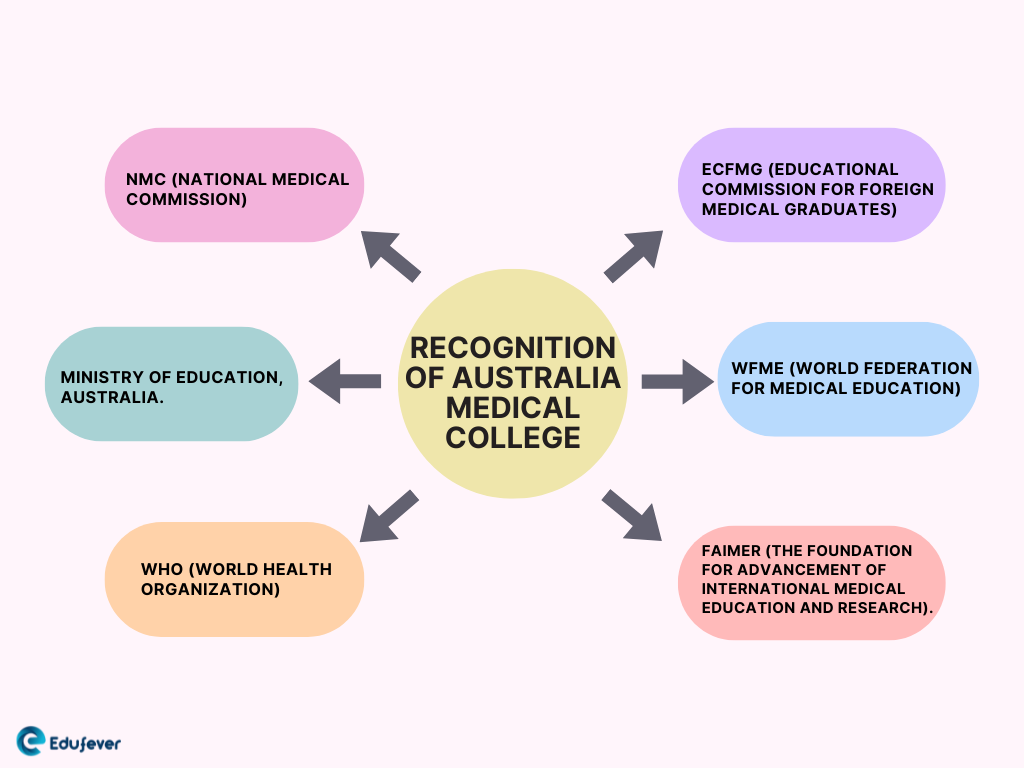
Recognition of Australia Medical College
The most critical factors in deciding on a good medical college are checking the affiliation, recognition, and other affiliating parameters. So, Indian students are affiliated with these authorities for MBBS in Australia.
- Ministry of Education, Australia.
- NMC (National Medical Commission)
- WHO (World Health Organization)
- ECFMG (Educational Commission for Foreign Medical Graduates)
- WFME (World Federation for Medical Education)
- FAIMER (The Foundation for Advancement of International Medical Education and Research).
Graphical Representation of Recognition of Australia Medical College
Why study MBBS in Australia?
- High-Quality Education: Australian universities are renowned for their high education and research excellence standards. MBBS programs are designed to equip students with comprehensive medical knowledge and practical skills.
- Global Recognition: An MBBS degree from an Australian medical university is recognized worldwide, opening up diverse career opportunities internationally.
- State-of-the-Art Facilities: Australian medical schools have modern facilities, including advanced laboratories, simulation centres, and clinical training opportunities in leading hospitals.
- Multicultural Environment: Australia is a culturally diverse country that welcomes students from all over the world. Studying in such an environment fosters cross-cultural understanding and collaboration.
- Excellent Quality of Life: Australia offers a high quality of life with a stable economy, excellent healthcare system, safety, and a relaxed lifestyle.
Admission Procedure 2026-27
If you want to take admission in Australia in 2026, you must qualify for the National Eligibility Entrance Exam (NEET) for Indian students.
Eligibility Criteria
The preferred destination for international students is Australia, where they can pursue their medical degree courses. Check the eligibility criteria below if you want to study MBBS in Australia.
| Age | Your age should be at least 17 on or before 31st December of the admission year. |
| Qualification | Candidates must have completed 10+2 from a recognized board or institute or have Equivalent and non-premedical backgrounds. |
| Minimum Qualifying (%) | 50% in 10+2 Science (PCB) |
| Qualifying Entrance | NEET (Qualified Only) |
Documents Required
Before applying for admission to MBBS in Australia, please do not forget to bring all these related documents.
- Passport (Minimum 18 months validity).
- Class 10th Passing Certificate & Mark sheet.
- Class 12th Passing Certificate & Mark sheet.
- Birth Certificate.
- 10 passport-size Photographs
- Official Invitation letter from the Medical University of Australia.
- Authorization of all documents from the Ministry of External Affairs, New Delhi.
- Legalization of all documents from the Australian Embassy.
- Visa fees.
- Bank receipt of University 1st year Tuition fee (required for some Universities).
- Medical test documents.
MBBS Syllabus in Australia
The MBBS syllabus in Australia covers all the essential topics necessary to help you become a successful professional in the field. Let’s take a look at some of the main issues which are part of the course syllabus of MBBS in Australia:

| Year | Subject |
|---|---|
| First Year | Human Anatomy, Bio-organic Chemistry, Embryology, Cytology, Medical Chemistry, Fundamentals of Psychology, Histology, Elective Courses |
| Second Year | MicrobiologyPhysiology, Biochemistry, Histology, Human Anatomy, Emergency Medicine, Embryology, Patient Care |
| Third Year | Biostatistics, Pharmacology, Internal Medicine Pathomorphology, Pediatrics, Pathomorphology, Ecology, General Surgery, Radiology, Elective Courses |
| Fourth Year | Surgery, Ophthalmology, Neurology, Tuberculosis, Social Medicine, Narcology, Obstetrics and Gynecology, Urology, Forensic Medicine, Medical Psychology |
| Fifth Year | Obstetrics, Traumatology, Gynaecology, Infectious Diseases, Clinical Immunology, Social Medicine, Epidemiology, Genetics Oncology |
| Sixth Year | General Practice, Elective courses |
Note: The above syllabus is for reference purposes only. The actual syllabus may vary according to different universities.
Top MBBS Colleges in Australia with Fee Structure 2026-27
Here is the updated 2026-27 list of all Australian MBBS Colleges officially made by India’s Medical Council. For detailed info about the fee structure, Courses offered, Admission Procedure, and Ranking, and to complete the college review, click the college link or read more. It will provide a list of the best medical colleges.
| Top MBBS Colleges in Australia | Fees in INR |
|---|---|
| The Australian National University Medical School | 62,71,600 INR |
| Monash University | 6,681,926 INR |
| The University of Sydney | 6,149,212 INR |
| Deakin University | 5,869,045 INR |
| University of Newcastle | 6,096,270 INR |
| University of New South Wales | 6,280,746 INR |
| University of Adelaide | 6,201,826 INR |
| James Cook University of Medical School | 4,694,644 INR |
| Bond University | 7,704,207 INR |
| University of Western Australia | 6,109,752 INR |
| University of Queensland | 6,847,658 INR |
| University of Melbourne | 7,365,901 INR |
Other Top MBBS Colleges in Australia
| S.No. | Top Medical Schools in Australia |
| 1 | Faculty of Medicine, Nursing and Health Sciences, Monash University |
| 2 | Deakin University School of Medicine |
| 3 | University of Western Sydney |
| 4 | The University of Adelaide Medical School |
| 5 | Faculty of Health Sciences and Medicine, Bond University |
| 6 | Griffith University |
| 7 | Macquarie University School of Medicine |
| 8 | University of Notre Dame School of Medicine, Sydney |
| 9 | University of Newcastle |
| 10 | University of Wollongong |
| 11 | Flinders University School of Medicine |
| 12 | Curtin Medical School, Curtin University |
| 13 | University of Tasmania |
| 14 | Royal Australasian College of Physicians Sydney |
| 15 | St Mary’s School of Medicine Cook Island |
| 16 | University of New England |
Scholarships for MBBS in Australia
If you want to pursue a low-cost MBBS in Australia, there are several universities to choose from. The list of some such scholarships in Australia is given below:
| Award | University | Scholarship |
|---|---|---|
| Monash International Merit Award | Monash University | 50,000 AUD-1,00,000AUD |
| Sydney Achievers International Award | University of Sydney | 10,000 AUD |
| Lindsay MCWha International Accommodation Funding | University of Adelaide | 50% waiver on the accommodation cost of the candidate |
| Destination Australia Scholarships International | Deakin University | 15,000 AUD every year |
| Deakin Warrnambool Residential International Scholarships | Deakin University | Around 50% waiver on accommodation fees |
| India Global Leaders Scholarship | University of Queensland | 5,000 AUD-20,000 AUD |
| ANU- Study Canberra India Scholarship | Australian National University | 10,000 AUD per year |
Advantages and Disadvantages of Studying in Australia
Australia offers high-quality education and modern medical training facilities. The higher education system is well developed, and most universities provide programs taught in English across various fields such as medicine, engineering, humanities, business, and finance. Studying in Australia allows international students to gain globally recognised qualifications and valuable clinical experience.
Advantages of studying in Australia for Indian Students
- Medical universities in Australia generally do not require donations or capitation fees during admission.
- Many universities are recognized by international organizations such as WHO and NMC.
- Students can work part-time while studying, which helps manage living expenses.
- The medium of instruction is English, making it easier for international students to adapt.
- Universities provide modern infrastructure, research facilities, and comfortable student accommodations.
Disadvantages of studying in Australia for Indian Students
- Tuition fees and living costs in Australia can be higher compared to some other study destinations.
- Admission to medical programs can be competitive, and some universities may require additional exams such as UCAT or GAMSAT.
- Students must meet English language proficiency requirements such as IELTS or TOEFL.
- Adjusting to a new education system and lifestyle may take time for some international students.