

Georgia is well-regarded for its quality medical education and vibrant cultural environment. With affordable tuition fees and a wide range of English-taught programs, it has become a preferred destination for Indian students. Meanwhile, Russia is known for its prestigious universities, rich heritage, and strong research opportunities, making it an attractive option for aspiring doctors worldwide.
This article offers a comprehensive comparison between Georgia and Russia across key factors such as quality of education, accreditation and recognition, FMGE passing rate, leading medical universities, cost of study and living, career prospects, and more.
[Page Index]
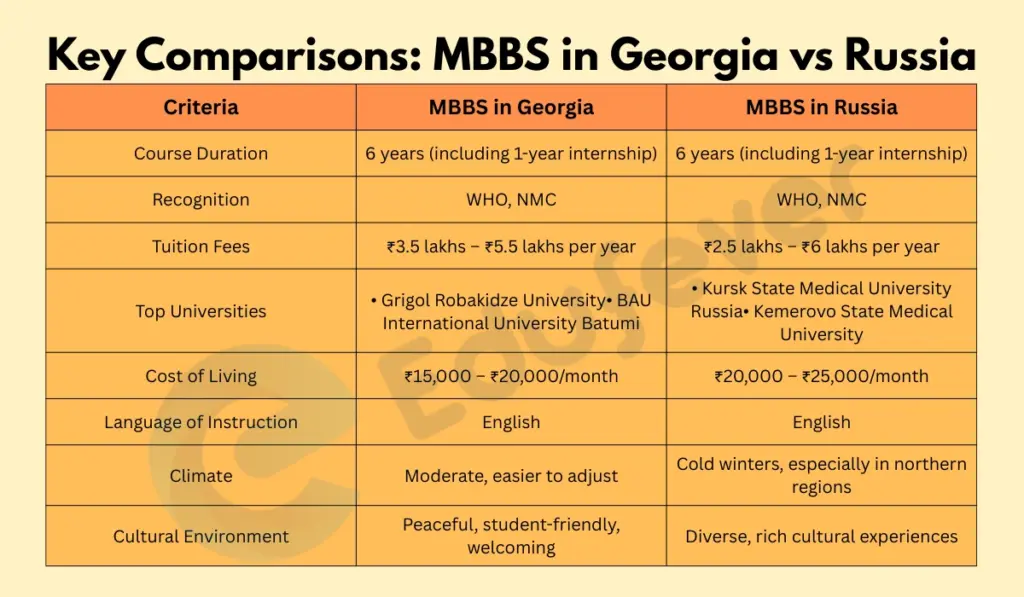
Key Comparisons: MBBS in Georgia vs Russia
Here are some key comparisons between Georgia and Russia:
Quality of Education
The quality of education in Georgia and Russia is:
Georgia offers high-quality medical education with a strong emphasis on clinical training and modern medical practices. Its universities are well-equipped and often collaborate with international institutions. Additionally, most programs are taught in English, making it convenient for international students to study and adapt easily.
Russia provides a high standard of medical education supported by advanced facilities, research centres, and collaborations with international institutions. Additionally, several universities offer English-medium programs, making them accessible for international students.
Accreditation and Recognition
The accreditation and recognition of medical degrees in Georgia and Russia are mentioned in the table below:
| Country | Medical Degrees | Accreditation Authorities | Recognition |
| Georgia | MBBS (Doctor of Medicine) | Ministry of Education and Science of Georgia | Recognized by WHO, National Medical Commission (NMC), and other international bodies |
| Russia | MD (Doctor of Medicine) | Ministry of Health of the Russian Federation | Recognized by WHO, NMC, and other international bodies |
FMGE Passing Rate
The FMGE Passing rate of Georgia and Russia is given below:
Georgia:
- The FMGE pass rate for MBBS graduates from Georgia generally ranges between 15% and 30%, varying by university and exam session.
- The success rate depends on factors such as the quality of education, individual preparation, and clinical exposure.
- Universities offering structured curricula and English-medium programs can support better understanding and exam readiness.
- Many students enrol in FMGE/NExT coaching programs alongside their studies to improve their chances of qualifying.
Russia:
- The FMGE pass rate for MBBS graduates from Russia typically ranges between 10% and 20%, depending on the university and exam session.
- Variations in curriculum structure, clinical exposure, and language of instruction can impact student performance.
- Universities offering English-medium programs and updated curricula may help students better align with FMGE requirements.
- Many students choose to join FMGE/NExT coaching classes to strengthen their preparation and improve their chances of passing.
Top Medical University for MBBS
The list of top medical universities for MBBS in Georgia and Russia, with fees for the 2026-27 academic year, is given below:
Georgia Universities:
| College | Annual Tuition | Annual Hostel | 6-Year Total Package |
| Tbilisi Medical Academy, 1992 | $7,000 (₹6,58,000) | $3,000 (₹2,82,000) | $45,000 (₹42,30,000) |
| East European University, 2012 | $5,500 (₹5,17,000) | $3,000 (₹2,82,000) | $36,000 (₹33,84,000) |
| Alte University, 2002 | $6,000 (₹5,64,000) | $3,000 (₹2,82,000) | $39,000 (₹36,66,000) |
| University of Georgia, 1785 | $6,500 (₹6,11,000) | $3,000 (₹2,82,000) | $42,000 (₹39,48,000) |
| David Tvildiani Medical University, 1989 | $6,000 (₹5,64,000) | $3,000 (₹2,82,000) | $39,000 (₹36,66,000) |
| SEU Georgian National University, 2001 | $5,900 (₹5,54,600) | $3,000 (₹2,82,000) | $39,400 (₹37,03,600) |
| New Vision University, 2013 | $7,000 (₹6,58,000) | $3,000 (₹2,82,000) | $45,000 (₹42,30,000) |
Russia Universities:
| College | Location | Annual Tuition | Annual Hostel | Total Package (incl. hostel) |
| Kursk State Medical University, 1935 | Kursk | $6,980 (₹6,56,120) | – | $41,480 (₹38,99,120) |
| Ulyanovsk State University, 1988 | Ulyanovsk | $3,520 (₹4,40,000) | $750 (₹93,750) | $25,620 (₹32,02,500) |
| Mordovia State Medical University, 1931 | Saransk | $4,260 (₹5,32,500) | $400–750 (₹40,000–93,750) | $27,960 (₹34,95,000) |
| Ural State Medical University, 1930 | Yekaterinburg | $3,600 (₹4,50,000) | $160–200 (₹16,000–20,000) | $22,560 (₹28,20,000) |
| North-Western State Medical University, 2011 | St. Petersburg | $5,500 (₹6,87,500) | $450 (₹56,250) | $35,700 (₹44,62,500) |
| Sevastopol State University, 1951 | Sevastopol | $2,875 (₹3,59,375) | $700 (₹87,500) | $21,450 (₹26,81,250) |
| Ivanovo State Medical University, 1930 | Ivanovo | $3,300 (₹4,12,500) | $250 (₹31,250) | $21,300 (₹26,62,500) |
| Yaroslavl State Medical University, 1944 | Yaroslavl | $3,950 (₹4,93,750) | $900 (₹1,12,500) | $29,100 (₹36,37,500) |
| Kirov State Medical University, 1987 | Kirov | $3,600 (₹4,50,000) | $900 (₹1,12,500) | $27,000 (₹33,75,000) |
| Mephi Moscow University, 1942 | Moscow | $7,600 (₹9,50,000) | $200–250 (₹20,000–25,000) | $46,800 (₹58,50,000) |
| Tambov State Medical University | Tambov | $4,100 (₹5,12,500) | – | $24,600 (₹30,75,000) |
Cost of Studying
| Aspect | Cost of Studying MBBS in Georgia | Cost of Studying MBBS in Russia |
| Tuition Fees | $5,500 to $7,000 per year | $3,000 to $6,500 per year |
| Accommodation | $3,000 per year (hostel, standard across most listed universities) | $1,000 to $2,500 per year |
| Living Expenses | $2,500 to $4,000 per year | $2,500 to $4,500 per year |
| Total Estimated Cost | ~$11,000 to $14,000 per year | ~$6,500 to $13,000 per year |
Advantages of Studying MBBS in Georgia
- Quality Education: Georgian medical programs follow European standards, ensuring high-quality education and providing clinical experience.
- Global Recognition: Medical degrees from leading Georgian universities are recognized globally, including by the WHO and NMC.
- English-Medium Instruction: All seven universities above offer fully English-taught MBBS programs, making admission and study straightforward for Indian students.
- Predictable Fee Structure: Tuition across the seven universities above ranges narrowly between $5,500–$7,000/year, with a consistent $3,000/year hostel fee – making budgeting easier than in some other destinations.
- European Lifestyle: Students enjoy a European and multicultural environment.
Advantages of Studying MBBS in Russia
- High-Quality Education: Russian medical universities offer advanced facilities with high academic standards.
- Global Recognition: Medical degrees from Russia are recognized globally, enabling students to explore job opportunities worldwide.
- Scholarship Opportunities: Russia provides government scholarships for international students, helping them secure admission more easily.
- Affordable Fees: MBBS programs in Russia are generally more affordable, making it a popular choice among Indian students.
- Cultural Diversity: Russia is known for its rich culture and diversity, giving students a vibrant experience.
Career Opportunities After MBBS
The career opportunities available to students after studying MBBS from Georgia and Russia are:
Georgia: After completing MBBS in Georgia, students can appear for exams like USMLE to practice in the United States or return to India and qualify the FMGE to start their medical career. Additionally, many students opt for postgraduate studies in Georgia or other European countries to enhance their qualifications and career prospects.
Russia: Graduates can appear for the FMGE to practice medicine in India. They can also pursue postgraduate studies in Russia or other European countries. Additionally, students interested in further education or career opportunities in the United States can prepare for exams like the USMLE.
Student Life
The table given below shows the key aspects of students’ lives in Georgia and Russia. Such as lifestyle, accommodation, culture, social activities and more:
| Aspect | Georgia | Russia |
| Lifestyle | Relaxed and student-friendly environment | More structured with emphasis on academics and discipline |
| Culture | Rich history with a vibrant and social lifestyle | Deep cultural heritage with frequent cultural events |
| Accommodation | Affordable options including dorms and private housing | Range of options from budget dorms to higher-cost private housing |
| Food | Diverse cuisine with local and international choices | Wide variety of traditional and global food options |
| Transportation | Well-connected public transport (buses, metro) | Extensive transport network, especially metros in major cities |
| Cost of Living | Generally affordable compared to Western countries | Varies by city; higher in major cities like Moscow and St. Petersburg |
| Social Activities | Plenty of outdoor activities, cafes, and events | Active social life with cultural, academic, and leisure activities |
| Student Organizations | Active student clubs including international groups | Wide range of cultural, academic, and student organizations |
Safety and Security
The safety and security comparison between Georgia and Russia is as follows:
Georgia:
- Georgia is generally safe, with a low crime rate. Cities like Tbilisi provide a welcoming and student-friendly environment to international students.
- You should follow basic safety tips like avoid going to isolated areas at night, keep your belongings secure, and learn about local customs and laws to have a better stay.
Russia:
- Safety may vary by the city. Major cities like Moscow and St. Petersburg are generally safe, but petty crime can be more common.
- Be aware of rules and follow standard safety practices for better stay.
Keep in touch with your university’s international office for important safety information and support in both countries.
Conclusion
Russia is recognized for its strong academic standards and excellent research opportunities, offering high-quality medical education. In contrast, Georgia is known for its affordable tuition fees, lower cost of living, student-friendly environment, and wide availability of English-medium programs. Both countries have their own advantages and limitations, but each provides quality medical education. It is important to carefully evaluate all these factors and choose the option that best aligns with your career goals, budget, and personal comfort.
