
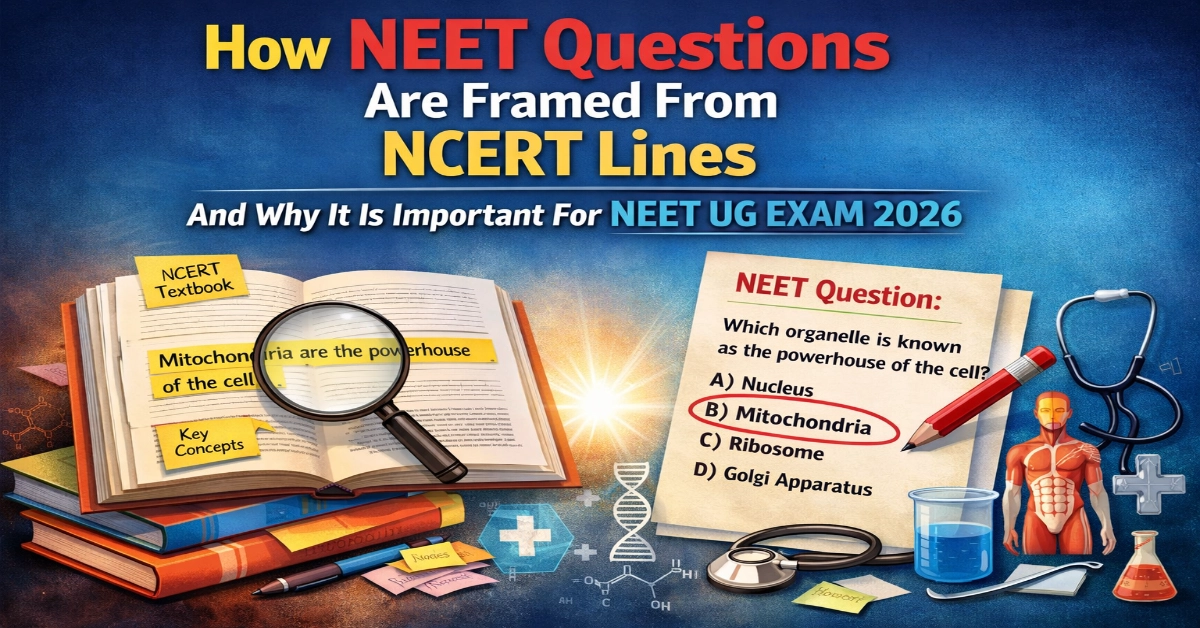
NEET UG EXAM 2026: Most NEET aspirants hear this sentence early in their preparation: “NEET comes directly from NCERT.” “NCERT is the Bible,” etc.
But what does that actually mean?
It doesn’t mean questions are copied word for word from NCERT. It means the NEET tests how deeply you understand the NCERT, including the lines you usually read once and then move on.

NCERT Is Not a Book, It’s a Question Bank in Disguise
Every NEET paper is built around NCERT’s language. Even when a question feels tricky, unfamiliar, or conceptual, the source is almost always a single sentence, phrase, diagram label, or footnote from NCERT.
Sometimes it’s:
 Join NEET News 2026
 - A definition written in one calm line
- A comparison hidden in a paragraph
- A word like “usually,” “rarely,” or “except”
- Or a diagram label you assumed was self-explanatory
NEET doesn’t test how fast you can solve. It tests how carefully you have read.
How One NCERT Line Becomes a NEET Question
A simple NCERT line like: “Most enzymes are proteinaceous in nature.”
Can turn into:
- An assertion-reason question
- A multiple-choice question asking for exceptions
- A comparison with ribozymes
- Or a confusing statement that tests whether you noticed the word “most.”
The examiners don’t twist facts; they twist attention. These questions are generally framed to test whether you pay attention to the details or not. So those who score well enough in the examination are the ones who have paid attention to every single detail written in the textbook.
How Toppers Read NCERT Differently
High scorers don’t just “revise” NCERT. They:
- Pause at every definition
- Read examples and boxes as carefully as paragraphs
- Compare similar terms written across chapters
- Notice how NCERT phrases limitations and conditions
They treat NCERT like a legal document; every word matters. NCERT, to be very honest, can get you in the top rankers. So, while reading or revising the NCERT, take a pencil, read every single line with one hundred percent attention.
Diagrams Speak Louder Than Paragraphs
Many NEET questions are made from:
- Diagram labels
- Arrow directions
- Shape, position, or sequence shown visually
Sometimes the question is not about the process, it’s about what the diagram quietly shows but never explains in words. If you can redraw NCERT diagrams from memory, you’re already thinking like a NEET paper setter. Recalling what you have learnt till now could be a wizard to correctly attempt many questions and getting good score.
Read Also: NCERT Diagrams for NEET UG 2026: The Most Underrated NEET Scoring Tool
Why Coaching Notes Can’t Replace NCERT
Coaching notes, Topper’s note, Anything can never replace NCERT, NCERT should be the primary book that one aspirant must refer to, I cannot emphasize enough on how important reading NCERTs are, and most importantly, making self notes, because shortcuts can never lead you to success.
Coaching or Topper’s Notes can definitely help with understanding, but questions come from the NCERT’s original language, not summarized versions. That’s why students who “know the concept” still feel shocked on exam day.
Why? Because, They learned around NCERT – not from it.
How You Should Read NCERT From Today Onwards
Instead of asking: “Is this important?” Ask:
- “Why is this line written this way?”
- “What would happen if one word here changed?”
- “What can be asked from this in a confusing way?”
When you read NCERT with curiosity instead of urgency, questions start revealing themselves. As i had already mentioned that reading between the lines, paying attention to each and every detail can fetch you really well scores.
Read Also: NEET UG 2026: Re-Reading is not Revision, How NEET Revision Actually Works
Final Note:
NEET doesn’t reward brilliance alone. It rewards attention, patience, and respect for the textbooks. So next time you open NCERT, don’t rush to finish pages. Slow down because somewhere in those quiet lines, your next NEET question is already waiting.
