
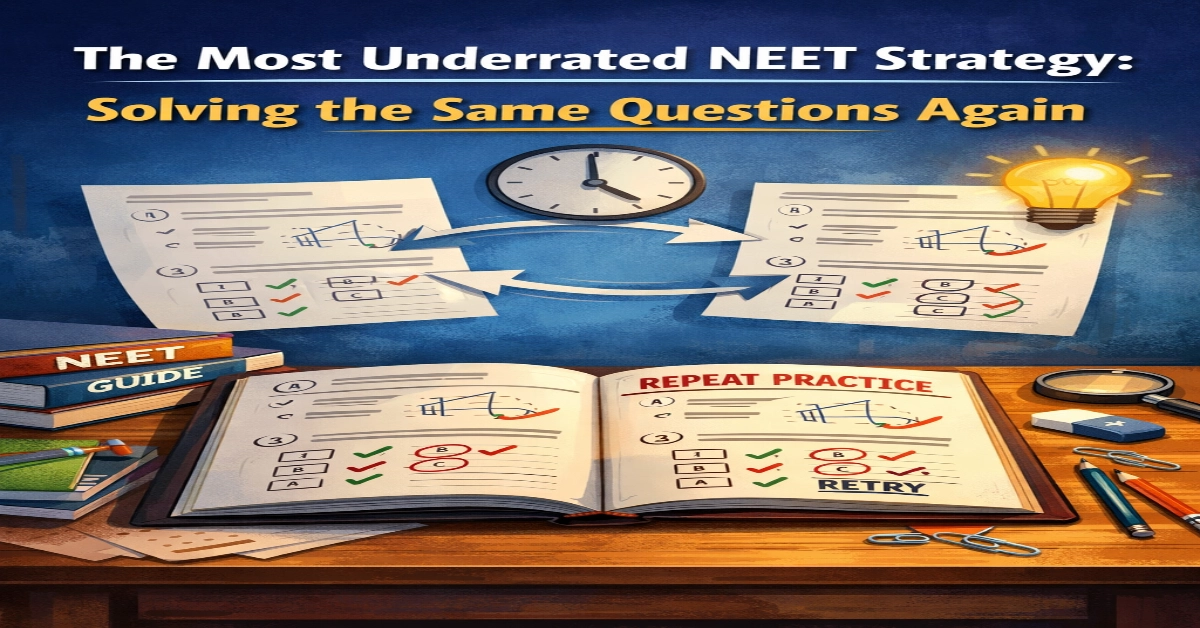
NEET Strategy: For most NEET aspirants, preparation feels like a race – finish the syllabus, attempt as many mock tests as possible, and move on. The logic seems simple: more tests = better performance. Yet every year, thousands of students attempt enough mock tests and still end up with disappointing ranks.
The problem isn’t a lack of effort. It’s a misplaced effort.
Re-solving old questions, especially previously attempted mock and PYQ-based questions, is far more powerful than continuously taking new tests.

Here’s why this strategy quietly works for top performers.
1. New Mock Tests Measure Performance; Re-Solving Improves It
Mock tests are like diagnostic tools. They tell you where you stand, not how to improve. Every time you take a new mock, you mostly repeat the same mistakes:
 Join NEET News 2026
 - Silly calculation errors
- Misreading questions
- Weak concepts you already know are weak
Re-solving old questions forces you to confront these mistakes directly. You’re not just identifying problems – you’re fixing them. Improvement doesn’t come from exposure; it comes from correction. Understanding where you are lacking, practicing similar questions again and again, especially in physics and chemistry, helps you achieve accuracy.
Read Also: How to Analyze NEET Mock Tests for NEET UG 2026
2. NEET & Pattern Recognition
NEET may change the wording of questions, but the core concepts repeat year after year. When you re-solve old questions:
- You start recognizing how concepts are framed.
- You understand why certain options look tempting, but are incorrect.
- You learn how NEET hides traps in simple questions.
This pattern recognition develops far faster when you revisit familiar questions than when you rush into unfamiliar mock papers. Resolving the same mock again helps you understand areas where you are lacking in concept, which topic or subject needs more attention and effort.
Read Also: What NEET UG 2026 Aspirants Must Learn From Last Year’s Paper Analysis
3. Memory Strengthens With Repetition
A common mistake aspirants make is believing that solving new questions equals learning more. In reality, the brain retains information through active recall and spaced repetition ( when you repeatedly work on the same set of things multiple times, it gets stored in your permanent memory).
When you re-solve an old question after a few days or weeks:
- Your brain is forced to recall the concept again.
- The correct approach becomes automatic.
- The chance of repeating the same mistake drops sharply.
This is why toppers often solve the same PYQs multiple times instead of hunting for new material.
4. Re-Solving Exposes the Real Reason You Lost Marks
After a mock test, most students only check:
- Right or wrong
- Final score
But when you re-solve:
- You notice why you chose a wrong option
- You identify whether the error was conceptual, emotional, or due to time pressure
- You learn how fatigue and panic affect decision-making
This level of self-analysis rarely happens during fresh mock attempts.
Read Also: If You’re Scoring 500-550 in NEET Mocks, Read This Before Panicking
5. Confidence Always Comes From Familiarity
Nothing boosts confidence like knowing you’ve already accomplished a question that once scared you. Re-solving gives psychological stability:
- Reduced panic during the real exam
- Faster decision-making
- Better time management
On exam day, NEET doesn’t feel new; it feels familiar. That calmness alone can add 20-30 marks.
6. Toppers Don’t Avoid Mocks They Use Them Differently
This doesn’t mean mock tests are useless. Toppers:
- Take fewer but more meaningful mocks
- Spend more time re-solving and analysing than attempting new tests
- Re-solve wrong and guessed questions at least 2-3 times
For them, one mock test creates a week’s worth of improvement.
The Smart NEET Strategy
If you’re stuck in the loop of taking test after test with little score improvement, pause and ask:
Have I truly mastered the questions I already attempted?
Re-solving old questions is not boring repetition; it’s refinement. In NEET, ranks aren’t decided by how many tests you take, but by how few mistakes you repeat.
Sometimes, moving forward means going back.
GOOD LUCK!!
Read Also: NEET 2026: NEET And Board Exam Prep for School-Going Students
