
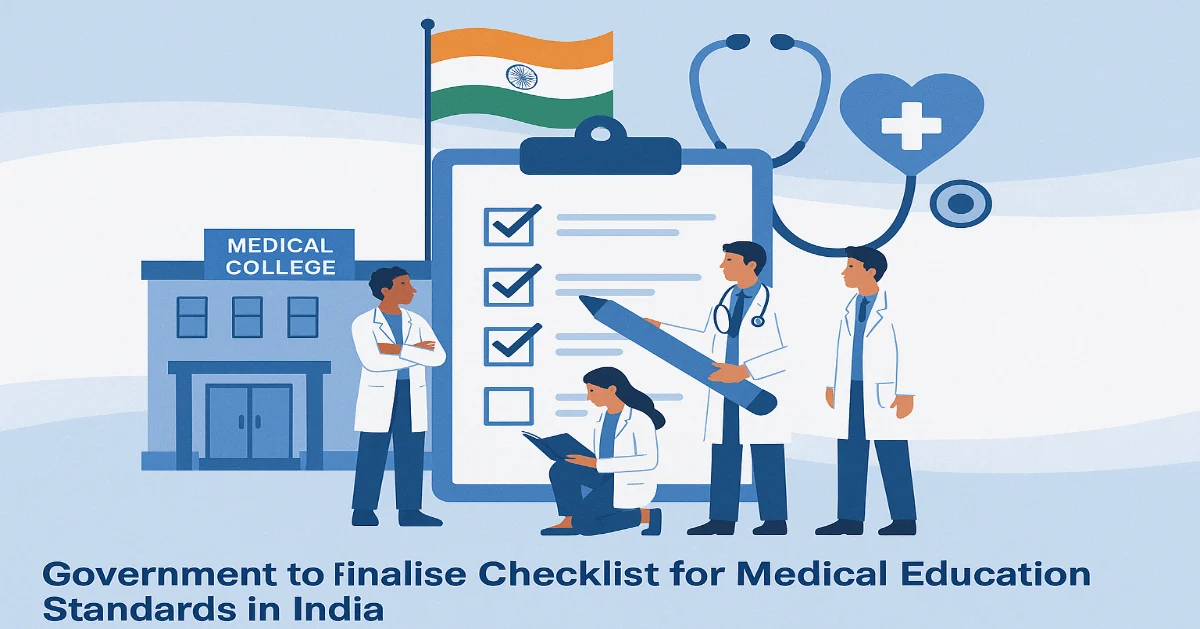
In a major step towards reforming medical education and healthcare standards, the Government of India is finalising a comprehensive checklist to assess and improve the quality of medical colleges and their attached hospitals. This initiative aims to bring uniformity, accountability, and transparency to medical education across the nation.
The checklist will serve as a benchmark for infrastructure, teaching facilities, hospital performance, laboratory standards, and patient safety protocols in government and private medical institutions.
Key Highlights
- The Ministry of Health and Family Welfare is developing a standardised framework for medical college-attached hospitals, public health laboratories, and critical care units.
- The checklist will align with National Quality Assurance Standards (NQAS) and include measurable, department-wise indicators.
- The move follows recommendations from the 11th Central Quality Supervisory Committee meeting, which focused on strengthening quality assurance in medical education and hospital services.
- The National Medical Commission (NMC) will play a key role in monitoring compliance. Institutions failing to meet the set benchmarks could face penalties or loss of recognition.
Why This Initiative Matters
Medical education and healthcare quality in India have often faced criticism due to varying standards across institutions. This checklist aims to:
- Establish a uniform quality monitoring system for all medical colleges.
- Improve patient care, hospital functioning, and teaching quality.
- Strengthen India’s medical infrastructure to meet global standards.
- Ensure that students receive consistent and high-quality training environments.
What Will Change
With this checklist in place, medical institutions will be evaluated not just on infrastructure but also on outcome-based performance parameters such as:
- Departmental efficiency and quality of services.
- Availability and condition of laboratories and critical care facilities.
- Patient safety practices and emergency management systems.
- Faculty engagement and student feedback.
Additionally, Block Public Health Laboratories (BPHLs) and Critical Care Blocks (CCBs) will have separate quality checklists to ensure consistent standards at all healthcare levels.
Read Also: RBI Data on MBBS Abroad 2025: Indian Students Shift to Georgia; 387% Rise in Education Remittances
Expert View
Experts believe this initiative could transform medical education in India by providing a structured framework for continuous improvement. The checklist will encourage medical colleges to adopt best practices, improve patient management, and maintain transparency in training standards.
Impact on Students and Institutions
For NEET aspirants and medical students, this move will help identify well-performing medical colleges that offer quality education and clinical exposure. Institutions that comply with the new norms are expected to gain higher credibility and better rankings in the long term.
Medical colleges, on the other hand, will need to strengthen their internal quality control mechanisms to meet the upcoming requirements from infrastructure to teaching methods and patient-care systems.
Read Also: NMC Clarifies Faculty Qualification Rules 2025: Key FAQs, Eligibility & Transition
 Join NEET News 2026
 NEET UG Counselling Guides 2026
State-wise MBBS/BDS Counselling Guide 2026
State-wise counselling & admission guidance
MCC NEET UG Counselling Guide 2026
MCC counselling, choice filling & admission planning
AACCC AYUSH NEET Counselling Guide 2026
AYUSH counselling & admission guidance
