
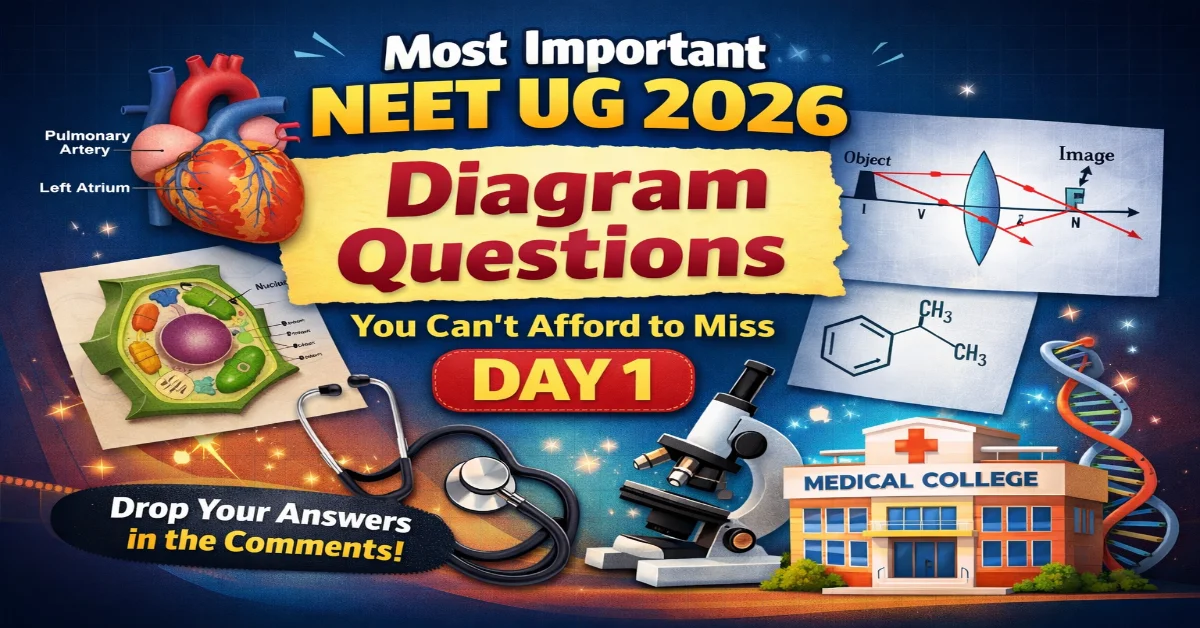
NEET UG 2026 Diagram Questions: With NEET UG 2026 just around the corner, smart revision is the key to maximizing your score, and diagrams play a bigger role than most students realize. From Biology processes to Physics setups, diagram-based questions are not only frequent but also score well. If you’ve practiced them well. In this Day 1 series, we bring you the most important diagram questions you simply can’t afford to miss, carefully selected to strengthen your concepts and boost your confidence in the final stretch.
Q.1. The hydrogen bond present between Adenine and Thymine is:
A. One
B. Two
C. Three
D. Four
Q.2. Which component forms the backbone of DNA?
A. Nitrogenous bases
B. Hydrogen bonds
C. Sugar and phosphate
D. Ribose sugar
Q.3. DNA strands are said to be antiparallel because:
A. Bases face opposite directions
B. Sugar-phosphate chains run in opposite directions
C. Hydrogen bonds are opposite
D. Helix turns in opposite direction
Q.4. Which base pair has three hydrogen bonds?
A. A-T
B. A-G
C. G-C
D. T-C
Q.5. Distance between two consecutive base pairs in DNA is:
A. 0.34 nm
B. 3.4 nm
C. 10 nm
D. 34 nm
Q.6. The genetic material present in a bacteriophage is:
A. ssRNA
B. dsRNA
C. dsDNA
D. ssDNA
Q.7. Which part of bacteriophage helps in attachment to the host?
A. Head
B. Collar
C. Tail fibers
D. Capsomere
Q.8. Shape of bacteriophage head is:
A. Helical
B. Cuboidal
C. Icosahedral
D. Spherical
Q.9. Bacteriophage infects:
A. Plants
B. Animals
C. Bacteria
D. Fungi
Q.10. The process of ultrafiltration occurs in:
A. PCT
B. DCT
C. Loop of Henle
D. Glomerulus
Q.11. Maximum reabsorption of glucose occurs in:
A. DCT
B. Loop of Henle
C. PCT
D. Collecting duct
Q.12. Which part of nephron helps in concentration of urine?
A. Bowman’s capsule
B. Loop of Henle
C. PCT
D. Glomerulus
Q.13. The filtrate formed in Bowman’s capsule is similar to:
A. Blood
B. Plasma with proteins
C. Plasma without proteins
D. Urine
Q.14. Which of the following matching is INCORRECT regarding the labelled parts of the nephron and their function?
| Option | Labelled Part | Function described |
|---|---|---|
| (a) | PCT | Reabsorption of glucose, amino acids, and most of the filtered Na⁺, K⁺, and HCO₃⁻ |
| (b) | Descending limb of Loop of Henle | Impermeable to water; active reabsorption of Na⁺ and Cl⁻ |
| (c) | Ascending limb of Loop of Henle | Impermeable to water; active transport of Na⁺, Cl⁻, and K⁺ into the medulla |
| (d) | DCT | Fine‑tuning of Na⁺, K⁺, and Ca²⁺ reabsorption under hormonal control |
A) Only (a)
B) Only (b)
C) Only (c)
D) Only (d)
Q.15. According to NCERT, the main distinguishing feature of chordates is the presence of
(a) notochord in all stages of life
(b) dorsal hollow nerve cord only in adults
(c) notochord at some stage of life
(d) closed circulatory system
Q.16. In the electron transport system in mitochondria (NCERT Class 11), the final electron acceptor is
(a) NAD⁺
(b) FAD
(c) oxygen
(d) water
Q.17. The hormone progesterone in human females is mainly secreted by
(a) anterior pituitary
(b) corpus luteum
(c) Graafian follicle
(d) endometrium
Q.18. In the central dogma as described in NCERT, the correct sequence is
(a) protein → RNA → DNA
(b) DNA → RNA → protein
(c) RNA → DNA → protein
(d) DNA → protein → RNA
Q.19. Which of the following is not a feature of C4 plants as per NCERT (e.g., maize, sugarcane)?
(a) Kranz anatomy
(b) PEP carboxylase in mesophyll cells
(c) RuBisCO located only in bundle‑sheath cells
(d) absence of Calvin cycle
Q.20. A diploid cell undergoing meiosis shows 23 tetrads in prophase I. After meiosis, each mature gamete will minimally differ genetically from the original cell due to
(a) independent assortment only
(b) crossing over only
(c) both independent assortment and crossing over
(d) random fertilization only
Q.21. In a typical C3 plant, when the CO₂ concentration is drastically reduced, the first noticeable change in the Calvin cycle is an increase in the concentration of
(a) RuBP
(b) 3‑phosphoglycerate
(c) ribulose‑1,5‑bisphosphate carboxylase
(d) phosphoenolpyruvate
Q.22. In a human pedigree, a recessive X‑linked disorder (e.g., as in NCERT examples) appears in all sons of a carrier female but in none of her daughters. Which of the following statements is always true?
(a) The father is affected.
(b) The father is homozygous recessive for the gene.
(c) The affected sons are hemizygous for the mutant allele.
(d) All daughters are carriers.
Q.23. In the lac operon model (NCERT Class 12), if the structural genes are deleted but the operator and promoter remain intact, what happens in the presence of lactose and absence of glucose?
(a) Repressor binds to operator and transcription occurs.
(b) Repressor cannot bind, so transcription occurs.
(c) Repressor cannot bind, but no enzyme is produced.
(d) RNA polymerase fails to bind at all.
Q.24. If a person has a mutation in the gene coding for the α‑subunit of the Na⁺–K⁺ ATPase pump, the most immediate effect on nerve impulse conduction would be on
(a) resting membrane potential
(b) action potential amplitude
(c) depolarization phase
(d) repolarization phase
As you wrap up Day 1, remember that consistent practice of diagrams can give you a significant edge in the exam. Don’t just memorize, understand, label, and revise actively. Stay tuned for the upcoming days where we’ll continue breaking down high-yield diagrams to make your preparation sharper and more effective. Keep practicing, stay focused, and you’re one step closer to your NEET goal!
We’ll be posting important diagram-based questions regularly drop your answers in the comments and let’s learn together!
We will share your scores tomorrow and also announce the top 5 scorers in the next post.
ALL THE BEST!!
Read Also: NEET UG 2026 Comeback Strategy
NEET UG Counselling Guides 2026
State-wise MBBS/BDS Counselling Guide 2026
State-wise counselling & admission guidance
MCC NEET UG Counselling Guide 2026
MCC counselling, choice filling & admission planning
AACCC AYUSH NEET Counselling Guide 2026
AYUSH counselling & admission guidance

Daily pratice wants
Keep posting… Don’t stop
Madam please do it daily
B
C
D
C
A
C
C
C
C
D
C
B
C
D
C
B
B
B
D
C
A
C
B
A
Thankyou mam ❣️ for being back i thought you left us
1 b
2 c
3 b
4 c
5 a
6 a
7 a
8 d
9 b
10 a
11 c
12 b
13 d
14 d
15 b
16 a
17 c
18 b
19 a
22 d