


Is MBBS in Nepal Worth It for Indian Students? The cost of studying MBBS in Nepal for Indian students is generally considered justified due to the quality of education and curriculum structure. The MBBS program in Nepal is a five-year undergraduate course divided into two main phases: pre-clinical and clinical. The pre-clinical phase covers core subjects such as anatomy, physiology, biochemistry, pathology, and pharmacology. The clinical phase focuses on practical and specialised areas, including obstetrics and gynaecology, paediatrics, psychiatry, and neurology, providing students with comprehensive medical training.
Nepal has long been a preferred destination for medical students due to its affordable tuition fees and low cost of living. Students from across the globe choose to study here because they can receive high-quality medical education at a reasonable expense.
Medicine is one of the most sought-after professions worldwide, with many aspiring to become doctors and nurses to improve lives and help those in need. However, pursuing a medical degree is not affordable for everyone, as the cost of medical education is high across the globe—not just in the United States.
Nepal faces a shortage of medical professionals, which is why the country is focused on training more doctors and improving healthcare access in remote areas. It is also known for having some of the world’s well-regarded medical institutions that offer flexible and affordable education for students aspiring to become doctors and nurses.
Medical education in Nepal is broadly divided into three stages: pre-medical, medical, and postgraduate programs. The pre-medical stage includes two streams—science and humanities. Nepal is home to many medical colleges, with some of the most well-known being the Institute of Medicine (IOM), Kathmandu Medical College (KMC), and the Tribhuvan University School of Medicine.
[Page Index]
Highlights
| Particulars | Description |
| Courses Offered | Bachelor of Medicine and Bachelor of Surgery (MBBS) |
| Courses Duration | 5 Years + 1 Year Internship |
| Basic Eligibility | 50% in 10+2 (UR) 45% (SC/OBC/ST) |
| Medium of Teaching | English and Nepali Language |
| Universities Recognition | NMC & WHO-accredited |
| Minimum Course Fees | 45 Lakhs (Total Fees) |
| Maximum Course Fees | 75 Lakhs (Total Fees) |
| Cost of Living in Nepal | 10-20 Thousand/Month |
| Entrance Exam | NEET Qualified (Only) |
Why is MBBS in Nepal worth it for Indian Students?
- Affordable Tuition Fees: Compared to private medical colleges in India, the cost of studying MBBS in Nepal is significantly lower, making it a more affordable option for many Indian students.
- Proximity to India: Nepal is geographically close to India, making it easier and more cost-effective for students to travel home during holidays and breaks.
- No Language Barrier: English is the medium of instruction in most medical colleges in Nepal, which is advantageous for Indian students. Additionally, Hindi is widely understood and spoken, making daily interactions easier.
- Similar Curriculum: The MBBS curriculum in Nepal is similar to that in India, ensuring that Indian students receive an education that aligns well with Indian medical standards. This makes it easier for students to return to India and practice medicine.
- NMC Recognition: Many medical colleges in Nepal are recognized by the National Medical Commission (NMC) of India, which means that graduates can sit for the Foreign Medical Graduates Examination (FMGE) and practice in India after completing their degree.
- Quality Education: Medical colleges in Nepal offer quality education with experienced faculty members, well-equipped laboratories, and modern medical facilities.
- Clinical Exposure: Students gain ample clinical exposure through internships and practical training in hospitals affiliated with their colleges, helping them build essential skills for their medical careers.
- Cultural Similarities: The cultural and social similarities between India and Nepal make it easier for Indian students to adjust and feel at home in Nepal.
- Safe Environment: Nepal is known for its friendly and hospitable people, and the country provides a safe environment for international students.
- Future Opportunities: Graduating with an MBBS degree from a recognized institution in Nepal opens up opportunities to practice medicine not only in India but also in other countries, after clearing the respective medical licensing exams.
Pursuing an MBBS in Nepal provides Indian students with a strong blend of quality education, reasonable costs, and cultural familiarity, making it a valuable and practical choice for achieving their medical career goals.
MBBS in Nepal for Indian Students
There are several benefits to considering an MBBS in Nepal. Its close proximity to India makes travel easy and convenient. Additionally, Nepal provides a wide range of opportunities for Indian students who wish to pursue their MBBS abroad.
Nepal is a preferred destination for Indian students aspiring to study medicine. It offers several advantages, including affordable tuition fees, a wide selection of universities, and extensive clinical exposure for practical learning.
Nepal is one of the most affordable destinations for studying medicine, offering various scholarships for Indian students. In addition, the country provides high-quality medical education, with many colleges recognized by global bodies such as the WHO. Overall, Nepal is an excellent choice for students seeking quality education at a great value for money.

Indian students are attracted to Nepal due to its affordable tuition fees and strong standard of education. MBBS in Nepal is not only cost-effective but also provides a quality of education comparable to many medical universities in India.
The following are a few reasons why medical education in Nepal is less expensive than in India:
| S.No. | Reason |
| 1 | Compared to most other nations, Nepal has lower living expenses. Living abroad (in India) can be expensive due to high rent and food costs. |
| 2 | The value of the Nepalese Rupee has drastically declined in recent weeks due to a sharp decline in the US dollar value. |
Why Study MBBS in Nepal?
Many people assume that pursuing an MBBS in Nepal is not a good option, believing it may limit residency opportunities abroad. However, medical degrees from Nepal are recognized by several countries as equivalent to their own. With relatively affordable tuition fees, students can save money for further studies, plans, or even investments if they intend to settle abroad after graduation. Additionally, there is a strong demand for healthcare professionals in Nepal, making medicine a rewarding career that offers the opportunity to serve society.
The country requires more doctors to serve its population and provide medical care to international patients seeking treatment. As the tourism sector continues to grow, so does the demand for healthcare professionals. In recent years, people from around the world have been traveling there for affordable medical treatment, significantly boosting the nation’s medical tourism industry.
The medical education system in Nepal consists of a five-year undergraduate program followed by a one-year internship. Studying in Nepal is generally safe and secure, making it a comfortable destination for international students. The country’s rich diversity in cultures, languages, religions, and lifestyles also provides an excellent environment for students to gain global exposure. Additionally, with its affordable tuition fees, overseas students can enroll without significant financial concerns.
Is MBBS in Nepal Valid in India?
An MBBS degree from Nepal is recognized in India, provided it is obtained from a medical college approved by the National Medical Commission (NMC). MBBS, which stands for Bachelor of Medicine and Bachelor of Surgery, is the primary qualification required to practice medicine. Many medical institutions in Nepal are recognized by the NMC, making their degrees valid in India. However, after completing the degree, graduates must pass the NMC screening test (FMGE) to obtain recognition and practice in India.
Eligibility Criteria
Aspirants interested in pursuing MBBS in Nepal can review the eligibility criteria for international students, which are largely similar to those required in India.
| Particular | Description |
| Age Limit | A student must be at least 17 years old. |
| Education Qualification | They should have obtained at least 50% in each primary subject and an overall grade in 10+2 English and Science. The students are required to present eligibility documents issued by NCM. |
Fee Structure
In Nepal, the cost of pursuing an MBBS degree is quite affordable compared to many other countries, and fees can often be paid in convenient instalments. The admission process is straightforward, making it accessible for students from around the world. While Hindi is widely understood, English is commonly used as the primary medium of communication in academic settings.
MBBS Colleges in Nepal Fee Comparison (Graphical Representation)
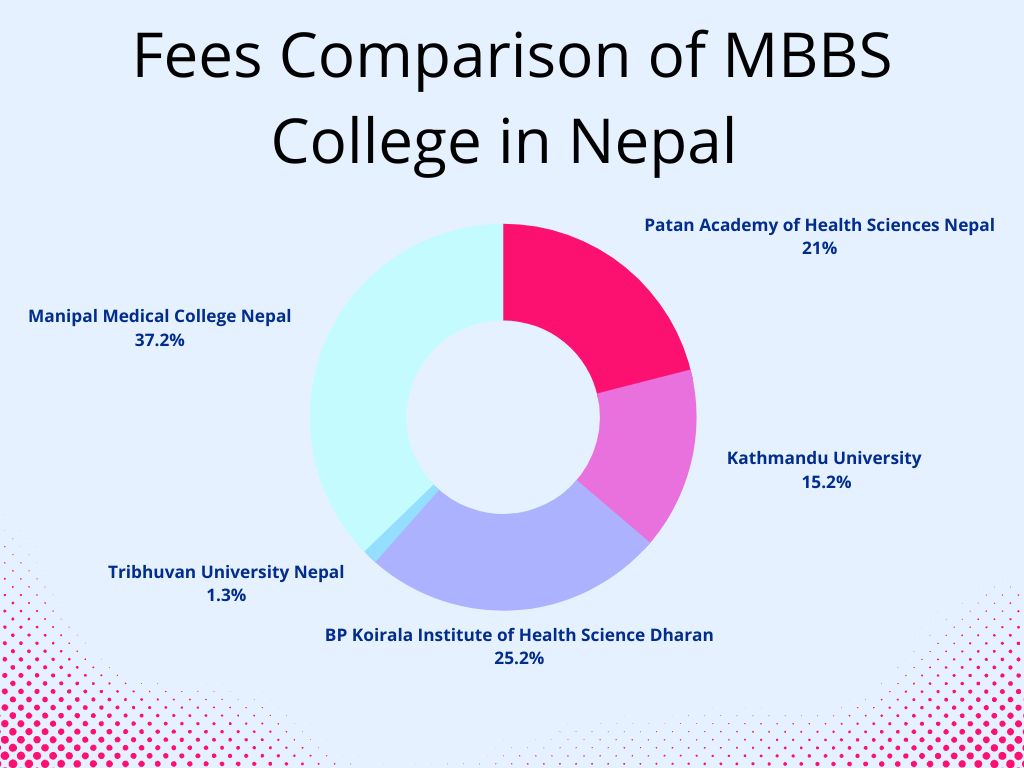
Nepali Medical Colleges with NMC Approval
There are various NMC-approved medical colleges in Nepal if you pursue a medical career. Students from medical schools in Nepal who have received NMC approval are qualified to practice medicine in India with the same degree as students from other nations. You will study for the MBBS exam in Nepal for five years, including an internship.
What is the cost of MBBS in Nepal?
In Nepal, MBBS tuition costs are relatively low compared to other nations. Even after accounting for additional expenses like food and lodging, the cost of living in Nepal is modest. It is for this reason, among others, that international students favour Nepalese medical schools. The same advantages to Indian students are also available to international students at reasonable tuition costs. The cost of an MBBS in Nepal varies depending on the university. The majority of colleges will want you to have finished your secondary schooling. Your fees will range from INR 30 to 60 lakhs depending on the college.
Advantages and Disadvantages of Studying MBBS in Nepal
Here are the image that shows about advantages and disadvantages of studying MBBS in Nepal.
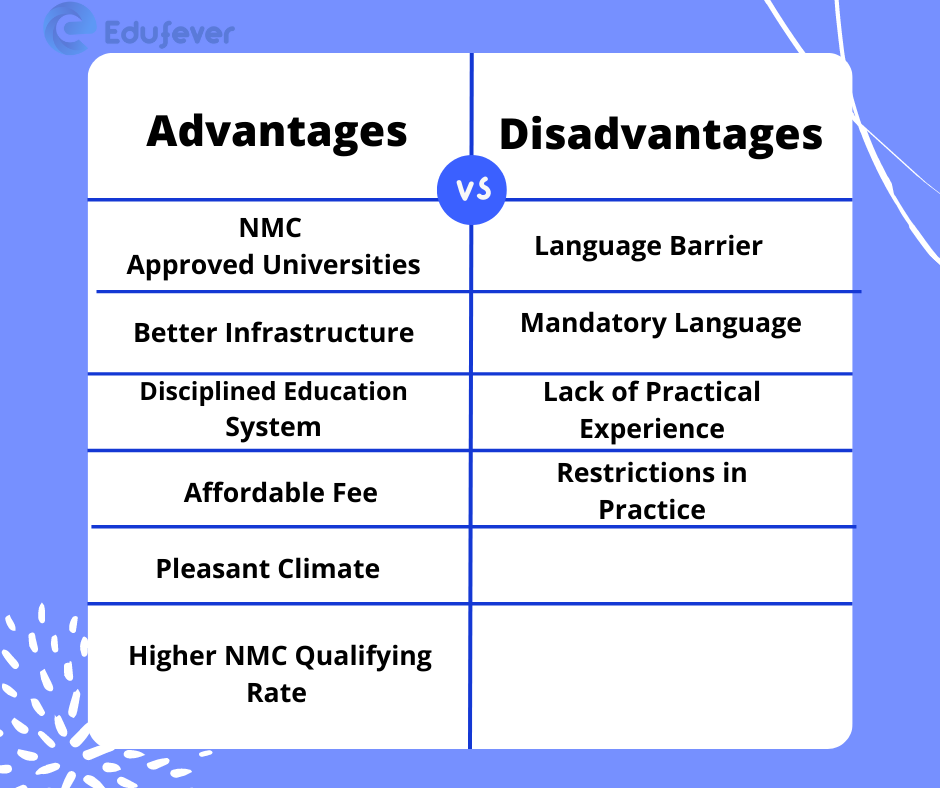
Advantages of studying MBBS in Nepal
There are multiple advantages of studying MBBS in Nepal for Indian students. Some of the essential advantages are listed below:
| Particulars | Description |
| NMC Approved Universities | The National Medical Commission of India NMC has accredited medical colleges and institutions in Nepal. The study habits in Nepal are almost the same as those in India. In Nepal, the MBBS programme lasts six years plus an internship year, the same as in India. |
| Higher NMC Qualifying Rate | Since the MBBS programme in Nepal is substantially identical to the one in India. The students find it simpler to pass the NMC screening test. The percentage of students studying MBBS in Nepal who pass the qualifying screening tests administered by the Medical Council of India is high. It aids students in starting their careers in India in the future. They can return to India later and begin working in their respective MBBS sector. |
| Disciplined Education System | The best educational facilities are found at MBBS universities and colleges. Nepal also has independent medical schools for those who want to study MBBS. Every MBBS college in Nepal consistently maintains the highest standard of instruction. They offer high-quality instruction, a 12-month internship, and several training opportunities for the students. Students get practical knowledge in their chosen fields. |
| Affordable Fee | For a middle-class household, the cost of living per student is reasonable. One can easily afford to stay for the entire length of their study. The best choice for overseas students pursuing an MBBS with reasonable and low-cost facilities is to do so in Nepal. |
| Pleasant Climate | Nepal also has a very pleasant climate. While studying for the MBBS, students take pleasure in the calm environment. International students can study MBBS in Nepal in a suitable environment. |
| Better Infrastructure | The cost of an MBBS programme in Nepal is highly reasonable compared to other nations. New facilities, such as a campus, educational resources, and hostels with more excellent facilities and better meals, are also an added benefit. |
Disadvantages of Studying MBBS in Nepal
There can be different disadvantages faced by students while studying MBBS in Nepal. Some of the disadvantages are listed below :
| Particulars | Description |
| Language Barrier | Poor English language proficiency and misunderstandings with some faculties can cause issues in Nepal. |
| Restrictions in Practice | International students can only watch patients in Nepali hospitals; they cannot touch them. |
| Lack of Practical Experience | In addition to operating on blood, surgeons also use it on corpses since it is challenging for students to get practical experience. |
| Mandatory Language | Indian students must take a separate subject in the course to learn the native tongue. |
