
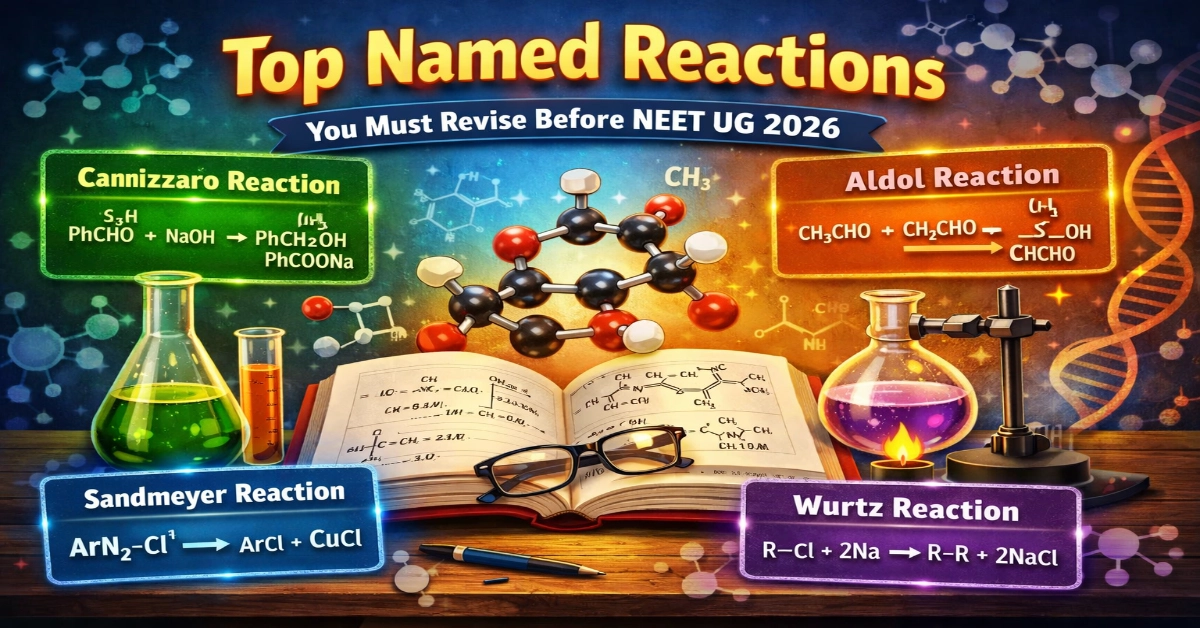
Top Named Reactions: As NEET UG 2026 gets closer, smart preparation becomes more important than just hard work. Organic Chemistry, often feared by many aspirants, can actually become one of your strongest scoring areas if approached strategically. Among all topics, named reactions stand out because they are repeatedly asked and help simplify complex concepts into predictable patterns.
The key to mastering named reactions is not just memorizing them, but understanding how and why they work. Once you grasp the reaction mechanism and conditions, you can easily tackle application-based MCQs. Below are the most important named reactions you must revise, each explained with clarity and exam-focused insights.
1. Aldol Condensation
Aldol condensation is one of the most fundamental reactions in carbonyl chemistry. It involves aldehydes or ketones having α-hydrogen reacting in the presence of a base to form β-hydroxy aldehydes or ketones, which further dehydrate to give α,β-unsaturated compounds. This reaction forms the basis of many multi-step organic transformations.
In NEET, questions often test whether you can identify if a compound has α-hydrogen and predict the final product after dehydration. Understanding the enolate ion formation is crucial to solving such questions quickly and accurately.
Key Points:
- Requires α-hydrogen
- Occurs in the presence of a base
- Forms β-hydroxy compound initially
- Final product is α,β-unsaturated carbonyl compound
2. Cannizzaro Reaction
The Cannizzaro reaction occurs in aldehydes that lack α-hydrogen. In the presence of a strong base, one molecule of aldehyde gets oxidized to a carboxylic acid, while the other gets reduced to an alcohol. This is known as disproportionation.
For NEET, the trick lies in identifying whether α-hydrogen is present or not. If absent, Cannizzaro is the most likely reaction. Questions may also test your understanding of product ratios and oxidation-reduction behavior.
Key Points:
- No α-hydrogen required
- Strong base (NaOH/KOH) needed
- Produces alcohol + carboxylic acid
- Example: Formaldehyde shows Cannizzaro
3. Friedel-Crafts Reactions
Friedel-Crafts alkylation and acylation are electrophilic substitution reactions of aromatic compounds. These reactions use alkyl or acyl halides in the presence of a Lewis acid catalyst like AlCl₃. They are essential for forming substituted benzene derivatives.
In NEET, students are often tested on rearrangements in alkylation and the fact that acylation does not rearrange. Understanding activating and deactivating groups also helps in predicting reaction outcomes.
 Join NEET News 2026
 Key Points:
- Catalyst: AlCl₃ (Lewis acid)
- Alkylation may show rearrangement
- Acylation does not rearrange
- Used to substitute benzene rings
4. Sandmeyer Reaction
The Sandmeyer reaction involves the conversion of aromatic diazonium salts into halides (Cl, Br) or cyanides using copper salts. It is a highly useful reaction for introducing functional groups into benzene rings.
NEET questions often directly ask about the reagents or products of this reaction. It is important to remember the role of copper salts and the types of substitutions possible.
Key Points:
- Uses diazonium salts
- Requires CuCl, CuBr, or CuCN
- Forms aryl halides or nitriles
- Very commonly asked in exams
5. Gattermann Reaction
The Gattermann reaction is similar to Sandmeyer but uses HCl or HBr along with copper powder instead of copper salts. It is another method to convert diazonium salts into halides.
Students often confuse this reaction with Sandmeyer, so it is important to clearly differentiate between the reagents used. NEET may test this distinction directly.
Key Points:
- Uses HCl/HBr + Cu powder
- Similar to Sandmeyer reaction
- Converts diazonium salts to halides
- Important for conceptual clarity
6. Wurtz Reaction
The Wurtz reaction involves the coupling of alkyl halides using sodium metal in dry ether to form higher alkanes. It is mainly used to prepare symmetrical alkanes.
In NEET, questions may involve predicting products when different alkyl halides are used. This can lead to multiple products, making the reaction tricky if not understood properly.
Key Points:
- Uses sodium metal in dry ether
- Forms carbon-carbon bonds
- Best for symmetrical alkanes
- Can give mixed products with different halides
7. Kolbe’s Electrolysis
Kolbe’s electrolysis is an electrochemical reaction where sodium or potassium salts of carboxylic acids are electrolyzed to form alkanes. The reaction involves decarboxylation and radical formation.
NEET questions often focus on the formation of even-numbered carbon chains and the mechanism of radical coupling.
Key Points:
- Involves electrolysis
- Produces alkanes
- Forms even-numbered carbon chains
- Includes decarboxylation step
8. Reimer-Tiemann Reaction
This reaction involves the treatment of phenol with chloroform in the presence of NaOH to produce salicylaldehyde. It is important in aromatic aldehyde synthesis.
In NEET, students are often asked about the major product and the position of substitution (ortho position is favored).
Key Points:
- Uses phenol + CHCl₃ + NaOH
- Forms salicylaldehyde
- Ortho product is major
- Important aromatic reaction
9. Hoffmann Bromamide Degradation
This reaction converts amides into primary amines using bromine and a strong base like KOH. A key feature is that the resulting amine has one carbon less than the original amide.
NEET frequently tests this carbon reduction concept, so it’s important to remember this unique feature.
Key Points:
- Uses Br₂ + KOH
- Converts amide → amine
- Carbon chain reduces by one
- Important for amine preparation
10. Gabriel Phthalimide Synthesis
Gabriel synthesis is used to prepare primary amines from alkyl halides using phthalimide. It is a clean method that avoids the formation of secondary and tertiary amines.
In NEET, it is often used in conceptual questions to test selectivity in amine formation.
Key Points:
- Produces only primary amines
- Uses phthalimide
- Avoids side products
- Important for selectivity
11. Clemmensen Reduction
Clemmensen reduction converts aldehydes and ketones into hydrocarbons using zinc amalgam (Zn-Hg) in acidic medium. It is particularly useful when the compound is stable under acidic conditions.
NEET questions often compare it with Wolff-Kishner reduction, so understanding the reaction conditions is critical.
Key Points:
- Uses Zn-Hg + HCl
- Acidic medium
- Converts carbonyl → hydrocarbon
- Works for acid-stable compounds
12. Wolff-Kishner Reduction
Wolff-Kishner reduction also converts carbonyl compounds into hydrocarbons but in a basic medium using hydrazine. It is preferred when the compound is sensitive to acids.
NEET questions frequently ask you to choose between Clemmensen and Wolff-Kishner based on reaction conditions.
Key Points:
- Uses hydrazine (NH₂NH₂)
- Basic medium
- Converts carbonyl → hydrocarbon
- Suitable for base-stable compounds
And hey, don’t let Organic Chemistry stress you out, you’ve got this! Think of these named reactions as your secret weapons for NEET 2026. The more you revise and practice, the more fun it actually gets (yes, really!).
If you have any doubts, tricky questions, or concepts that still confuse you, drop them in the comments and share them with us- we’ll be picking the most common ones and answering them in a separate post just for you.
Keep learning, keep revising, and let’s nail NEET 2026 together!
Read Also: Most Important NEET UG 2026 Diagram Questions You Can’t Afford to Miss DAY 1
NEET UG Counselling Guides 2026
State-wise MBBS/BDS Counselling Guide 2026
State-wise counselling & admission guidance
MCC NEET UG Counselling Guide 2026
MCC counselling, choice filling & admission planning
AACCC AYUSH NEET Counselling Guide 2026
AYUSH counselling & admission guidance


Mam so helpful thanks 😊
Day1 answers plz post🙏
Waiting for day 2,……..