
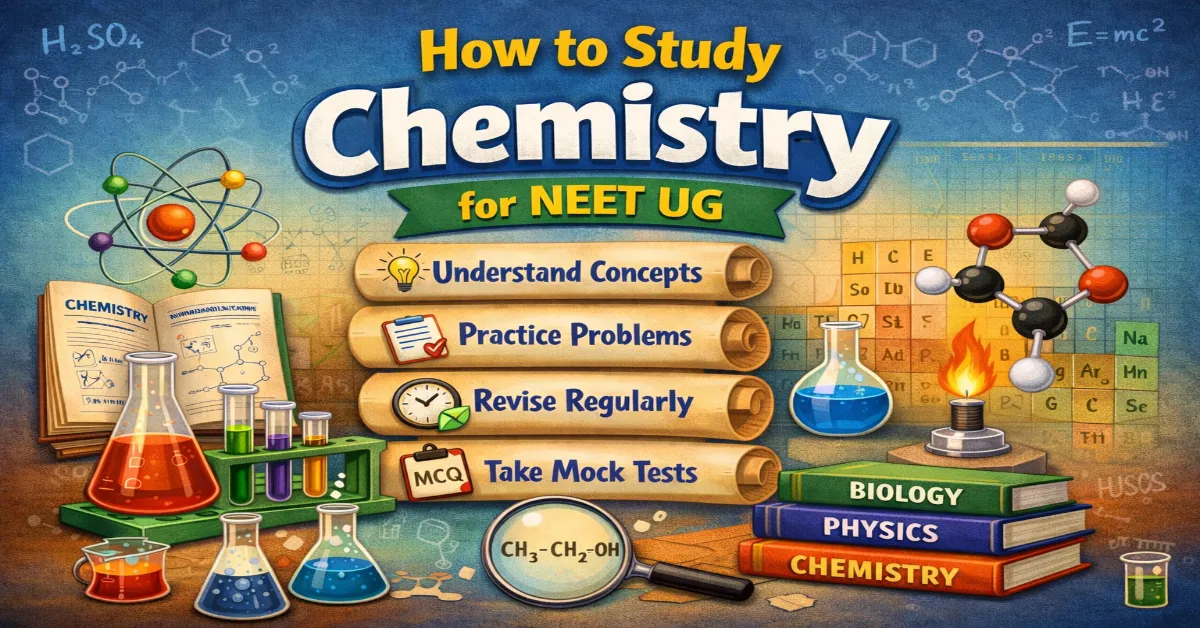
How to study Chemistry for NEET UG: Many students often neglect preparing for NEET UG Chemistry, assuming it is moderately difficult and less important than Biology. However, this misconception can lead to last-minute stress and lower performance in the Chemistry section. Experts and top scorers consistently emphasize the importance of giving equal priority to all NEET UG subjects, including Chemistry, to achieve a high overall score.
NEET UG 2026 is anticipated to take place in the first week of May, though the National Testing Agency (NTA) has not yet released the official notification. Regardless, aspirants should not wait for the announcement and begin their preparation immediately.
NEET UG Chemistry Exam Pattern
When planning how to study Chemistry for NEET, the first step is to understand the NEET UG exam pattern. The table below outlines the structure of the Chemistry section in the NEET UG exam.
| Chemistry | Number of Questions | Marking Scheme |
| Chemistry Section A | 35 | 140 |
| Chemistry Section B | 15 | 40 |
| Total | 50 (45 applicable for attempt) | 180 |
How to Prepare for NEET UG Chemistry (Strategies)
- Start with the NCERT book of both classes (Class 11 & Class 12 NCERT Book).
- Create short chemistry notes for the last-minute revision.
- Start full revision as soon as you complete the NEET UG 2025 syllabus
- Practice as several sample papers of NEET Chemistry as you can
- Practice last year’s question papers of NEET.
NEET UG 2026 Chemistry Important Topics
| Organic Chemistry | Inorganic Chemistry | Physical Chemistry |
| Basic Principles of Organic Chemistry (GOC) | Classification of Elements & Periodicity | Atomic Structure |
| Hydrocarbons & their Substituents | Chemical Bonding & Molecular Structure | Mole Concept & Stoichiometry |
| Organic Compounds Containing Oxygen | Hydrogen & s-block Elements | States of Matter |
| Organic Compounds Containing Nitrogen (Amines) | p-block Elements | Thermodynamics & Thermochemistry |
| Biomolecules | d-block Elements | Equilibrium |
| Polymers | f-block Elements | Redox Reactions |
| Practical Organic Chemistry | Coordination Compounds | Electrochemistry |
| Environmental Chemistry | Chemical Kinetics | |
| Surface Chemistry | ||
| Solutions |
NEET Chemistry Preparation: Weightage of Important Topics
The perfect method to solving the NEET chemistry section involves understanding the essential topics, the syllabus, and their weightage. The following table brings the topics from the NEET Chemistry Chapter Wise Weightage as assigned.
| Section | Topic | Weightage |
| Inorganic | Chemical Bonding | 8–10% |
| p-block Elements | 6–8% | |
| Coordination Compounds | 4–5% | |
| Periodic Table | 2–3% | |
| s-block, Hydrogen, Metallurgy | 2–3% | |
| Organic | General Organic Chemistry + Isomerism | 5–7% |
| Hydrocarbons | 4–5% | |
| Haloalkanes & Haloarenes | 3–4% | |
| Alcohols, Phenols & Ethers | 4–5% | |
| Aldehydes, Ketones & Carboxylic Acids | 5–6% | |
| Amines | 3–4% | |
| Biomolecules, Polymers, Everyday Life | 3–5% | |
| Physical | Mole Concept | 5–6% |
| Thermodynamics | 4–5% | |
| Equilibrium (Chemical + Ionic) | 6–8% | |
| Electrochemistry | 4–5% | |
| Chemical Kinetics | 3–4% | |
| Solutions | 4–5% | |
| Atomic Structure | 3–4% | |
| Solid State | 2–3% | |
| Surface Chemistry | 2–3% |
What are the Best Books for NEET Chemistry?
Candidates preparing for the NEET UG exam must use Chemistry NCERT books for classes 11 and 12 NCERT Book. Candidates must choose the best NEET books that can be helpful to crack the NEET exam. Selecting the best books is undoubtedly the most important preparation for NEET UG. These books also included the most important topics & relevant resources from the excess of study materials available in the market. More practice from the best books will help you to enhance the preparation strategy, speed, and accuracy level.
Best Book for NEET UG Chemistry
NEET UG Analysis for Chemistry Section
In this section, we take last year’s Chemistry NEET analysis in terms of topics, difficulty level, weightage and coverage of the NEET UG syllabus.
Section A
The table below shows the number and difficulty level of chemistry questions in Section A by topic.
| Category | Easy | Medium | Difficult | Total |
| Organic Chemistry Class 11 | 3 | 0 | 0 | 3 |
| Organic Chemistry Class 12 | 3 | 5 | 0 | 8 |
| Inorganic Chemistry Class 11 | 4 | 3 | 1 | 8 |
| Inorganic Chemistry Class 12 | 1 | 2 | 2 | 5 |
| Physical Chemistry Class 11 | 0 | 3 | 1 | 4 |
| Physical Chemistry Class 12 | 3 | 3 | 2 | 8 |
| Total | 14 | 16 | 6 | 36 |
Section B
The table below shows the number and difficulty level of Chemistry questions in Section B by topic.
| Topic | Easy | Medium | Difficult | Total |
| Organic Chemistry Class 11 | 1 | 1 | 2 | 4 |
| Organic Chemistry Class 12 | 1 | 1 | 1 | 3 |
| Inorganic Chemistry Class 11 | 0 | 0 | 0 | 0 |
| Inorganic Chemistry Class 12 | 2 | 1 | 0 | 3 |
| Physical Chemistry Class 11 | 0 | 3 | 0 | 3 |
| Physical Chemistry Class 12 | 1 | 1 | 1 | 3 |
| Total | 5 | 7 | 4 | 16 |
NEET UG Counselling Guides 2026
State-wise MBBS/BDS Counselling Guide 2026
State-wise counselling & admission guidance
MCC NEET UG Counselling Guide 2026
MCC counselling, choice filling & admission planning
AACCC AYUSH NEET Counselling Guide 2026
AYUSH counselling & admission guidance
